![What is Nano (NANO)? [A comprehensive Guide to Understanding NANO]](https://www.publish0x.com/img/66499.webp?action=resize&ar=1&enc=webp&inv=0&ori=1&st=1&up=1&w=1140&signature=a3fbcf79208f0845d28fd97654baca8a7291136a75dbd4ee00b66ae6f94d0d4f)
While the growth and development of smart contracts platforms has seen Distributed Ledger Technologies (DLTs) vastly expand its set of potential use cases, the primary goal of these technologies still seem to be upending the financial paradigm by replacing nation-bound fiat currencies with globally accepted digital currencies.
Bitcoin was the first true such token, but others have quickly come to the fore, built on top of different architecture and with more tailored features. Whether it is a token that offers complete transaction privacy, like Monero or Zcash, or tokens that implement different algorithms or DLTs, the crypto market has shown that there are several paths towards a decentralized financial future.
Given that there are many proposed solutions today, and the solutions themselves are just in the trial and testing phase, it’s worth looking at different projects and their approaches to see where they may land up in the future - whether out of interest in seeing where digital assets might take us or as an investment opportunity.
The project we will take a look at today is NANO, whose network and tokens aim to support a digital currency that is feeless and immediate. We will examine the history of NANO, its specific goals and achievements, how it is attempting expansion into everyday usage and the competition it faces in doing so.
The History of Nano (NANO)
Nano was founded in 2015 by Colin LeMahieu, who has extensive experience working with software companies like Qualcomm, AMD and Dell. The project launched on the market in 2017 and Raiblocks (XRB), as it was known then, underwent a rebranding in January 2018.
The project has also seen the formation of the Nano Foundation, which is described as having the purpose of “empowers individuals with the most efficient and accessible digital money possible, connecting them to the global economy in a sustainable way.” The Nano Foundation will be aiding in protocol development, supporting services, and education and resources, among other things. In other words, strengthening the network, encouraging adoption and spreading awareness are the key priorities of the Nano Foundation.
The Purpose of Nano (NANO)
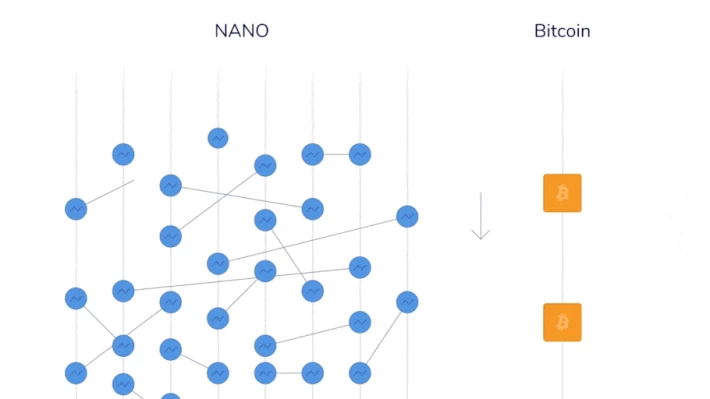
Source: https://medium.com/nanocurrency/why-is-nano-fast-the-basics-a2ef32cc3f80
On the face of it, the Nano project is not particularly unique in its use case. It is simply trying to perfect the application of digital assets by offering zero fees, instantaneous transaction confirmations and scalability for global adoption. The NANO network uses a Proof-of-Work consensus algorithm. Documentation describes Nano as “a digital payment protocol designed to be accessible and lightweight, with a focus on removing inefficiencies present in other cryptocurrencies.” Nano uses a Directed Acyclic Graph (DAG), made famous by the IOTA project.
One important technical aspect of the Nano DAG that is worth noting is the “block lattice”. Each account on the network has its own DAG, an account chain, and only the account holder has access to this DAG.
The instantaneous confirmation comes from these two aspects: a computationally small PoW value is generated by users “allowing occasional, average user transactions to process quickly and consistently.” These computations can be executed by an average CPU. The combination of this block structure and unique use of the PoW algorithm results in minimal block sizes for quicker confirmations, lower energy consumption and greater decentralization (as there is minimal reliance on consensus computation and the cost of running nodes is negligible.)
Nano’s white paper describes the network architecture more in more depth.
Nano is working with third party developers to facilitate the building of new tools and ecosystem expansion. This includes a NANO tip bot for Twitter and NANO tip bot for Reddit. Other third party developments include BrainBlocks, a service that provides online and in-store solutions for paying with NANO, like a Point-of-Sale app. Another interesting development is a plugin that has been made for the Unreal Engine 4. This third party development includes a NANO faucet, live rewards for defeating enemies in-game and in-game purchases.
Nano’s community is certainly strong, with one user’s Reddit post that encouraged users to pay in Nano for the feeding of birds really gaining some traction.
The developers of the project have made it a point to make integration with Nano simple and seamless. The current list of third party managed services include CoinGate, BrainBlocks and Kappture. They have also taken the time to build comprehensive to help developers build on Nano.
The development team has several ideas lined up for the future, much of which is already being prepared for. The team is currently working on a new Proof-of-Work infrastructure, among other things. Following this, the team will shift their attention to dual phase voting, node telemetry and ledger pruning, among other changes. In the research phase is an entirely new PoW algorithm, a DHT-based network overlay, durable vote snapshots, QUIC protocol and local account priority bootstrapping.
Other priorities for upcoming months, as far as adoption is concerned, will be global markets, merchant services, point of sale and fiat on-ramp.
Controversies
Nano has lived its life largely unmarred by controversies or issues. The worst that has happened was a loss of users’ funds from the BitGrail exchange in February 2018. An investigation showed that the loss of funds was not a result of a fault on Nano’s side. The problem had to do with BitGrail, which at the time was going through insolvency. The Nano team set up a legal fund for the victims. CEO Colin LeMahieu said of the incident,
“The BitGrail situation is extremely unfortunate, but it has not impeded the project. As far as protocol development and overall project milestones are concerned we have continued to move forward.”
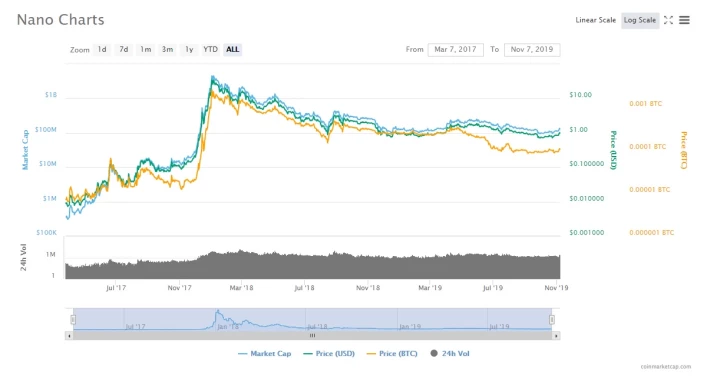
Nano has remained relatively stable at around the $1 mark since the big boom of 2017, where it stood at a much higher price of roughly $31. The token’s market cap is roughly $131 million. The token’s max supply coin is 133 million, each of which is in circulation. 24 hour trading volume stands at just under $9 million.
Nano’s price was somewhat affected by the news, but it doesn’t have to have demoralized Nano’s community members, which, as we mentioned, is a particularly enthusiastic one. The token’s price has largely remained stable since the big price spike during late 2017/early 2018, something which not all coins have experienced.
Competitors
As necessary and reasonable as it may be “to remove the inefficiencies present in other cryptocurrencies”, it must be said that Nano is not the only one with this goal in mind.
The fact that NANO is doing what many others are doing - improving upon the current state of cryptocurrencies as a means of payment - puts it in a tough spot. It is by no means the only one doing so, as there are dozens of projects doing the same in a variety of ways, though only a handful are doing convincingly - NANO being one of them.
The list of competitors is so large that it is pointless to list them all here. Bitcoin (BTC), Stellar Lumens (XLM), Litecoin (LTC), and privacy coins like Monero (XRM) and Zcash (ZEC) are only just a few - you’ll find a good half a dozen more than one could count as solid competitors.
So why would one choose Nano over any one of those many competitors? Those who get into this space early are more likely to succeed, because it has more time to corner the market and more time for development. In that case, however, Bitcoin ought to be the runaway winner and, frankly speaking, it’s hard to believably argue that Bitcoin will be toppled by one of the many projects have taken after it. True, Bitcoin is facing scalability issues, but solutions like the Lightning Network are increasingly proving to be an effective solution for that problem.
Conclusion
There is a problem of being too spoilt for choice when investors have to pick a token that may succeed as a token is used as a widespread means of payment. Unlike other niches, supply chains or distributed computing for example, one cannot simply choose the few projects that seem very likely to come out with solid working products and be reassured that the investment will turn out positive. Choosing between the multiple payments focused token can be a bit of a hit and miss.
Payments focused tokens also face another problem - all things being equal, which is more likely to grow than others? Assuming at least a handful of these projects achieve scalability, minimal fees and instantaneous transactions times, why would one become more widespread than others? It becomes more of a social/marketing game and we all know which token is leaps and bounds ahead of the others in this regard. There is nothing to touch Bitcoin here. Critics may argue that Bitcoin’s capability to scale has not been proven yet and that it functions more as a store of exchange, but that is not the most indefensible of arguments. Bitcoin can overcome that too.
Perhaps more than one such token can exist - like multiple national currencies, we could have multiple digital currencies that are intended simply for payments. Perhaps a particular sphere of merchants or entities will use NANO as opposed to other tokens. The good news is that NANO is certainly one of the strong payments focused tokens, so it is well worth checking out.





