
In an increasingly monitored digital landscape, the pursuit of privacy in online transactions is gaining escalating relevance. Within the realm of cryptocurrencies, this demand manifests in the emergence of projects that prioritize the anonymity of their users. Among these, Monero (XMR), Zcash (ZEC), and Dash (DASH) stand out, each employing distinct approaches to ensure a greater degree of confidentiality in transactions.
This article intends to explore the underlying technologies that confer privacy upon these cryptocurrencies. We will analyze how Monero, with its mandatory privacy enforced by the CryptoNote protocol, seeks to obscure the origins, destinations, and values of transactions. Subsequently, we will examine Zcash and its utilization of zero-knowledge proofs to enable protected transactions with selective privacy. Finally, we will discuss Dash's "PrivateSend," which offers an optional layer of anonymity through the mixing of funds.
Throughout this article, we aim not only to describe the functioning of these technologies but also to discuss their implications for usability, regulation, and the perceived value of these cryptocurrencies within the broader ecosystem. Join us on this journey to understand the nuances of anonymity in the world of digital currencies.
Monero (XMR): Mandatory Privacy and the CryptoNote Protocol
Monero distinguishes itself in the landscape of privacy-focused cryptocurrencies by adopting an approach where confidentiality is not optional but rather a fundamental attribute of all transactions on its network. This mandatory privacy is achieved through the implementation of the CryptoNote protocol and innovative technologies such as Ring Signatures, Ring Confidential Transactions (RingCT), and Stealth Addresses.
Ring Signatures allow a signatory to conceal their identity by mixing their public key with the public keys of other network participants (the "mixins"). Consequently, when verifying a transaction, it is possible to ascertain that one of the participants in the group signed the transaction, but it becomes computationally infeasible to determine which one did. The greater the number of mixins, the higher the degree of anonymity.
To obscure the values of transactions, Monero implemented Ring Confidential Transactions (RingCT). Prior to RingCT, only the sender was obfuscated by ring signatures, but the transaction value was publicly visible. RingCT employs cryptographic proofs to enable the verification of transactions without revealing the amounts involved, thus ensuring confidentiality in this crucial aspect as well.
Additionally, Stealth Addresses are used to protect the recipient's identity. For each transaction, a new, unique address is created for the beneficiary, derived from their public address. This prevents third parties from linking multiple received transactions to the same recipient, significantly enhancing the privacy of the receiver.
Recently, news and discussions have circulated regarding the potential for tracking transactions on Monero. Some claims have emerged from blockchain analysis firms, suggesting that, through sophisticated methods, it might be possible to break the anonymity that Monero aims to provide. It is important to critically analyze these claims.
Academic research and the Monero community itself acknowledge that, historically, some vulnerabilities and implementation errors in wallets could lead to reduced privacy in certain scenarios. However, the protocol itself is designed with robust privacy mechanisms. Claims of tracking often rely on probabilistic analyses and the collection of metadata, such as IP addresses, rather than a fundamental breach of the cryptography underlying Ring Signatures, RingCT, and Stealth Addresses.
The effectiveness of anonymity in Monero depends on the correct utilization of privacy features by users, such as choosing an adequate number of mixins and using wallets that correctly implement the privacy protocols. While challenges persist and research continues in the area of privacy analysis, Monero remains one of the cryptocurrencies with the strongest focus on anonymity, and claims of widespread tracking should be examined cautiously, distinguishing between potential implementation flaws or leaked metadata and an inherent breakdown of the privacy protocol.
Zcash (ZEC): Selective Privacy with Zero-Knowledge Proofs
Zcash adopts a distinct approach to privacy, offering users the option to conduct transactions with enhanced confidentiality through the use of zero-knowledge proofs, specifically the variant known as zk-SNARKs (Zero-Knowledge Succinct Non-Interactive Argument of Knowledge). This technology enables the creation of "shielded" transactions, where the sender, the recipient, and the transaction value can be fully encrypted, while maintaining the transaction's validity verifiable by the network.
zk-SNARKs are an advanced form of cryptography that allows one party (the prover) to demonstrate to another party (the verifier) that a certain statement is true, without revealing any information beyond the validity of the statement itself. In the context of Zcash, this technology makes it possible for the network to verify that a transaction occurred according to the protocol's rules (for example, the sender has sufficient funds and the signature is valid) without the need to expose the transaction details.
A key feature of Zcash is the distinction between transparent addresses (starting with "t") and shielded addresses (starting with "z"). Transactions between transparent addresses are public and function similarly to transactions on Bitcoin, with the complete history visible on the blockchain. In contrast, transactions involving shielded addresses, known as "shielded transactions," utilize zk-SNARKs to conceal the transaction details on the blockchain.
This selective privacy offers flexibility to users. They can choose to conduct transparent transactions when privacy is not a concern, or utilize shielded addresses for greater confidentiality. However, this optionality also implies that a user's level of privacy depends on their choices and the adoption of shielded addresses by other network participants. If few users utilize shielded transactions, there may be less anonymity in the overall set of private transactions.
The technology behind zk-SNARKs is complex and initially required a trusted "parameter generation ceremony" to ensure the network's security. This ceremony created the proving and verification keys necessary for shielded transactions. The transparency and security of this ceremony were central to the trust in Zcash's technology.
Dash (DASH): The "PrivateSend" and the Optionality of Privacy

Dash offers a different approach to privacy through its feature called "PrivateSend." Unlike Monero, where privacy is standard, and Zcash, where it is selective through shielded transactions, PrivateSend in Dash is an optional feature that users can employ to obfuscate their transactions.
PrivateSend operates through a process of coin "mixing." When a user wishes to send a private transaction, their funds are divided into standard denominations and sent to "masternodes" – special servers on the Dash network that perform the mixing. These masternodes mix the funds of multiple users, making it more difficult to trace the origin of the funds when they are finally sent to the recipient.
The process involves several rounds of mixing with different masternodes, with the aim of breaking the traceability between the sender and the recipient. The more rounds of mixing a user chooses (up to a maximum of ten), the theoretically greater the level of anonymity achieved. However, each additional round also takes longer to complete.
The optional nature of PrivateSend has direct implications for the effectiveness of anonymity. Since not all transactions on the Dash network utilize PrivateSend, privacy becomes a user's choice. This means that the effectiveness of obfuscation depends on the number of users who are also using PrivateSend during the same period. If few users are mixing their funds, the mixing pool may be smaller, potentially making analysis easier.
On the other hand, the optional approach may offer greater convenience for users who do not always require privacy and prefer faster, more direct transactions. The integration of PrivateSend into the Dash wallet facilitates the use of the feature for those who desire greater anonymity in specific transactions.
However, there are some limitations to consider. The effectiveness of PrivateSend depends on the activity of the masternodes and the number of users participating in the mixing. Furthermore, as funds are divided into fixed denominations for mixing, analysis may, in some cases, attempt to track these denominations through the mixing rounds.
Comparative Analysis: Monero, Zcash, and Dash
To facilitate a comparison between the privacy approaches of Monero, Zcash, and Dash, we present the following table:
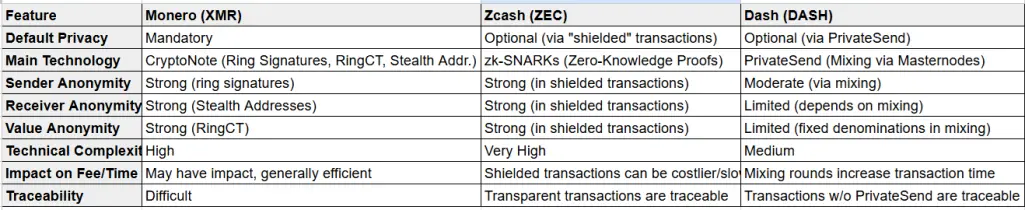
Monero positions itself as the cryptocurrency with the most robust focus on privacy, making it standard in all transactions. This offers a high degree of anonymity but may present regulatory challenges.
Zcash offers selective and powerful privacy through zk-SNARKs. Shielded transactions provide strong anonymity, but the existence of transparent addresses means that privacy is not guaranteed for all users. The complexity of the technology is also a factor to consider.
Dash, with its optional PrivateSend, seeks a balance between privacy and usability. While it offers an improvement in privacy for those who use it, its effectiveness depends on adoption and may have limitations due to the nature of mixing.
The choice between these cryptocurrencies will depend on the individual priorities of each user regarding privacy, convenience, and regulatory acceptance.
Considering your own needs and concerns about privacy in online transactions, which of these anonymity models – default privacy (Monero), selective privacy with zero-knowledge proofs (Zcash), or optional privacy via mixing (Dash) – do you find most interesting or useful? Share your opinion in the comments below!






