Switzerland now has its first spot Bitcoin ETF. Trading is launching under the ticker BBIT, offering spot exposure with custody handled by AMINA Bank, investment management by BIT Asset Management, and fund direction overseen by PvB.
Subscriptions will also be possible in-kind—meaning directly in Bitcoin—a method that, at least in the U.S. and according to statements from BlackRock and Morgan Stanley, has proven quite popular. However, participation in in-kind subscriptions is not open to everyone: investors must already have an active banking relationship with AMINA Bank, complete KYC, and receive approval from the fund’s management. The fund will launch with 350 BTC in its portfolio, during one of the toughest periods in recent years both for price action and for market attention toward this specific asset. The listing follows approval from FINMA, Switzerland’s financial market regulator, granted last October 20 after an 18-month review period.
Key Features of BIT’s Bitcoin ETF
The fund will feature segregated asset custody entrusted to AMINA, a Swiss-licensed bank. Fees will be competitive with U.S.-listed products, with investors paying 0.19% per annum.
On European Union markets, however, lower-cost options are available: CoinShares, iShares, and WisdomTree already offer products with a 0.15% TER.
Furthermore, in the European Union it is not possible to offer single-asset ETFs, which is why Bitcoin ETPs generally take the form of either ETNs or ETCs. For this reason, BIT claims to be launching the first spot Bitcoin ETF in continental Europe.
How Much Demand Will There Be?
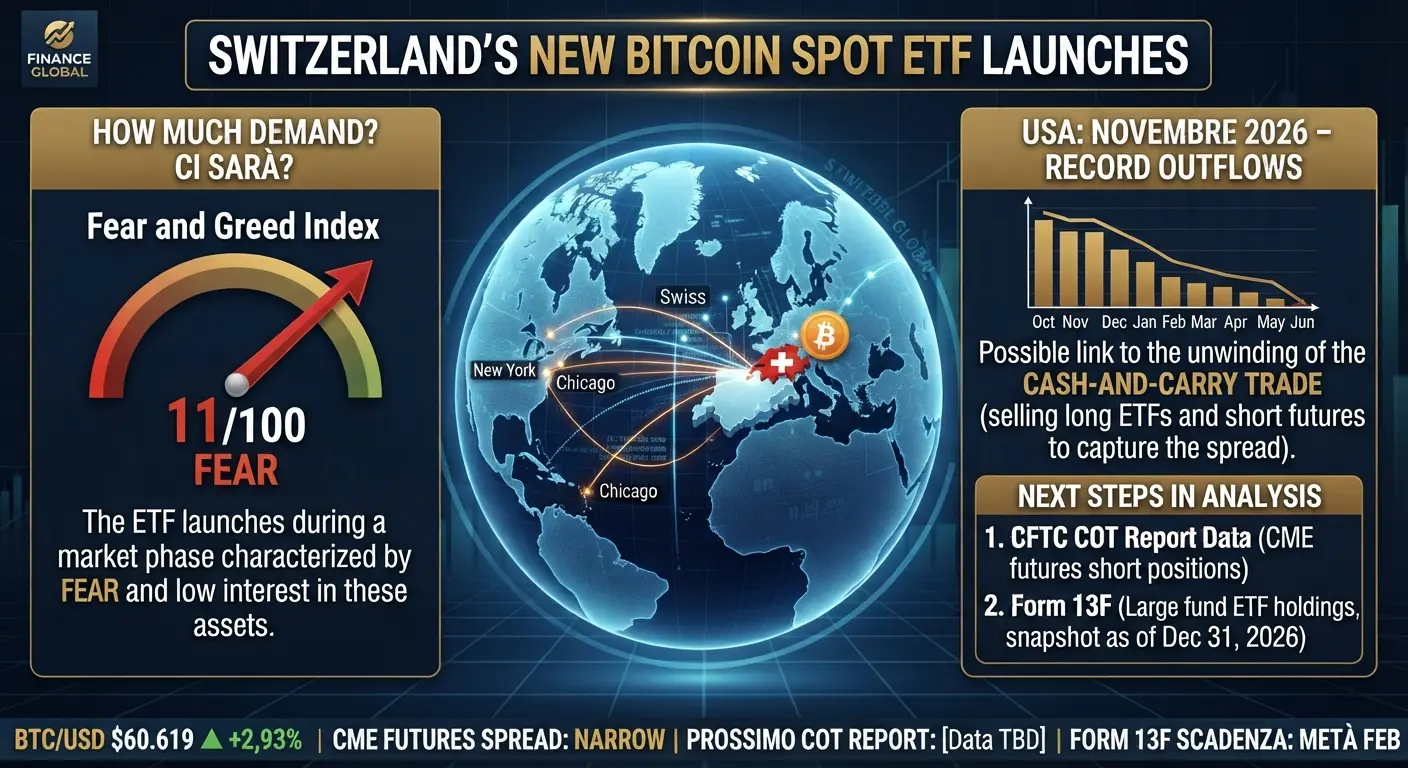
This remains the real question, one that only the markets will be able to answer—preferably over a long time horizon. The ETF is launching during a market phase characterized by fear—our Fear and Greed Index currently stands at 11 out of 100—and weak interest in this asset class.
In the United States, barring any major turnaround in the final two sessions, November 2026 will close with the worst performance in terms of outflows since these products first launched. However, it is possible that a significant portion of these outflows is tied to the unwinding of cash-and-carry trade positions—a trading strategy in which funds and institutional players go long via spot ETFs and short via futures to capture the spread between the two prices.
That spread has narrowed considerably, making the trade far less attractive. As positions in this trade are unwound, alongside closing short futures positions, funds also sell off their long spot ETF holdings.
We will gain a clearer picture of what happened once short positions on CME futures are updated in the CFTC’s COT Report. Subsequently, it will be useful to analyze the Bitcoin ETF holdings of major funds in the next round of Form 13F filings. Those filings, due by mid-February, will provide a snapshot of positions as of December 31, 2026.