
Nano has seen a very flat year of trading in 2019 as the cryptocurrency pretty much trades around the same price as it did when 2019 opened to trading. Although this could be seen as a positive action, especially when we consider that the majoirty of the altcoin market is well below their 2019 opening prices, however, this will not sit too well with the majoirty of Nano holders who demand growth!
The cryptocurrency did see a promising bullish run in the first half of the year. Nano surged by a total of 160% from the February low to reach a high close to $2.00 in June. After reaching this level of resistance, Nano rolled over and went on to fall by a significant 60% to the current trading price of $0.877 (as of early-December 2019)
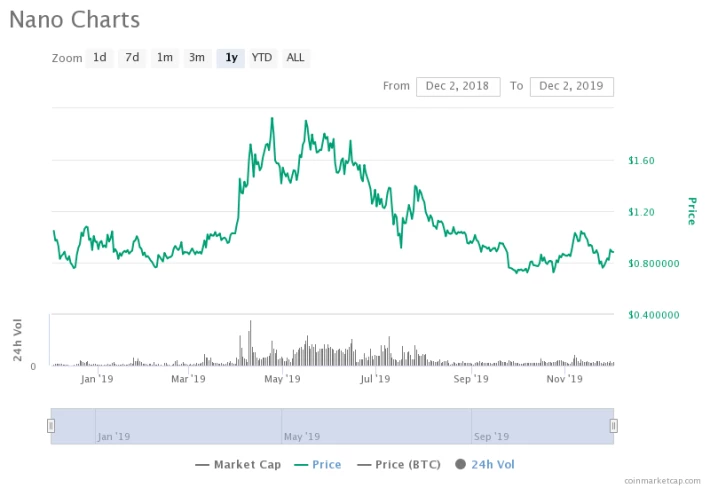
Nano also created a fresh 2-year low during the year at around $0.71, however, this can be written off as a marginal ‘lower low’. Nano has rebounded 3 times from this new low and is now attempting to recover above the 100-day EMA.
Nevertheless, Nano does have a very promising future ahead of itself as 2020 approaches. The team over at Nano always takes a ‘hands-on’ approach to their network as they continuously make improvements throughout the year. This is evident after their latest network upgrade which introduces a host of new performance features as well as a much anticipated new PoW algorithm! Furthermore, the team is also confident enough to have their code reviewed by 3rd party companies, helping to solidify trust in the network.
For the reasons stated above, and more discussed below, I believe that NANO has the potential to surge by a total of 300% in 2020 to reach my target price of $3.50 at some point during the year.
In this article, I’ll firstly cover a range of topics that I believe will influence NANO in reaching my $3.50 target during 2020 and then analyze NANO on the long term weekly and daily charts to highlight some areas of resistance on the way toward the target.
A Quick Introduction To Nano
Nano was founded in 2015 by Colin LeMahieu and was launched as Raiblocks in 2017 before being rebranded into Nano in January 2019.
It is described as a digital payment protocol that is designed to be accessible and lightweight! It incorporates a lattice known as a Directed Acrylic Graph instead of a blockchain. The interesting thing about this set-up is that each account on the Nano network has its own DAG known as an “account chain” and only the account holder has access to this account chain.
This block lattice-type structure allows for instantaneous and free transactions to occur. Furthermore, this architecture also allows Nano to be highly scalable and can already achieve up to 75 TPS (according to a stress test last year). This is much higher than the 8 TPS that Bitcoin can handle today and is even faster than the 25TPS that Ethereum offers.
To find out about how Nano works in more detail, take a look at this fantastic “What Is Nano” post.
Nano Wallet Passes Security Audit

The Nano Foundation recently announced that its wallet, Natrium, had completed a code review and security audit with a third-party company known as Red4Sec. The audit came back with zero critical vulnerabilities found which increases the trust within the number one Nano wallet.
Created by Brandon and Yekta, the pair worked very hard to create a user-friendly wallet that is available on both the Apple App Store and Google Play store. The wallet was created with the intent to deliver a great user experience with a particular focus on simple daily spending.
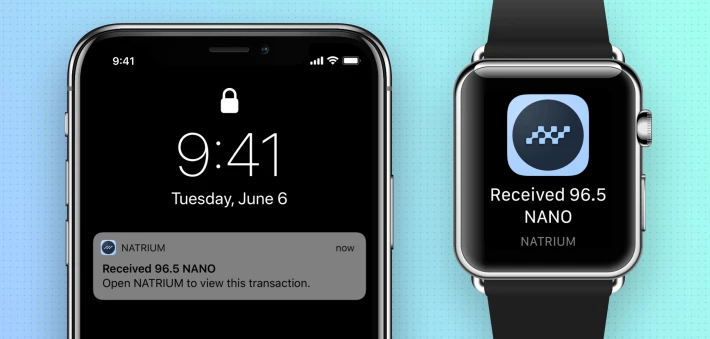
The team has even made it possible to link the wallet up with your smartwatch allowing for notifications to appear on your wrist - how delightful!
Nano Development Continues At A Staggering Pace
Data from Santiment shows that the team has continuously made improvements to their protocol, and when compared to other top-level projects, the Nano development pace outstrips many in its class.
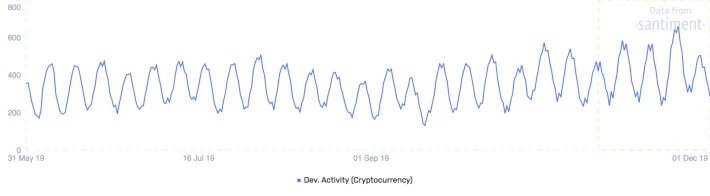
The team have been working very hard this year and have most recently introduced their latest upgrade known as V20 Lydia!
V20 Lydia Arrives On The Mainnet
In November 2019, the team had announced that V20 Lydia has officially arrived on the main network bringing a host of new features as well as security and performance improvements.
The most anticipated feature from this release is certainly the new Nano PoW consensus mechanism that the team has been diligently working on. This new algorithm is described as a “memory-hard” Proof-of-work Algorithm.
The original PoW algorithm made it too easy and cheap for specialized hardware to be used to mass-compute PoW and send a bunch of transactions known as “Spam transactions”. To resist this, the new Nano PoW will scale based on memory rather than computation. This makes it much more expensive to scale for Spam transactions and should theoretically price them away from conducting such spam attacks. Furthermore, the new algorithm also uses less energy as a requirement for memory access is more energy-efficient.
It doesn’t stop there! V20 Lydia comes with a whole bunch of new features that include;
Easier config management - the existing .json config files are difficult to maintain and don’t allow commenting. This update sees config film moving to a .toml format to make management easier. It also allows for commenting and makes it easier to read, maintain and understand the config files.
Optimization Of Various Node Operations - Lydia has implemented many improvements for node operations after months of extensive beta testing. This includes improvements to block propagation, vote caching, bootstrap behavior and disk I/O operations. This helps the node to achieve a lower and more efficient resource usage across the board!
Nano (NANO) Price Analysis
LONG TERM - DAILY CHART
What Has Been Going On?
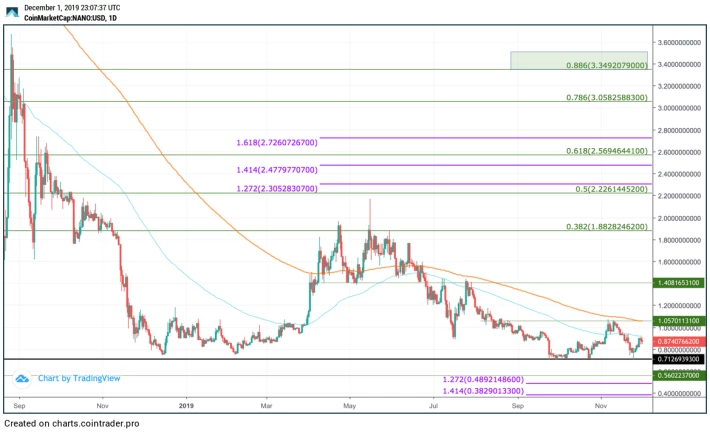
Analyzing the daily chart above, we can instantly see the flat price movement that Nano has seen throughout the year. Don’t get me wrong, the cryptocurrency did surge in Q1 and Q2 of 2019 (much like the rest of the industry) but Nano went on to fall after this and returned to the 2019 opening price of around $0.85.
As Nano went on the bullish run during the first half of the year, it ran into resistance at $1.88 which is provided by a long term bearish .382 Fibonacci Retracement level. This long term bearish Fibonacci Retracement level is measured from the August 2019 high to the December 2018 low.
After reversing from this resistance, Nano went on to fall quite significantly and it even created a fresh 2-year low around the $0.71 level. The cryptocurrency has since bounced 3 times from this level of support, solidifying it as a strong level of support moving forward.
Are We Bullish Or Bearish (as of December 2019)?
As of December 2019, we are presently trading within a neutral market. For this market to be considered as bullish, we would need to see Nano rising and breaking above the resistance at $1.05 (200-day EMA). Alternatively, for this market to be considered as bearish, we would need to see Nano dropping beneath the support at the $0.71 level.
If Nano does indeed drop beneath $0.71, we can expect immediate support beneath at $0.70, $0.65 and $0.60. If the selling continues to drop beneath $0.60, this will greatly affect my 2020 prediction. Further support toward the downside can be found at $0.49 and $0.38 which is provided by the downside 1.272 and 1.414 Fibonacci Extension levels.
Where Is The Resistance On The Way Up TO $3.50?
On the other hand, if the bulls can continue to develop some momentum and push higher above the current resistance at $0.88 (100-days EMA), we can expect immediate higher resistance to then to be located at $1.05 which is provided by the 200-days EMA.
Above this, resistance is then located at $1.40, $1.50 and at $1.88 (long term bearish .382 Fibonacci Retracement level). The market struggled to break above this level of resistance during mid-2019 and therefore significant momentum will be required for the buyers to overcome this level.
Beyond $2.00, we can expect higher resistance at $2.22 (bearish .5 Fib Retracement), $2.30 (1.272 Fib Extension), and $2.47 (1.414 Fib Extension). Following this, resistance lies at $2.56 (bearish .618 Fib Retracement) and $2.72 (1.618 Fib Extension).
If the buyers can continue to drive Nano above $3.00, the bulls will need to overcome resistance at $3.05 (bearish .786 Fib Retracement) and $3.34 (bearish .886 Fib Retracement) before being free to make an attempt at my 2020 target of $3.50.
Conclusion
In conclusion, I strongly believe that NANO can indeed surge by 300% to reach my 2020 target of $3.50. Although this is a pretty steep increase it is entirely possible due to the fact that Nano continues to improve its infrastructure on a regular basis. As the network becomes more secure and the performance increases, we can expect this to attract many users to the platform.
Before reaching my 2020 target, Nano must overcome solid resistance at $1.05, $1.50, and $1.88. Above this, resistance is expected at $2.22, $2.56, $3.05, and $3.34. If the buyers can break beyond the aforementioned levels of resistance, they will be free to make an attempt at my 2020 price target.






