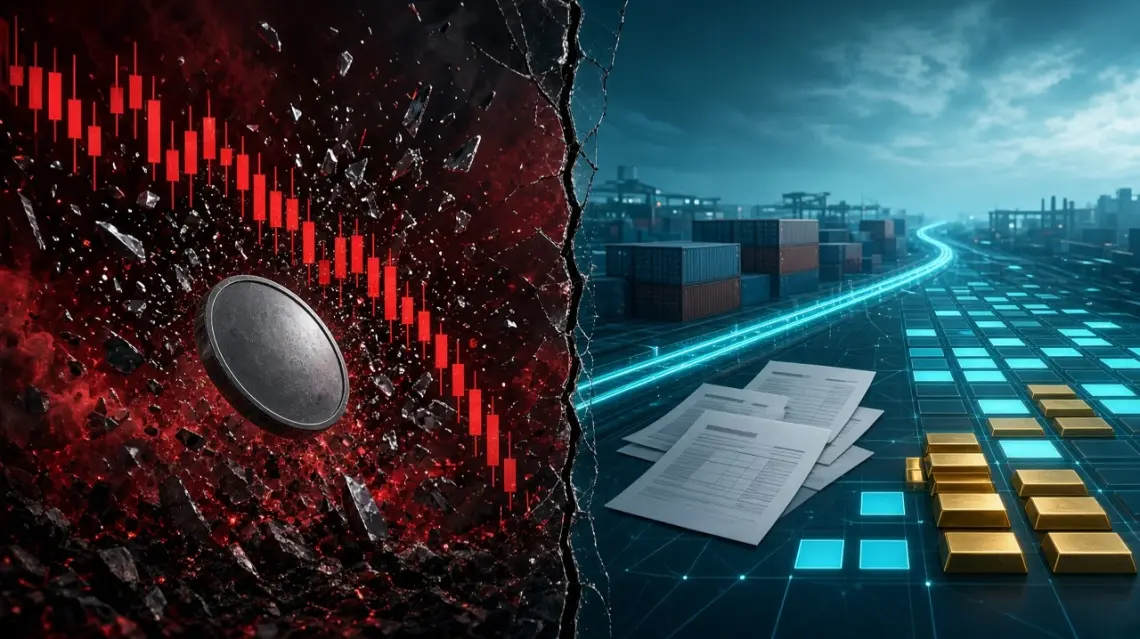
Bitcoin crash November 2026: BTC fell below $57,000 as $2.4B in crypto liquidations hit. Why XDC Network trade finance runs on fees and finality instead.
Bitcoin slid below $57,000 on 21 November, its lowest level since September 2024, extending a bear market that began after the October 2025 peak above $126,000 [1][2]. The Bitcoin crash of November 2026 leaves BTC down 28% for the quarter and more than 50% from that high [1][2]. Ether traded near $1,560, and total market capitalization slipped 7.58% to about $1.95 trillion [2]. Sentiment gauges sat in Extreme Fear [2][3].
Crypto didn't fall alone. Analysts pointed to rising inflation-adjusted U.S. Treasury yields and a more hawkish Federal Reserve outlook [1]. On Friday, an AI and technology sell-off dragged the Nasdaq down more than 4% (Seoul Economic Daily said 5.28%) and spilled into crypto [1][3]. LiveMint, citing Bloomberg, reported year-to-date Bitcoin ETF outflows above $3 billion [2].
Crypto Liquidations: $2.4B in Leverage Made the Drop Faster
Coinglass data, reported by CoinDesk, showed $2.40 billion in crypto futures liquidated over 24 hours. Bitcoin futures made up more than $1 billion of that and Ether futures $545 million. The largest single liquidation was a $51.71 million long Bitcoin position [1].
A liquidation happens when an exchange forcibly closes a leveraged bet that no longer has enough collateral, and those forced sales can push prices lower and trigger more closures. According to CoinDesk, most participants had been positioned for a bull market and didn't expect Bitcoin to fall back below $60,000 [1].
Leverage sped the move up. The macro pressure was already there.
XDC Network Trade Finance Runs on a Different Clock
Price gets loud in a crash. Settlement rails quietly keep processing invoices, trade documents and payments whether Bitcoin is above $126,000 or below $57,000.
XDC Network is an enterprise-focused, EVM-compatible Layer 1 designed for trade finance and real-world asset tokenization [4][5]. Official materials describe tokenizing invoices, bills of lading, letters of credit and receivables, and say XDC was the first blockchain to join the Global Trade Finance Distribution Initiative [5][6]. It's integrated with Singapore's IMDA TradeTrust framework for electronic trade documents (MLETR), and official docs say its architecture is designed to integrate with ISO 20022 financial messaging systems [4][6].
Those workflows run on cost and finality. On XDC transaction fees, the documentation lists a simple transfer at about $0.00004, with fees under $0.0001 [4][7]. The XDC 2.0 upgrade, completed on 30 September 2024, brought two-second block times and three-block finality. A transaction is finalized about six seconds after it lands in a block, and official throughput is cited at 2,000+ transactions per second [4][6][8][9][10].
None of this is a price forecast, and it doesn't mean any token is insulated from a risk-off market. Leveraged speculation can be wiped out in a day. Tokenized trade finance doesn't need a bull run to clear a payment.
What the Bitcoin Crash Leaves Behind
A $2.4 billion liquidation wave shows how fast crowded leveraged longs can unwind when yields rise and liquidity thins. Afterwards, the better question is whether the rails (fees, finality and document standards) still do their job.
FAQ
What caused the Bitcoin crash in November 2026?
Bitcoin fell below $57,000 on 21 November 2026. Reports pointed to rising real U.S. Treasury yields, a more hawkish Federal Reserve outlook, a technology-stock sell-off and Bitcoin ETF outflows, followed by forced liquidations of leveraged futures [1][2][3].
How large were crypto liquidations during the crash?
Coinglass data reported by CoinDesk showed $2.40 billion in crypto futures liquidated in 24 hours, including more than $1 billion in Bitcoin futures and $545 million in Ether futures [1].
Does a Bitcoin crash stop trade-finance activity on XDC Network?
The token price can fall in a risk-off market, but XDC's trade-finance and real-world asset (RWA) workflows are built around settlement cost, speed and document standards. Official materials cite fees of about $0.00004 and roughly six-second finality [4][5][6][7].
References
XDC 2.0 upgrade overview (30 Sept 2024)
Disclosure: This article is for information and education only. It is not financial, investment or legal advice. Crypto assets are volatile and you can lose money. Always do your own research before making any decision.






