
On March 31, 2025, Privacy Pools was launched on the Ethereum (ETH) mainnet. This tool is developed by 0xbow.io, an organization focused on developing decentralized finance (DeFi) for the Ethereum ecosystem.
That protocol, still in the testing stage, comes with the promise of offering on-chain privacy without sacrificing regulatory compliance, a balance that has eluded previous solutions. Privacy Pools is a project inspired by a 2023 research paper co-authored by Ethereum co-founder Vitalik Buterin and other experts.
Following the announcement of the launch of Privacy Pools, Buterin himself made a deposit of 1 ETH in this decentralized platform demonstrating his support for the project.
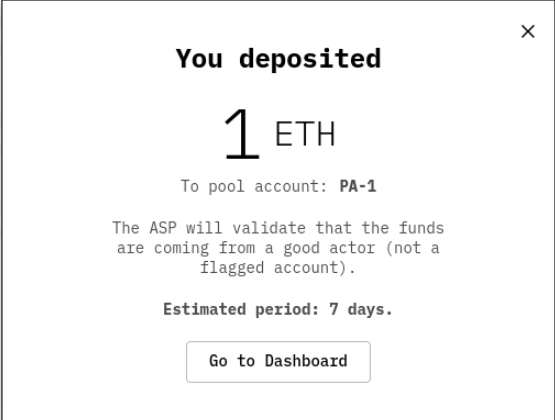 Vitalik Buterin supports the Privacy Pools initiative. Source: X.
What is Privacy Pools and what is it for?
According to its documents, Privacy Pools, which does not require KYC verification, is a smart contract- based protocol that would allow users to conduct private transactions on Ethereum using zero -knowledge proofs (ZK). ZK technology makes it easier to execute transactions by hiding sensitive data, such as identity or transaction amounts.
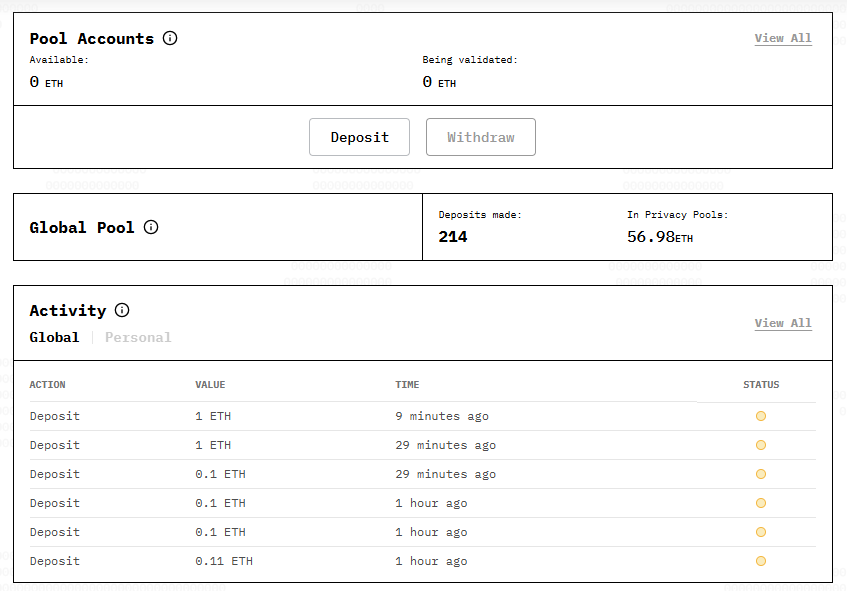 Privacy Pools is a tool that would allow users to move funds without revealing sensitive user data. Source: Privacy Pools
In simple terms, this tool allows users to hide their funds, breaking the public trail: no one can easily connect the deposited ETH with the withdrawal, unlike a direct transfer between wallets .
Privacy Pools aims to offer users the ability to hide their transaction history, something essential for those who value financial confidentiality and privacy.
According to the Ethereum developer who goes by the name “zak.eth” on X and is also the co-founder of 0xbow.io, Privacy Pools would be compatible with the regulatory and standard requirements that governments and international organizations impose on platforms that operate with cryptocurrencies, especially with regard to the prevention of illicit activities such as money laundering, terrorist financing or the use of stolen funds.
This doesn't mean that Privacy Pools comply with a specific list of predefined laws, as regulations vary by country and there's no unified global standard. Rather, they are designed to mitigate risks that often concern regulators by preventing the mixing of legitimate funds with those from illegal activities, such as hacking or scams.
At the time I tested this dApp, the minimum amount to send funds was 0.1 ETH, which is currently equivalent to approximately $200. This threshold may be high for new users or those just looking to experiment with the system, especially in an early adoption context. It is also possible to send ERC-20 standard tokens. The maximum amount per transaction is 1 ETH.
And how do Privacy Pools work on Ethereum?
To operate Privacy Pools, you must have a compatible wallet, such as MetaMask or WalletConnect, connected to the Ethereum mainnet or the Gnosis layer-2 network, where the protocol operates. Additionally, you must have sufficient funds in ether or ERC-20 tokens not only to cover the minimum deposit but also to cover gas fees. This dapp operates from a browser such as Chrome, Firefox, or Brave.
Once the deposit is made, the wallet requests the transaction to be signed and the gas fees to be paid. After on-chain confirmation, Privacy Pools introduces a new feature into their operation with the use of an “Association Set Provider” (ASP), a component that evaluates the funds before integrating them into the system.
Unlike other dApps like Tornado Cash, which faced sanctions for its failure to filter suspicious funds, if the funds analyzed by ASPs are not linked to illicit activity, they are integrated into the smart contract's anonymity pool. This process can be tedious, as the evaluation can take up to seven days.
Otherwise, the user could recover their funds using a "ragequit" feature, maintaining control of their assets at all times, as explained in the Privacy Pools documents. Withdrawal follows a similarly structured process.
Not everything is rosy
One aspect that raises questions is the opacity surrounding ASP operators. The protocol's official website explains: “The ASP is a crucial compliance layer that controls which deposits can be privately withdrawn from Privacy Pools. It maintains a set of approved tags and provides the data necessary for cryptographic proofs of tag inclusion, serving as a bridge between privacy and regulatory requirements.”
In response to a question on an X thread about who runs ASPs, zak.eth noted, “I don’t want to speak out of turn,” tagging Oxbow.io’s CEO (X’s “nattyfried”) in the same comment and assuring that he and “others will have official communications on this soon.” He thus left up in the air specific details that could influence the perception of the project’s transparency.
Another disadvantage of the ASP evaluation process is that, according to information shared by Vitalik Buterin, it can take up to 7 days . During this time, the funds remain in the system but are not available for private withdrawals until they are approved and integrated into the anonymity pool; if they fail verification, the user can recover them via “ragequit.” This timeframe, which aims to ensure regulatory compliance, introduces a delay that could vary depending on the complexity of the analysis.
On the other hand, among the potential advantages of Privacy Pools, zak.eth highlights that it opens up a range of new possibilities for applications, such as anonymous voting in DAOs, verifiable donations, or private airdrops, which could boost its adoption in the Ethereum ecosystem.






