
Howdy, all.
I trade crypto. That's my thing.
The more you understand about the crazy in's and out's from psychology to order books, the better you can accomplish your goals.
Trading crypto has it's benefits, including a 24/7 trading cycle, low requirements for getting started (compared to classifying as a day trader in stocks that has a $20,000 minimum account size). It also comes with many of the same challenges found in traditional trading, be it forex or stocks.
The topic I'm covering here is regarding the buy wall and sell wall.
To start, here's an image that shows the proportion of buys, in green, and sells, in red/purple.
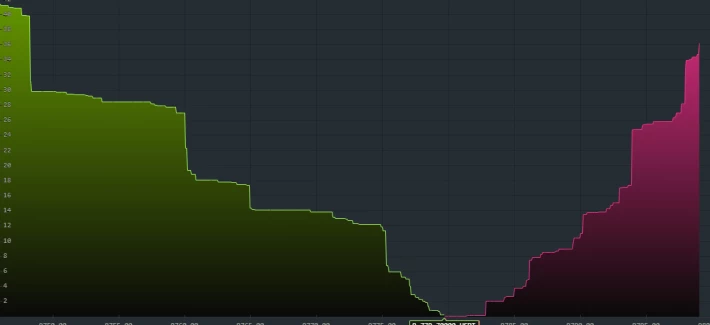
Between the two piles of trades, we see a very small gap. If there is a wide gap here, it is called the spread, and this is the difference between the highest amount someone is offering to buy, and the lowest value someone is willing to sell. If this amount is very small, and both are looking to buy/sell a fairly large amount, there is good liquidity, meaning it is easy to match a buy with a sell, and the orders will go through.
In the case that there is a wide gap in the spread, buys or sell will tend to accumulate. As there either isn't a buyer willing to take the seller's price or vice versa, people may try to re-enter their positions closer and closer to the spread. People typically aren't looking to be stuck in their positions. So, they may try offering slightly more than they wish to buy a coin, and those who are above their minimum profit may be willing to come down just to get out. This typically helps to resolve low liquidity.
It is true for penny stocks, but because crypto is such a young industry and there are so many coins worth fractions of fractions of pennies, we see it more often in crypto, especially considering there is one NYSE, and hundreds and hundreds of small crypto exchanges. When there is a gap i the spread and there is little resolution to the order book, a wall will tend to build up, where it is too steep in volume for the orders to be matched. Until someone decides to change their positions, and the market shifts in a positive direction, a buy wall will make it impossible to get further into the order books in it's favor, and just as true a sell wall will make it impossible for the positions to get past it's 'wall'.
These extremes are caused by an extremely large amount of the coin at a single specific price. This can have a bit of a scaling, meaning there is a gradual wall that builds up from the positions near the largest value, or it can be an extreme, massive buy or sell amount at a single value.
Buy/Sell walls tend to build up naturally in coins that have a very low value, because there are not small units in between price values. For instance, a single sat is the lowest unit to buy/sell against a coin traded in BTC pairs. This looks like 0.00000001 Sats. This is a tiny value and if a coin sits at 1 Sat it is as close to dead at market as it could be. But, there are a lot of coins that hover close to 10, 20, 30 Sats. People will build up huge amounts of BTC worth of these coins, thinking it is an easy 10%, 5%, 3%. And, if these had the potential for liquidity, they would be right. But, despite the fact there are sometimes hundreds of Bitcoins worth of positions at every single position, it acts as if every unit of value is a buy and sell wall, because the jump from 1 Sat to 2 Sats, or 11 Sats to 11 Sats is 10% or more. There is no unit in between, so it takes something extreme to shift the value. Usually, when Bitcoin makes an extreme move up or down, it will shift the relative value of the coin up or down, and it will break up a tiny bit of the coin's stuck positions until people try to get in all over again.
Sometimes, a buy or sell wall is intentional. Often times the sell walls are simply the result of positions people have already purchased that accumulate at numbers people do not want to sell lower, knowing they will be a loss if it goes below a certain value. But, creating a buy wall is often an intentional strategy to build up a point where liquidity breaks down.
Manipulating the exchange to intentionally prevent the price going up or down is considered dishonest, and on stocks would be seen as illegal. But, seeing that every position actually manipulates the market to one degree or the other, and if a person sees the natural accumulation of certain values, there isn't much wrong with adding to something that is naturally occurring based on a shared perception. When a buy wall builds up a few ticks lower than the current highest buy offer, it can be an extreme amount that there is nothing to equal this in the number of sells.
In theory, a person can create a buy wall that almost guarantees the coin will not go lower than that value. A person or group could create a sell wall that theoretically would make it impossible for that coin to go higher than that value. If it were intentional, one reason for doing so could be to create one's own arbitrage opportunity. If they know, under normal conditions, for instance, a low liquidity exchange can normally handle clearing positions of a certain value, but is easy to overload certain values for a given time, let's pretend a valuable coin is going down on almost all exchanges by let's say 10%, a person could theoretically place a buy wall just under the current value and that smaller exchange would only be able to go about 1% down before getting stuck not being able to buy any lower. A person could buy the coin at 9% lower than the buy wall anywhere else, and then sell it for 7-8% profit. This is not a recommendation, but is an important concept to understand why these things tend to happen on less bountiful exchanges.
On the larger exchanges, we see a lot of this take place, because there are a lot of smaller coins traded. But, we also see a natural accumulation of huge amounts of coins at promising values, so when you see these taking place, realize that at a given moment, people could remove large buy or sell orders and the coin could come shooting up or down.
I hope this is helpful!
For the funny stuff, go here:
https://www.publish0x.com/crypto-satire-fake-news-ripped-from-the-headlines






