
"How I built a 7-agent DeFi signal system on a Raspberry Pi — most people use $50,000 rigs. Mine cost $80."
Before Robinhood. Before retail investing was cool. Before everyone had a brokerage app on their phone. There was crypto.
Bitcoin when it was pennies. Ethereum before anyone knew what Ethereum was. Binance when it was the only place to trade. A small group of us who believed that everyone deserved access to the same wealth-building tools the ultra wealthy had always had. Wall Street wasn’t open to us. The stock market felt like a club we weren’t invited to. So we built our own.
We were the ones up at 2am watching charts, trading on gut and research, figuring it out as we went. No Bloomberg terminals. No prime brokerage. Just people with laptops and a belief that financial access shouldn’t be gated by how much money you already had.
I’ve been there since the beginning.
And for years — even as DeFi exploded, even as yield farming and liquidity pools and arbitrage bots became the new frontier — I was still on the outside looking in. Watching YouTube videos about building trading bots. Googling everything. Trying to learn Rust because I thought that’s what you needed to build on Ethereum. Studying DeFi protocols late at night, dreaming about building something automated that could find opportunities faster than I could manually.
Always learning. Never building.
Then one Saturday night in April 2026 I stopped watching and started building.
Six weeks later I had a 7-agent autonomous DeFi system running on an $80 Raspberry Pi in my home lab in Atlanta.
This is how it happened.
The Frustration That Started Everything
I kept seeing DeFi opportunity posts — Twitter threads, Discord alerts, Telegram channels all screaming about yield opportunities and arbitrage windows. By the time I read them the opportunity was already gone. Some bot had already taken it.
That’s when it clicked.
The signal channels broadcast AFTER they catch the trade. What if I built something that got the signal FIRST?
That one thought turned into a build session that didn’t end until 5am. And then another. And another.
Who I Am
I’m not a quant. I’m not a professional developer.
I have 25 years in IT infrastructure and networking. I’ve been trading crypto since before most people knew it existed. And about a year ago I started teaching myself Python and Linux properly — not just enough to get by, but enough to actually build things.
The homelab came first. Raspberry Pis, Docker containers, self-hosted services. Then local AI. Then Discord bots. Then trading bots on SUI and HBAR.
Each project taught me something the next one needed.
By the time I decided to build ARB NETWORK I had just enough Python to be dangerous and just enough DeFi knowledge to know exactly what I was looking for.
What Is DeFi Arbitrage (The 60-Second Version)
If you’re not in crypto, here’s the simple version.
DeFi runs on liquidity pools — automated systems that let people swap tokens directly on the blockchain, no middleman. The same token often trades at slightly different prices across different pools. Pool A might price a token at $3,500. Pool B might price it at $3,520. That $20 gap is an arbitrage opportunity — buy on one, sell on the other, pocket the difference.
These gaps exist for seconds to minutes before bots close them.
Yield arbitrage is similar but slower. One platform might offer 45% APY on the same token pair that another offers 12% for. Move your liquidity to the higher-yielding pool and you capture the spread.
Both happen constantly on Base chain — an Ethereum Layer 2 that’s fast and cheap. Aerodrome Finance is the dominant DEX there. Beefy Finance is the main yield optimizer. Those two became my targets.
Saturday Night, April 26, 2026
I sat down to build Agent 1.
The plan: watch Aerodrome pools, score them by opportunity size, flag anything worth acting on. Write results to a shared file called signal_bus.json that future agents could read.
First problem hit immediately. The API I planned to use — The Graph — had migrated to a paid service. Dead end.
Then I found DeFiLlama. Free, no API key, better data than what I was trying to build. Sometimes the obstacle is the path.
Two hours later, Agent 1 was alive:
🔥 HOT  | WETH-USDC    | APY: 47.3%  | TVL: $2.1M  | Score: 87
🔥 HOT  | AERO-WETH    | APY: 89.1%  | TVL: $890K  | Score: 82
👀 WATCH | CBBTC-WETH   | APY: 23.4%  | TVL: $4.2M  | Score: 71
👀 WATCH | USDC-USDbC   | APY: 8.2%   | TVL: $12M   | Score: 44
62 HOT pools. 42 WATCH pools. 229 total Aerodrome pools being monitored in real time.
It was 2am. I was locked in.
The Architecture I Sketched That Night
By 5am I had Agent 1 running and a full system planned:
Agent 1 — Pool Watcher ✅ Built — Monitor 229+ Aerodrome pools every 60 seconds. Score them. Write to signal bus.
Agent 2 — Yield Hunter → Next — Cross-reference Beefy Finance vaults. Find APY gaps.
Agent 3 — Arb Scout → Planned — Find the same token trading at different prices across pools. Calculate the execution window.
Agent 4 — Trade Coordinator → Planned — Combine signals. Apply risk filters. Issue EXECUTE, HOLD, or ABORT verdicts.
The note I wrote that night: Get the infrastructure battle-tested before the next bull cycle.
Two Months Later
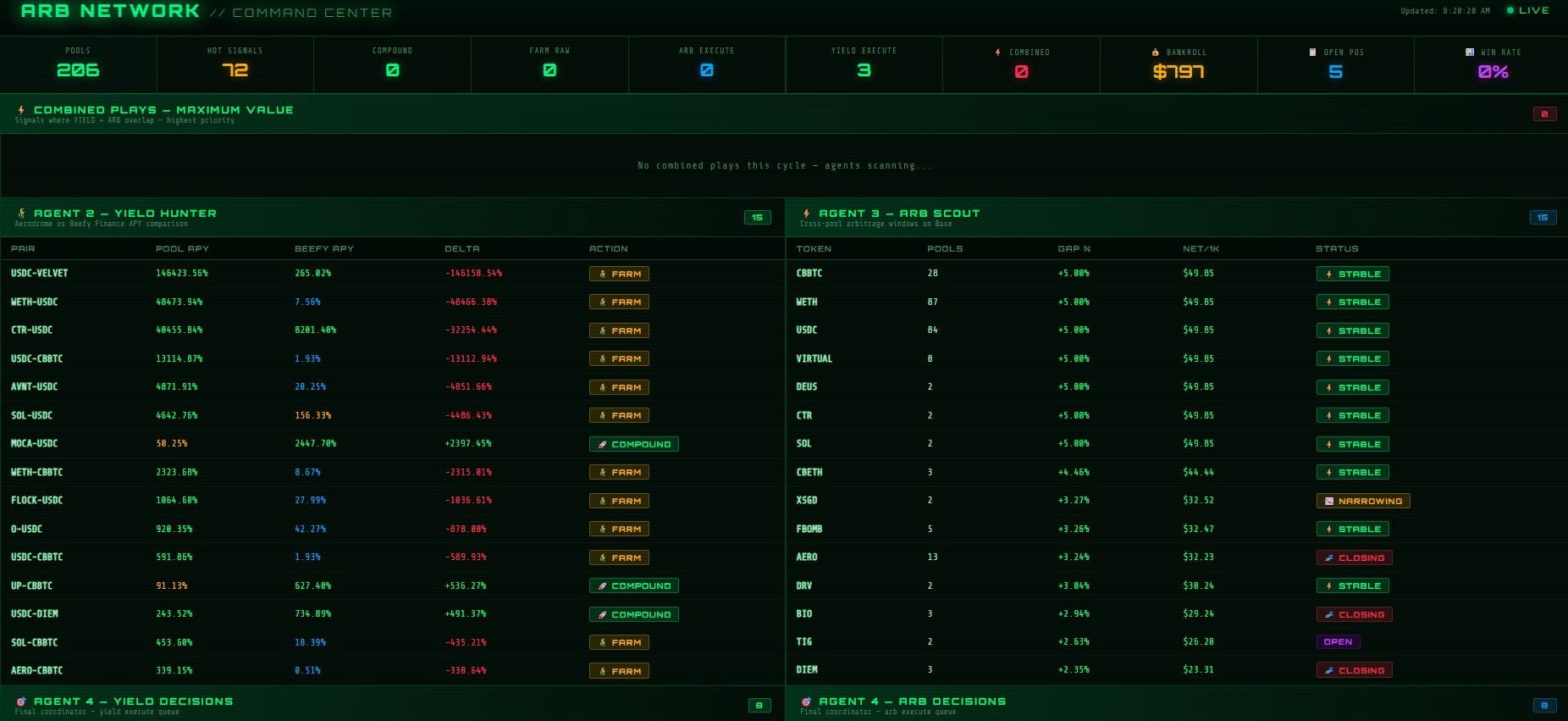
All 7 agents are live. The system runs 24/7. Agent 7 — the execution engine — placed its first paper trades last week. Day 1 P&L: +$3.25 on 5 positions. 4 out of 5 profitable.
Small number. But the pattern matched the prediction exactly.
This series documents the full build — one agent at a time, in the order I actually built them, with the real mistakes and breakthroughs included. No polished tutorial. No hindsight wisdom. Just what actually happened when someone who’s been in crypto since the beginning finally stopped watching and started building.
Next article: Agent 2 — Yield Hunter. How I connected Beefy Finance to the signal bus and started finding real APY gaps on Base chain.
“Whatever you’re building today, keep going!”
— Voytek
If you enjoy this content and want to support the builds, grab me a coffee ☕
👉 ko-fi.com/askvoytek
Full codebase: github.com/askvoytek
Thanks for reading! Subscribe for free at https://askvoytek.substack.com receive new posts and support my work. Also medium.com/@askvoytek





