
Details on the Greco-Persian Wars were primarily recorded by the 5th century BC Greek historian, Herodotus, and his work, The Histories, is among the best narratives in world literature, and has been a primary source for my works here. For the Greeks of the time, the war stood for fighting for freedom against outside oppressors, and arguably still stands as such to this day. Preserved overtime orally, it is definitely biased, glorifying the Greeks and vilifying the Persians, and very likely over-exaggerating the odds the Greeks faced. While other Greek sources from different Greek states have varying slants on the story overall, they don’t greatly oppose one another, and Herodotus isn’t thought to have had to distort his accounts to create a more coherent version of events. What it absolutely gets right though are the overall events, for these were about to shape inter-Greek relations for the next centuries to come.
Check out my previous Persian post on the rise of King Xerxes, and his march to Greece
Check out my previous Greek post on the Battle of Marathon, 490 BC
THE SECOND GRECO-PERSIAN WAR
For his narrative, Herodotus relied on the story-telling devices of past epics like Homer’s Iliad, while also employing more traditional story-tellers throughout Ionia. It’s key that they were from Ionia since Greeks living in the mainland would have a far more biased mindset of the Persians than Greeks living in the empire itself, who would have had joint loyalties to both their ancestors and the wealthy state they now lived under. Herodotus’s accounts of Persian logistics seems suspect; his account of 1,207 Persian triremes may just be the size of the entire empire’s navy together rather than a document detailing the invading fleet, but it’s entirely possible that he simply had access to documents that we can't possess today, and it has been suggested that some of his information came from Zopyros, a grandson of one of Darius’s generals who deserted to Athens in the mid-fifth century.
Xerxes’s oncoming army did not stay unknown to the Greeks for too long; despite their past differences, a shaky coalition of city-states formed to combat the invasion, headed by Athens and Sparta. Leading the two states would be two men that would go down in history as saviours of all Greece: the Athenian politician and veteran of the battle of Marathon, Themistocles, and one of the most famous individuals in world history: the warrior king of Sparta, Leonidas.
THEMISTOCLES
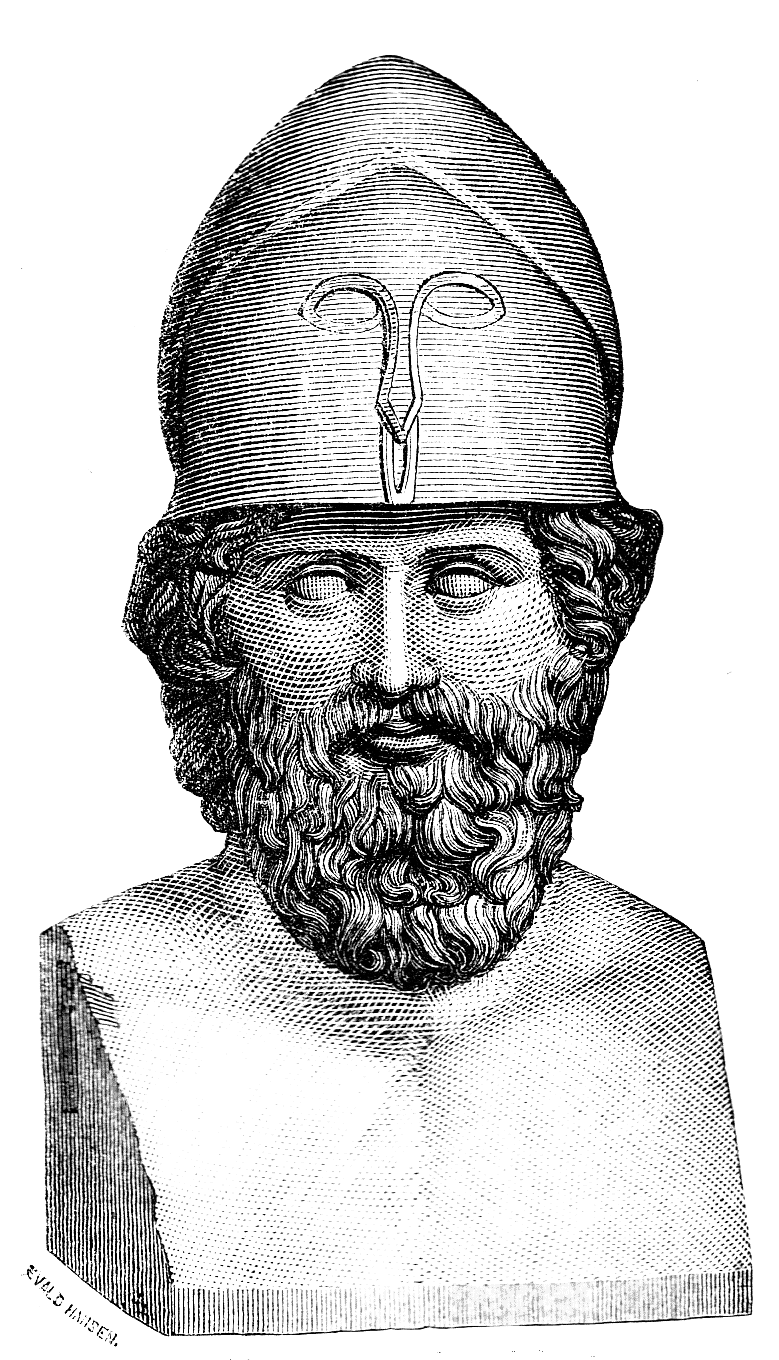
[ABOVE: An illustrated herm (replica head and squared-off upper torso) of Themistocles, 1875]
Themistocles, by his own wit, and without special study or experience, understood the present circumstance with the least planning, and anticipated the future course of events with the greatest success. Whatever he had in hand, he was able to explain clearly, and what he had little experience of, he could judge sufficiently. In particular, he foresaw in an unclear situation what was better and what was worse: to say it in a word, by his natural ability and with little practice, he always divined what was necessary.
[Thucydides]

[ABOVE: A Severe style (a style predominant in Greece from c.490-450 BC) Roman-era bust of Themistocles, based off of an original from 470 BC, which was said to be "the first full portrait of an individual European". Roman copy now held in the Museo Archeologico Ostiense, Ostia, Rome]
EARLY LIFE
The circumstances of Themistocles’ birth were rather humble for one who would go on to become so distinct; his father, Neocles, was not very eminent in Athens throughout his life, and his mother was of mixed descent, no doubt making Themistocles seem like somewhat of a foreigner to other native Athenians at the time. Themistocles’ mother was either Euterpe of Halicarnassus, according to Phanias, or Habrotonon of Thrace, according to an inscription:
Habrotonon am I, a woman of Thrace; and yet I gave birth
To an illustrious Greek - I mean, of course, Themistocles.
Whoever his mother was, it’s of no question that he belonged to the Lycomidae family, since he himself paid for the restoration of of paintings held at the Lycomidae-owned shrine at Phyla, which was damaged with fire by Persians. Athenian Illegitimates at this time were enrolled in Cynosarges, gymnasiums dedicated to Heracles - who was also illegitimate - outside Athens. It was Themistocles who, having to go to these gyms, one day challenged some Athenians to exercise with him, proving his physical prowess in the process and earning a reputation of having abolished the distinction Athens then made between legitimate and illegitimate Athenians.
As a child, Themistocles was described as restless and intelligent; when not being schooled, he diverted away from playing games and chose to rehearse speeches, causing his tutors to state that he would be destined for outstanding things one day, whether great to terrible. He looked up to Mnesiphilius, the forefather of the sophists who tutored Themistocles in practical intelligence and political ingenuity, and his favoured subjects were those that didn’t promote high-cultured lifestyles, preferring to rely on his natural capabilities more. This less refined choice of lifestyle would later in life get him teased by higher-class, more refined citizens, to which he would famously reply:
While I do not know how to tune a lyre or handle a harp, I have taken a small and insignificant state and made it a place of distinction and importance.
EARLY POLITICS
Preferring to follow only his natural inclinations, Themistocles was self-admitted to be impulsive, unstable and erratic, causing him to shift greatly in daily activities and often leaving him degenerate. Whatever his impulses, politics became a big part of his early life. It’s from this background that he intended to become the leading citizen of Athens, soon butting heads with the statesman, Aristides. Conflict between the two began in a rather immature manner, as both men had fallen for the beautiful Stesilaus of Ceos, and the rivalry ensued from thereon. However it should be noted that their political and lifestyle differences were also a great dividing factor between the men; where Aristides was conservative and moderate, seeking to keep Athens safe and just, Themistocles was ambitious, desiring recognition from the people. While still a young man, Themistocles could often be found caught up in his own head, and turning down offers to drink with others, a change in lifestyle brought on after Militades’ victory at the Battle of Marathon, in which Themistocles took part in as one of the ten Athenian commanders. Themistocles knew that this victory would only spark revenge while the rest of Athens reassured themselves that Persia would dare not try again. He thus made it his goal to champion the idea of a more united Greece, seeing into the future that it could very well be the Greeks’ only chance of survival.
THE "WOODEN WALL"
While Xerxes’ primary target was indeed Athens, the whole of Greece was likely in his crosshairs. This was not unknown to the Greeks, many of whom had already submitted to Xerxes while he marched through Thessaly, fearing his sheer power. Those who had not yet submitted were left worried, partly because their naval forces combined would still be outnumbered, but mostly because they simply did not wish to participate in the oncoming war, and so many eagerly collaborated with Persia.
With Xerxes marching closer to them, Athens sent out emissaries to the Oracle of Delphi, seeking her advice. The then-Oracle, a woman named Aristonice, replied:
Fools, why sit you here? Fly to the ends of the earth,
Leave your homes and the lofty heights girded by your city.
The head is unstable, the trunk totters; nothing -
Not the feet below, nor the hands, nor anything in between -
Nothing endures; all is doomed. Fire will bring it down,
Fire and bitter war, hastening in a Syrian chariot.
Many are the strongholds he will destroy, not yours alone;
Many the temples of the gods he will gift with raging fire,
Temples which even now stand streaming with sweat
And quivering with fear, and down from the roof-tops
Dark blood pours, foreseeing the straits of woe.
Go! Leave my temple! Shroud your hearts in misery!
Athens’ emissary was left totally disheartened. However, a distinguished Delphian, Androbulus, suggested the emissary to return to the Oracle, but this time with branches of supplication, a form of prayer done on behalf of someone else or another party, and consult her again as suppliants. The Athenians took this advice, returning to the Oracle and begging the gods for better favour, under threat of never leaving. A second prophecy was given to them:
No, Pallas Athena cannot placate Olympian Zeus,
Though she begs him with many words and cunning arguments.
I shall tell you once more, and endue my words with adamant:
While all else that lies within the borders of Cecrops’ land
And the vale of holy Cithaeron is falling to the enemy,
Far-seeing Zeus gives you, Tritogeneia, a wall of wood.
Only this will stand in tact and help you and your children.
You should not abide and await the advance of the vast host
Of horse and foot from the mainland, but turn your back
And yield. The time will come for you to confront them.
Blessed Salamis, you will be the death of mothers’ sons
Either when the seed is scattered or when it is gathered in.
This reply was less harsh than the last. The emissaries wrote it down and returned it to Athens, where many attempted to interpret it themselves, and two of the most thought-of interpretations were as follows: the more elderly of citizens generally said that the Oracle was predicting the survival of the Athenian Acropolis, which in the past had been defended by a wooden stockade. Others argued that the "Wooden Wall” was the Athenian navy, since warships of the time were constructed primarily out of wood. They thus argued that Athens should focus everything on building a large fleet, however these people failed to make any sense of the last two lines of the Pythia’s reply, which confounded the idea of the Wooden Wall being ships; they interpreted that if Athens engaged the Persians at sea off the island of Salamis (just south of Attica) then the Persians would win.
In this crowd was Themistocles, a man now of some prominence. He argued that if the Pythia’s words about Salamis were indeed in favour of Persia being victorious, then it wouldn’t have claimed Salamis to be “Blessed”, but rather something like “Cruel”, thus he argued that the Oracle was speaking of Persia’s coming defeat, telling the Athenians that they should get to building a fleet as soon as possible. This interpretation quickly became the most preferred.
Around this time, 483 BC, the Athenians had become use to handing out among themselves revenue from the recently-found silver mines at Laurium, just south of Attica. Themistocles stood alone in suggesting that this silver should be put towards a navy instead; Themistocles told the Athenians that their old, bitter rival Aegina, an island nation just south of Attica, wouldn’t stand a chance against an Athenian navy funded by this much money, essentially using Athens’s bitterness towards Aegina to fund the construction of two-hundred triremes.

[ABOVE: A silver ore sluicing tank at Laurium, Attica]
Using his oratory prowess, Themistocles convinced the Athenians that they stood a better chance of defeating any and all rivals at sea than on land. Turning once-infantrymen into oarsmen and marines, against Miltiades’ objections, Plutarch leaves whether Themistocles’ infantry conversion here compromised the purity of Athens’ constitution in the air, while agreeing that it was a key move to preserve Athens as a whole given the events that were to play out soon. Writing a century later, Plato describes the charges brought down on Themistocles as a result:
Themistocles had robbed his fellow citizens of the spear and the shield and reduced the Athenian people to the rowing-bench and the oar.
Themistocles is suppose to have been keen on taking money-making opportunities when they arose, understood through his described generosity; He’d often invite people to feasts, pouring plenty of money on his guests in the process, with the result that he needed plentiful income. Others have described Themistocles as stingy, however; he’s reported to have sold donated food, and once threatened to turn a horse breeder’s house into a wooden horse, hinting he would enact lawsuits on him, after the man refused to give him what he wanted. Once, he asked for Epicles of Hermione, a famous lyre player, to play at his home for the people’s entertainment, and so they’d know where he lived. He was, no doubt, popular with the people, supposedly being able to recall all of his fellow citizens by name and being readily available for every business deal that came his way. With his popularity grew power, until he was eventually able to win his political fight against Aristides, having him ostracised soon after, somewhere in the years 485 and 482 BC.
DIPLOMACY
All Greeks keen to defend the Greek mainland held a meeting. They first agreed to right there and then end all their wars and agree to peace, to face the common foe, among these conflicts being the war between Athens and Aegina. When they learnt that Xerxes was in Sardis, they decided to send three spies to Asia to keep a check on the army. While successful in their espionage at first, these three spies would be caught, interrogated and sentenced to death. Before their deaths, however, Xerxes had them spared and brought to him, where he found out exactly what they were doing there. Xerxes then allowed the spies to see his entire land force - potentially millions strong - and then said they were free to travel to any nation they pleased. Xerxes was clearly hugely proud of his army. Other spies were sent to Argos, hoping to see if they would join the coalition against Persia, and to Sicily, Corcyra and Crete to ask for their aid, hoping to unite the entire Greek world against what would threaten them all.
The Argives were already aware of what was coming, and knew that the other Greeks would consult them for aid, so they too had already sent emissaries to Delphi. They were worried about the safety of their state more-so than most other Greeks, since a recent defeat at the hands of the Spartans killed 6,000 of their troops. It was this loss that prompted their consultation at Delphi, who told them to go on the defensive to preserve their homeland. So when the other Greeks arrived at Argos seeking their aid, the Argives told them that they would join under two conditions: a thirty year peace treaty with Sparta, and command of at least half of the forces being sent to fight Xerxes’ army. While the Oracle forbad Argos from joining a Greek alliance, they responded to the messengers, telling them that their wish for a Spartan peace treaty outweighed their anxiety of the Oracle, fearing Spartan hegemony over their nation more. Spartans in the Greek delegation told the Argives that they would refer the treaty matter back to a more numerous body of people, but that they had been sent to Argos to discuss who would lead the army; they pointed out that Argos only had one king, whereas Sparta had two, and that while this made it impossible for either Spartan king to lose his command, nothing was stopping the Argive king’s views from having the same force of power as both of Sparta’s kings together. Disgusted by Sparta’s selfishness, Argos told the messengers that they would prefer Persian subjugation to Spartan, and so ordered the Greeks to leave or else be considered enemies.
Persia supposedly sent envoys to Argos before the Greeks did; they apparently stated that Persians and Argives shared ancestry through Perseus, stating that it would thus be wrong for Persia to wage war on Argos, and vice-versa, encouraging them to remain neutral in the coming conflict. Argos was allegedly so taken in by this envoy that they didn’t put themselves forward to make demands on the Greeks, but instead made the demands mentioned before since they knew that Sparta would reject joint leadership, giving them the excuse to do nothing and not aid their old enemies.
The Greek delegation to Sicily met with Gelon, ruler of Gela and Syracuse. Warned of the coming Persian threat, Gelon scorned them, for the mainland Greeks had refused to come to his aid against their old enemy sharing the isle of Sicily, Carthage, and avenge the death of one of their own at the Carthaginian's hands, yet the mainland Greeks refused to aid them then. In spite of this, Gelon told the delegation that he was still willing to help: 200 triremes, 20,000 hoplites, and 2,000 archers, slingers and horsemen were ready for deployment, fully supplied with their own food and livestock. This offer, again, came with one condition: Gelon, again, wanted full command of the entire Greek army. This condition nearly ended negotiations; the Greeks knew that Sparta would not allow anyone else full command of the land forces. The delegation told Gelon that his army could come, but only if it could take being under the orders of others. Not wishing to fall further into petty insults, Gelon wished to return to the original offer, where he would send his army under the command of the Spartans, but he would have command of the fleet. Since the delegation was there to gain an army, not a leader, this offer too was rejected. Gelon would later send a delegation to Delphi with money and instructions to see how the coming war would turn out. If Xerxes won, he was to hand him his Earth and Water submission, but if the Greeks won, he would simply return to Sicily with the money, which of course is what ended up happening. Envoys sent to Crete also failed in getting the Cretans to join the coalition, since the Oracle had convinced them not to join due to past grudges.
THE VALE OF TEMPE
As Xerxes quickly marched unopposed through Thessaly, this left the Thessalians with little choice in the matter, quickly submitting to the Persians without a fight. They had, however, previously offered the rest of the Greeks keen on defending Greece the chance to fight Xerxes at Mount Olympus, at a mountain pass known as the Vale of Tempe, if they sent a big enough army. While this army - ten-thousand strong - did arrive there by fleet, a message from Alexander I of Macedon (no, not THAT Alexander) convinced them to abandon Tempe, since another path that wound round the mountains would have left the Greek army positioned at Tempe completely surrounded. This secret route was the route Xerxes ended up taking, so Alexander clearly made a good call, and saved ten-thousand men from certain death.
Greeks that had already joined the Persians prior to their arrival at Tempe included the Aenianians, Dolopians, Melians, Perrhaebians and Magnetans, and upon the Persian’s arrival at Tempe, the Pthians, Locrians and the majority of Boeotians and Thessalians. Those Greeks who met at Corinth to plan their defence of Greece voted to make those Greeks who had chosen the cause of the Persians pay a tithe to the gods.
The army returned south, now planning where they should make their stand, eventually arriving at the conclusion that they should defend the mountain pass at Thermopylae.
THERMOPYLAE AND ARTEMISIUM
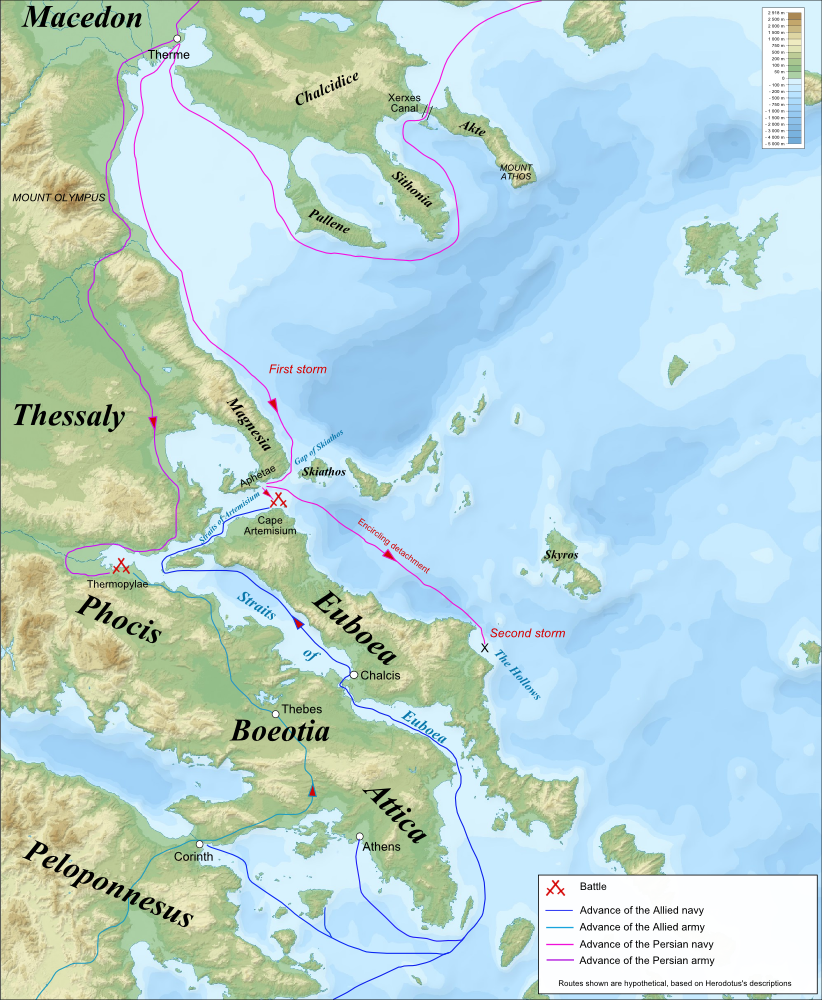
[ABOVE: The route of the Persian army (purple) and navy (pink) towards Thermopylae and Artemisium, and the route of Themistocles's navy (blue) and the Greek army (teal)]
A lot narrower than the Vale of Tempe and a lot closer to home for the remaining Greeks, Thermopylae is Greek for the Hot Gates; it was famous for its hot springs. While a lot wider today, the pass was shadowed from the south by Mount Otea, overlooking the Aegean sea to the north, and it was so narrow at points that carts would struggle to get through. Two and a half thousand years after these events, the narrow pass has been eroded and is now over a mile wide. While too narrow for Xerxes to utilise his large army at once, the other strategic advantage Thermopylae had was its close proximity to the Straits of Artemisium, Artemisium being a town on the very northern tip of the isle of Euboea. The straits here were wedged between the southern Thessalian coast and Euboea, narrow enough for a small navy to compete with a much larger one, similar to Thermopylae. A wall had once been constructed at Thermopylae by the Phocians - which we simply call the Phocian Wall - who feared a Thessalian invasion, which came, and won. At the time we’re discussing, the wall had crumbled over time, and the Greek army, with help from a nearby settlement and its resources, planned to restore it.

[ABOVE: The beach of Cape Artemisium, with Magnesia seen in the distance]

[ABOVE: Modern-day Thermopylae]
Together, Artemisium and Thermopylae would negate the Persian’s huge numerical and cavalry advantages. When the Greeks got word that Xerxes was in Pieria, their meeting was brought to an end, and the forces set out for Artemisium and Thermopylae.
PERSIAN ENCOUNTERS IN NORTHERN GREECE
Having left Therma, some of Xerxes’ fleet reached Sciathos, where an advanced Greek guard of three ships waiting there fled at the mere sight of the Persians. One ship was captured, and a Greek on board had his throat slit as a sacrifice. Another one of the three ships was also captured, but one of its marines put up a heroic fight, killing several, which impressed the Persians so much that they spared him. The other ship managed to escape, and its crew were able to beach it and make their way back home.
News of this reached the Greek fleet at Artemisium. Worried, they re-anchored at Chalcis to guard the Euripus, leaving look-outs on the hills at Euboea, while the entire Persian fleet now sailed from Therma, reaching the small island of Skiathos, north-east of Euboea and beaching there for the night. By morning, however, the calm weather had turned; a summer gale, known to the locals as the Hellespontine, caused the sea to become wild as storms lashed at the Persian armada. Several ships perished at sea, or crashed against the rocky coastline. Two days of this storm cost the Persians upward of four-hundred ships, roughly a third of the entire navy - a devastating loss for Xerxes. Athenians at the time would say that their prayers to Boreas, the divine North Wind, caused this storm, and they would later build a sanctuary to him back home. Survivors of the storm included the tyrant of Caria, who was captured by the Greeks, and a commander who had brought with him from Asia twelve ships, yet only his survived. Attempting to return to the main fleet, he was captured and interrogated, revealing everything about Xerxes’ army to the Greeks before being sent away in chains. Xerxes’ main fleet, however, had reached the southern Magnesian coastline of Aphetae, closing in on Artemisium.
THE COALITION
Come Xerxes’ invasion, when the Athenians were attempting to choose commanders, everyone else aside from Themistocles was too scared of the enemy approaching them that they withdrew from being chosen, leaving a popular leader, Euphemides, to take up the call. However, Themistocles worried that his leadership in these events would ruin everything, and so bribed him out of his position. It’s around here that a Persian delegation arrived in Athens, only to be swiftly arrested by Themistocles and put to death. Arguably his greatest achievement before the war to come was ending the inter-Greek warfare that had plagued Greece for generations, as he even ended the war between Athens and Aegina that was still concerning the Athenians at the time.
Once his men were boarding their ships to go meet the Persians at sea, Themistocles said it would be best to meet them as far away from Greece as possible. When this proposal met heavy opposition, however, Themistocles decided on following the Spartans on their way to the pass at Tempe. When it was discovered that the Thessalians at Tempe had betrayed the Greeks, however, Themistocles’ proposal to meet Persia at sea far away was agreed upon, so he headed his fleet for the narrow straits of Artemisium. Themistocles refused to hand over leadership to Eurybiades, the Spartan general leading the Peloponnesian fleet, arguing that he had more ships than all other fighting Greeks together. Appreciating the danger ahead, Themistocles not only argued that he should lead the navy instead of Eurybiades, but calmed his fellow Athenians down with a guarantee of getting the other Greeks to willingly submit to them after the war, so long as they proved themselves during it.
Once the Persian fleet had reached Aphetae, not far from the Artemisium Straits, Eurybiades became worried by its sheer size. Furthermore, upon hearing that two-hundred more Persian vessels were sailing around Sciathos, he planned to sail back the short way to the interior of Greece to remain in better communications with the Peloponnese, to use the fleet as protection for the land army; Eurybiades believed the Persians too strong to take on in open waters. Afraid the Greeks were going to abandon them, the Euboeans negotiated with Themistocles, sending a large quantity of money as a bribe, which Themistocles accepted. Few resisted Themistocles’ plans, among those who did was Architeles, a vessel commander afraid to go on with the plan because he lacked the funds to pay his men. When his crew turned on him one night and stole his personal rations, Themistocles secretly broke bread with him, handing him a talent of silver which he told Architeles to give to his men.
While the Persian fleet reached Euboea, the land force, drinking the rivers of southern Thessaly dry, reached Thermopylae. It’s here that Xerxes finally encountered the land force: 1,120 men from Arcadia, 1,000 from Phocis, 700 from Thespia, 500 from Tegea, 500 from Mantinea, 400 from Thebes, 400 from Corinth, 200 from Phleousia, and 80 from Mycenae. Over five-thousand in total, these men were headed by three-hundred elite soldiers from Sparta, in turn lead by their Agiad king, a man whose name would become synonymous with bravery and heroism and live on forever: Leonidas.
LEONIDAS
His name means "Son of the Lion".

[ABOVE: A marble statue thought to be of Leonidas, c.5th century BC, now held in the Archeological Museum of Sparta]
Being able to trace his lineage back to Heracles himself, Leonidas, born around 540 BC, was a son of Anaxandridas II and an unknown mother, reigning from c.489 to 480 BC. While bigamy was unheard of in Sparta, Anaxandridas had two wives, both of who’s names are unknown. His first wife birthed Dorieus, (the exiled Spartan prince who had previously attempted to establish colonies in Libya and Sicily, but failed and died) Leonidas and then Kleombrotos. His second wife birthed Cleomenes prior to Leonidas's birth, the king who went insane and committed suicide by chopping himself into pieces. Despite his name being one of the most famous ever, little of Leonidas besides the coming deeds are known. Not being an eldest son of a king, Leonidas had undergone the full extent of the Agoge, Sparta’s harsh training regime that turned boys as young as seven years old into hardened warriors and nothing else. Being around sixty years of age come the Persian invasion, it’s likely he would have had experience in battles dating back to roughly 520 BC, most likely in small-scale wars against Sparta’s traditional enemies of Argos and Athens. Upon the death of Cleomenes, Leonidas married his heiress Gorgo, making her Queen.
As he was asked to help defend Greece against Xerxes, Leonidas consulted the Oracle at Delphi for guidance. The reply was given in hexameter verse:
Here is your fate, inhabitants of spacious Sparta:
Either your great and glorious city will be destroyed
By men descended from Perseus, or that will not be,
But the borders of Lacedaemon will mourn the death
Of a king descended from Heracles. For neither the might
Of bulls nor yet that of lions will check the foe head on,
Since he has the might of Zeus. Nor, I declare, will he
Be checked until one of the two has been thoroughly rent asunder.
When told by the ephors that he should send more men, Leonidas told them in private,
For preventing the barbarians from getting through the passes they are few, but for the task to which they are now bound they are many. Ostensibly, I am leading them to the defence of the passes, but in fact to die for the freedom of all; and so, if a thousand set forth, Sparta will be more renowned when they have died, but if the whole body of the Lacedaemonians take the field, Lacedaemon will be utterly destroyed, for not a man of them, in order to save his life, will dare to turn in flight.
it was during Sparta’s festival known as the Carneia, honouring Apollo, that Leonidas decided to march to Thermopylae with three-hundred Spartans. While this was the size of the standard Spartan bodyguard, these particular men had been picked for this instance because they all had sons to carry on their lineage. This could be telling that these three-hundred Spartans were not expecting to return - they may have known that this was a suicide mission.
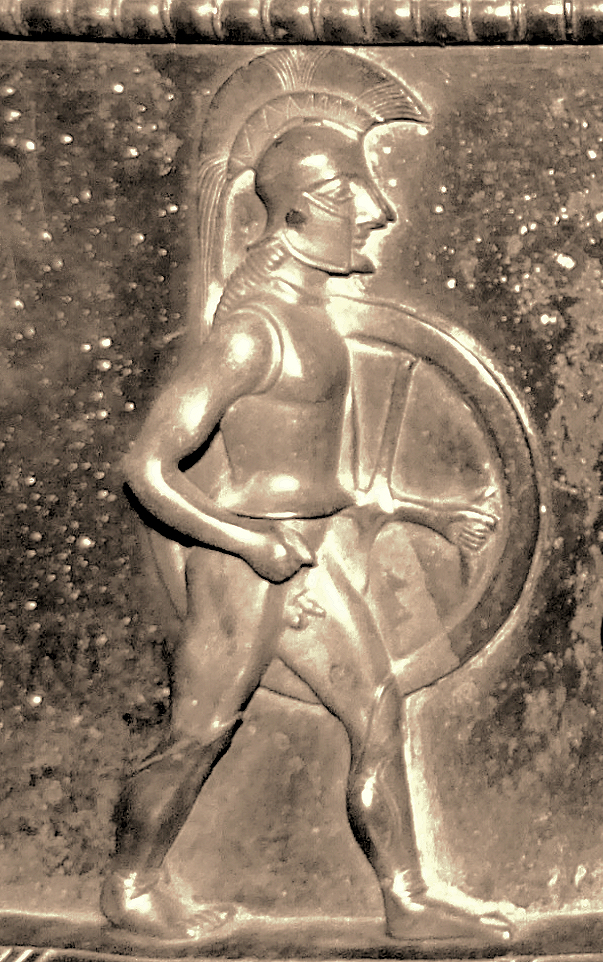
[ABOVE: Likely, a Spartan hoplite, c.500 BC, part of the Lady Vix grave burial mound, Burgundy, France]
In total, one thousand Lacedaemonians, headed by three-hundred Spartan citizens, and three-thousand other Greeks marched to Thermopylae. A thousand Locrians, however, and an equal number of Melians and Phocians, were already at Thermopylae, having sided with the Persians in promising to hold the pass until Xerxes’ main forces arrived there. They soon switched sides however when Leonidas showed up, bringing the land force now to over seven-thousand men.
On their way to Thermopylae, Leonidas recruited a Theban contingent under the command of a man named Leontiades, since Leonidas was suspicious of Thebes collaborating with Persia. Wishing to prove loyalty, Leontiades joined Leonidas with 400 of his own men, in spite of his loyalties lying elsewhere. On the march to Thermopylae, Leonidas led the way with his 300 bodyguard, inspiring the rest of the Greek forces behind them, all of which had also only sent an advance guard each, small in number; the Olympic Games were taking place at this time, and the Greeks did not expect that the coming battle would be decided very quickly.
Once at Thermopylae, several Greeks, fearing the Persian army, wished to retreat, thinking that withdrawing to the Peloponnese and blocking off the Isthmus of Corinth would be better. This angered many, and Leonidas voted in favour of remaining where they were, while sending envoys across Greece to ask for more aid; a mere five-thousand men could not hold this pass forever.
The stage was now set: as Xerxes marched with an army beyond counting, Eurybiades and Themistocles commanding their two-hundred-plus warships were to hold the straits of Artemisium, while Leonidas stood guard over the Hot Gates with seven-thousand soldiers.
The legend of three-hundred Spartans was about to be born...
NEXT BLOG: THE BATTLES OF THERMOPYLAE AND ARTEMISIUM, 480 BC: Last Stand of the 300 Spartans

SOURCES
- Herodotus's "Histories"
- Diodorus Siculus, "Library of History"
- Plutarch, "Greek Lives: Themistocles"
- Oswyn Murray, "Early Greece"
- Robin Osborne, "Greece in the Making 1200 - 479 BC"
- Nic Fields, "Thermopylae 480 BC, Last Stand of the 300"
- Philip Parker, "World History"
YOUTUBE LINKS
(I do NOT own these videos)
"Armies and Tactics: Greek Armies during the Persian Invasions" by "Kings and Generals"
"Armies and Tactics: Ancient Greek Navies" by "Kings and Generals"
"300 Spartans Road to Thermopylae (Part 1/2) 490-480 BCE DOCUMENTARY" by "Hoc Est Bellum"
MY ANCIENT GREEK HISTORY BLOG PAGE
MY ANCIENT PERSIAN HISTORY BLOG PAGE
MY TWITTER
All feedback - positive and/or critical - is appreciated!
All images used are copyright-free
Don't forget to rate this post and leave a tip if you enjoyed it
Thanks for reading :)






