
Abstrac
Smart contracts are critical components of blockchain-based decentralized applications. While block confirmation times are determined by the underlying consensus mechanism and cannot be directly altered, developers can improve transaction execution speed at the contract level by optimizing the code. This article examines three best practices for achieving faster and more efficient smart contract execution: (1) keeping smart contract logic simple to minimize computational overhead, (2) leveraging Solidity compiler version updates to benefit from performance enhancements and security improvements, and (3) preferring the transfer method over send for Ether transfers to ensure streamlined error handling. The results demonstrate that following these practices not only reduces gas costs and execution delays but also enhances overall contract reliability. Together, these measures provide a framework for developing efficient and secure decentralized applications.
Keywords: Smart Contract, Blockchain, Solidity, Compiler, Transfer Function.
1. Introduction
Smart contracts on blockchain platforms such as Ethereum and Binance Smart Chain execute code deterministically across thousands of nodes. Since execution is replicated, efficiency in contract logic is paramount. Transaction throughput and block production time are largely constrained by the consensus protocol of the blockchain (e.g., Proof-of-Stake on BSC or Ethereum).
Although developers cannot directly influence block times, they can optimize smart contract design to achieve faster execution within each block. This ensures users experience reduced gas consumption, quicker state updates, and lower likelihood of failed or reverted transactions.
This paper focuses on three practical optimizations:
- 1. Simplicity in smart contract design
- 2. Utilization of the latest Solidity compiler
- 3. Using transfer instead of send for Ether transfers
2. Methods
2.1 Simplification of Smart Contract Logic
Unnecessary computations, complex inheritance chains, or redundant storage operations increase gas costs and transaction execution time. By simplifying contracts —minimizing loops, avoiding deeply nested calls, and utilizing efficient data structures —developers ensure faster and more predictable execution. For instance, instead of iterating through all users to update balances, contracts should map addresses directly to balances, avoiding O(n) operations.
2.2 Using the Latest Solidity Compiler
The Solidity compiler is continuously updated to improve performance, reduce gas usage, and patch vulnerabilities. For example:
- Solidity 0.6.x introduced ABIEncoderV2 as stable.
- Solidity 0.7.x reduced redundant gas costs for certain operations.
- Solidity 0.8.x added built-in overflow/underflow checks and optimized revert messages.
By compiling with the latest stable version (e.g., pragma solidity ^0.8.30;, last update on Oct. 2025), developers benefit from these optimizations without additional coding effort.
2.3 Using transfer Instead of send
When sending Ether, developers historically used send or call. send returns a boolean and requires manual error handling:
bool success = recipient.send(1 ether);
require(success, "Transfer failed");
Transfer automatically reverts if the transfer fails, reducing complexity:
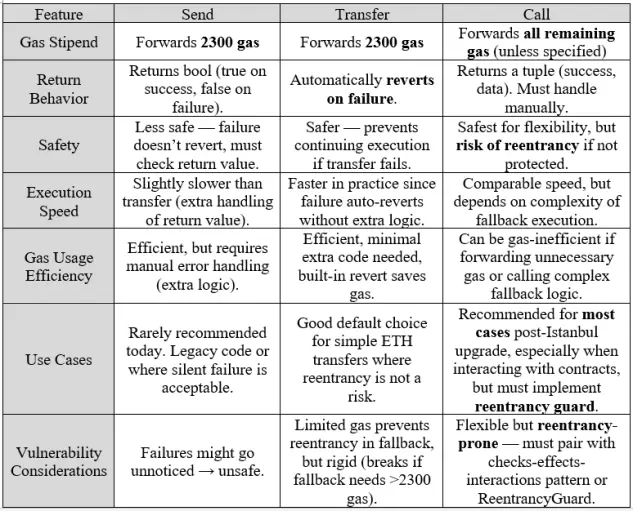
recipient.transfer(1 ether);Since transfer uses a fixed gas stipend (2300 gas) and reverts on failure, it provides faster and safer execution. This minimizes unexpected behavior, reduces the need for manual checks, and shortens code length—contributing to faster execution.
Note that in newer Solidity versions, call{value: amount}("") is often used for flexibility, but transfer remains the simpler and safer option for contracts with straightforward Ether transfers.
In the following table, the comparison of send, transfer, and call in Solidity is shown.
3. Results
Applying these optimization methods yields:
- Simplified Contract Design: Reduced execution complexity and lower gas costs per transaction. For instance, avoiding loops over arrays reduces O(n) execution to O(1).
- Latest Solidity Compiler: Automatic improvements without altering code. Overflow protection, efficient error handling, and optimized opcodes contribute to faster execution and fewer transaction failures.
- Transfer vs. Send: Using transfer ensures faster execution with built-in failure handling, reducing code size and eliminating unnecessary conditional checks.
Collectively, these practices make transactions execute faster within the constraints of the blockchain’s consensus-driven block times.
4. Discussion
While developers cannot influence block generation intervals (e.g., ~3 seconds on BSC, ~12 seconds on Ethereum), they can optimize intra-block execution efficiency.
- 1. Simplicity: Leaner code reduces both gas consumption and runtime, benefiting users financially while improving throughput.
- 2. Compiler Updates: Compiler advancements often include micro-optimizations in the EVM bytecode, effectively accelerating execution. Developers relying on outdated compilers miss out on both performance and security improvements.
- 3. Transfer vs. Send: Historically, vulnerabilities like the DAO hack encouraged defensive coding practices. Using transfer simplifies logic and provides faster fail-safe execution compared to send.
However, caution is advised:
- Over-optimization (e.g., overly compact logic) may compromise readability and maintainability.
- transfer’s gas stipend limitation (2300 gas) can break if the recipient contract has complex fallback functions. In those cases, developers may prefer call.
5. Conclusion
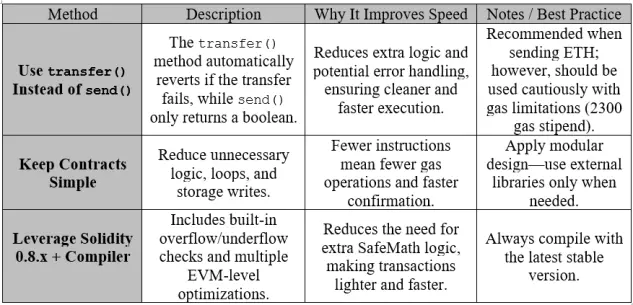
Smart contract performance optimization is essential for reducing transaction execution time and improving user experience. Although developers cannot shorten block confirmation intervals, they can:
- 1. Simplify contract design to minimize unnecessary operations.
- 2. Use the latest Solidity compiler for built-in performance and security enhancements.
- 3. Prefer transfer over send for safer, faster Ether transfers.
Summary of the methods is shown in the following table:
By applying these strategies, developers maximize efficiency and reliability while reducing risks. This layered approach ensures that decentralized applications execute quickly, economically, and securely.
References
[1] Antonopoulos A., Wood G., 2018, Mastering Ethereum: Building Smart Contracts and Dapps, 1st Edition, O'Reilly Media, ISBN-13: 978-1491971949.
[2] Solidity Documentation. Version 0.8.0 Release Notes. https://docs.soliditylang.org/en/v0.8.0/080-breaking-changes.html/
[3] OpenZeppelin Contracts. https://docs.openzeppelin.com/contracts/4.x/ , https://docs.openzeppelin.com/contracts/5.x/
[4] Binance Academy. https://academy.binance.com/en/articles/how-do-gas-fees-work-on-ethereum/






