
The main selling point of the blockchain and its applications is that the records distributed with cryptographic security are practically "unbreakable" under normal circumstances, given the current state of computer technology. Its validity, however, depends to a large extent on the assumption of the "state of technology". If there is a paradigm shift in computing, contemporary blockchain-based systems can become vulnerable to threats that are not taken into account in their design. But how urgent is the threat of this happening in the near future?
An introduction to quantum computing
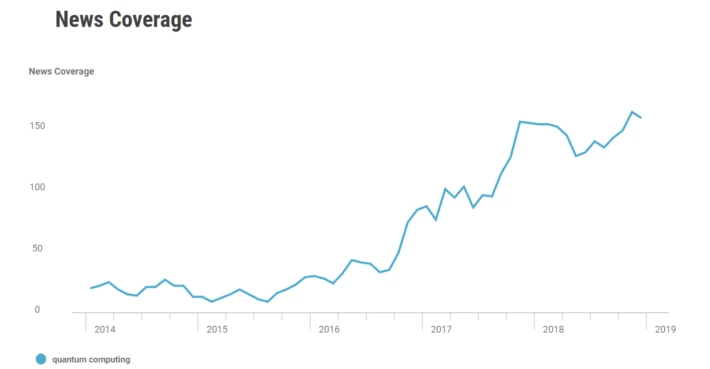
A quantum computer is any device that uses the principles of quantum mechanics to perform calculations. To store and manipulate information, traditional computers use binary units called bits, which can represent one of two possible states: 0 or 1. Quantum machines depend on quantum bits (or qubits), which can be a 0 and a 1 at the same time. This phenomenon, called superposition, allows these devices to perform certain tasks much faster than their bit-based counterparts.
Another fundamental term in quantum theory is entanglement. When two particles intertwine, they exist in the same quantum state, and they change in the state if one prompts their pair to change accordingly, no matter how far they are in physical space. The pairing of qubits in this way leads to the exponential growth of the computational power of the quantum computer.
The state of overlap, necessary to perform the calculations, is difficult to achieve and enormously difficult to maintain. Physicists use lasers and microwaves to put the qubits in this state of work and then use a series of techniques to preserve them from the slightest fluctuations in temperature, noise and electromagnetic waves. Current quantum computers are extremely prone to make mistakes due to the fragility of working conditions, which dissipates in a process called decoherence, before most operations can be executed.
The quantum computational power is determined by the number of qubits that a machine can take advantage of simultaneously. Starting with the humble two qubits achieved in the first experiments in the late 1990s, the most powerful quantum computer of today, operated by Google, can use up to 72 qubits.
Quantum computers and blockchain
Recognizing all conventional reservations, the idea of the immutability of the blockchains and unparalleled security is widely accepted: It is the basis of public confidence in digital assets and promotes mass adoption. However, the advent of quantum computing could potentially jeopardize the integrity of public key cryptography, which is the backbone of blockchain security.
While the range of potential applications of quantum computers is very wide, the most relevant in the context of blockchain technology and cryptography in general is the ability to execute specific algorithms much faster than any existing supercomputer. One of the most discussed cases of alleged use is the execution of Shor's famous algorithm for the decomposition of factors, which could make many of the contemporary encryption techniques obsolete.
As a group of researchers from the Russian Quantum Center observed in an article for the journal Nature, a potential risk stems from the fact that the blockchain's security depends to a large extent on unidirectional mathematical functions, which are easy to execute, but much more difficult to calculate backwards. These functions are used both to generate digital signatures and to validate operations in the registry.
An offender equipped with a functional quantum device could perform inverse calculations much more quickly, which would allow him to forge signatures, impersonate other users and access his digital assets. In the context of mining, a malicious actor could take over the process of updating the registry, manipulating the transaction history and double spending of coins.
Russian researchers suggested that architects of encrypted systems should start taking precautions against this threat immediately. One solution could be to replace conventional digital signatures with quantum-resistant cryptography, the kind of security algorithms specifically designed to withstand an attack from a sufficiently powerful quantum computer. Another remedy, Russian physicists proposed, will only be available with the advent of a quantum Internet, which is still several decades away. This future wireless communication architecture, based on the connection between quantum particles interlaced remotely, will unlock a lot of new models and blockchain designs.
This is in keeping with the mind-boggling idea that Del Rajan and Matt Visser of the Victoria University of New Zealand expressed in a recent research article. They proposed to renounce the use of quantum cryptography and jump directly to convert the blockchain into a system based on quantum. His model describes a blockchain based on qubits interlaced not only in space, but also in time. The attempt to retrospectively alter the record of transactions, encoded by the history of the states of a single particle over time, would be impossible without destroying the particle completely. The realization of this model, however, would be impossible until a quantum Internet is in operation.
While the futuristic solutions proposed by academics may be decades away, a large amount of practical research and development in quantum computing and quantum cryptography is occurring at this time. Experts working with quantum computing applications say that quantum computers are becoming incredibly powerful and moving faster than most people expected. However, its capabilities will not break the blockchain. Every year, when new hardware is released, it raises concerns about the integrity of the blockchain, but there is no evidence that quantum computing can compromise it.
Quantum computers will redefine cryptography not only from the blockchain, but also wherever there is a cryptography application that includes simple things like an online banking website. There is considerable research and work being done to mitigate the effects and move to quantum cryptography or post-quantum cryptography. However, the challenge of the blockchain is not only the threat that quantum computing represents, but the scope of how the blockchain will migrate to the new version of cryptography. in simple terms the blockchain will have to evolve, but it is unlikely that quantum computing technology will threaten its existence.






