
A former community in western Micronesia used giant stones with a monetary system very similar to what we know today as cryptocurrencies and their underlying technology, Blockchain.
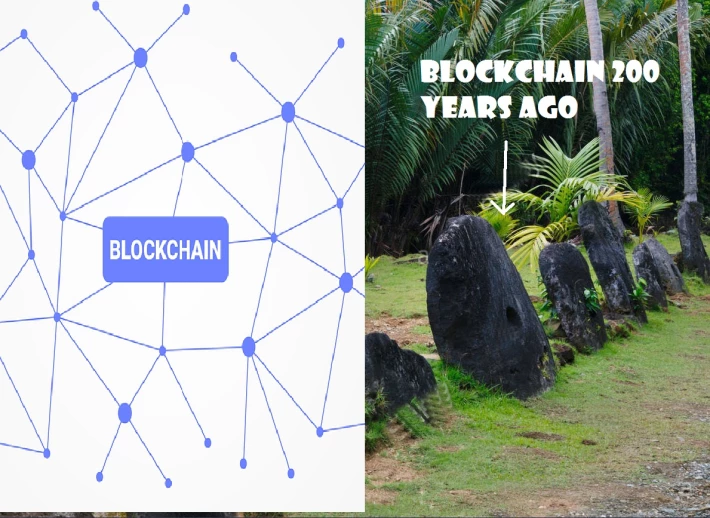
Centuries ago, in western Micronesia (Oceania), the Yap Islanders sailed to the Palau archipelago, 400 km away, to carve their famous stone discs, called "Rai". Then, they transported those gigantic limestone circles back to use them as objects of value and method of change in various transactions.
According to studies conducted by archaeologists from the University of Oregon, although the rai were not strictly currencies, their use is very similar to the modern use of Bitcoin. According to the research, the concept behind the stone money of the ancient Yapeses may have even inspired the creation of Bitcoin and Blockchain.
What are the Rai?
The villages of the small group of Yap islands initiated one of the most unusual and ambitious exchange systems of the ancient world. An ambition comparable to the project that Satoshi Nakamoto launched in 2008 and that inspired the creation of the thousands of cryptocurrencies that exist today.
Since limestone did not exist in Yap, the islanders traveled hundreds of kilometers to the southwest, to the Palau archipelago, to extract the giant and precious stone. But not only the scarcity of the limestone gave them the value to the rai among the community. The precarious conditions of maritime transport and labor to forge "stone money" also made them valuable objects.
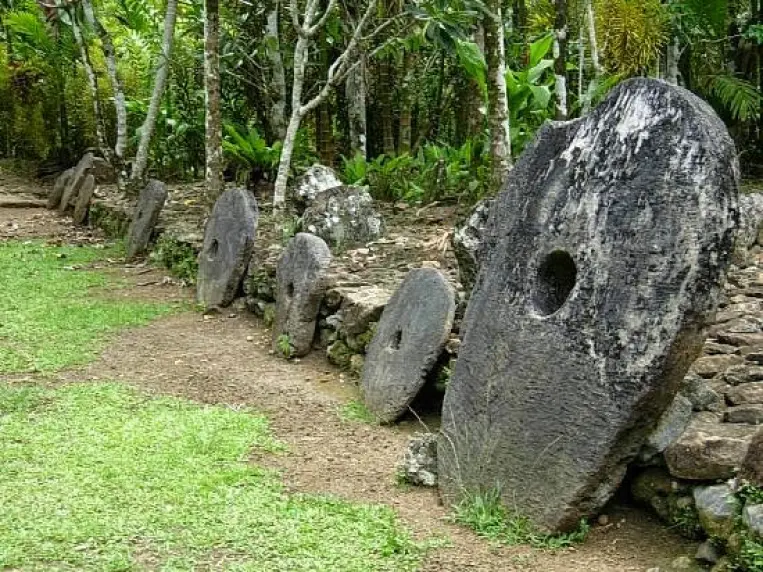
Upon arriving at Yap after their arduous trip, the stone money discs were offered or exchanged with several individuals and subsequently exhibited in prominent places. In general, rai are discs with a hole in the middle and of very variable sizes. The largest can weigh 4 tons, and the smallest, measure 8 centimeters.
Similarities to Crypto
One of the main similarities between Bitcoin and Rai is that both maintained a similar system to manage property information. Although their differences are evident when it comes to relating the method of an old society with the use of modern technology, the principle of both activities is the same.
The rai were extremely valuable, but due to their size, weight and fragility, it was not common for them to be moved after being placed in a specific place. As a result, the owners of a disk could not live very close to the location of the stone. The first similarity between Bitcoin and the rai jumps at sight, none requires physical possession.
Although unlike Bitcoin the Rai do have a physical reference and the inability to possess is due to issues such as size and weight, these stones offer an ancient example of assigning value to a monetary instrument without requiring physical possession.
In fact, it tells a local story that on one occasion a boat that moved a giant stone disk sank to the bottom of the sea. Although they could never recover the stone, the Yapeses maintained the property through oral tradition, safeguarding the value of an object without needing to have it physically.
They were oral Blockchain
On the other hand, the nature of the rai forced the Yapeses to create a peculiar method for securing property: the invention of an oral accounting book. In this way, the community registered the property, and maintained transparency and security.
Perhaps the most striking similarity between Bitcoin and rai is the use of a distributed ledger for property records. In the case of Bitcoin it is Blockchain, while for the Yapeses villagers it was a shared oral book shared by the community.
Within the Bitcoin network, the nodes keep a copy of the ledger, validating and retransmitting new transactions. An ancient analog of the Bitcoin nodes are the villagers of Yap, who confirmed and repeated information about transactions made with rai stones through oral tradition. A way in which, in addition, double spending of the same currency is avoided.
Essentially, the process was to travel by sea, negotiate with the chiefs of Palau to extract the limestone, carve the rai, bring them back to Yap, and have them inspected and verified by a local chief. All this, in order to place them in a deposit and maintain proof of ownership for long periods of time through the oral Blockchain. This is analogous to the way in which Bitcoin is created and maintained through the Blockchain.
Work contribution
Also, the process of creating both currencies is similar. Just as bitcoins can not be generated at will, the offer of rai was also limited. In the case of Bitcoin, because the supply program is established in advance by code and can not be modified unilaterally. In the case of the rai, it was a physical limitation related to maritime travel and negotiation with the inhabitants of Palau.
In both cases, Bitcoin and rai, the expansion of the money supply is generated only through the contribution of labor. In the case of the rai, it required the energy of the workforce to navigate, carve new discs and return to Yap with the new units of change. Similarly, new Bitcoin units are minted only through the mining process, which requires work through computational resources known as hashpower to validate and account for transactions.
In addition, in both cases there are incentives to contribute to work. For the rai, the fees or rewards of the yapeses miners could be represented in rai, products or status within the community. For Bitcoin, the main economic incentive is the block reward, a small amount of new Bitcoin that is minted and granted to the miner who completes the block.
Decentralization and collective validation
In the traditional financial system, property transactions are made through an intermediary. The banks, for example. In the case of rai and Bitcoin, the transfer of value does not consist of a central intermediary but of a network of participants.
For both rai and Bitcoin, third parties are eliminated during peer-to-peer transactions and the value is transferred without intermediation. For the tradition of the rai involved the realization of rituals and social events to communicate and verify the property.
Checking the property through networks, using Blockchain or oral accounting books allows all participants to reach a consensus on the property. In addition to that it is a way to guarantee transparency; a key feature in both systems.
Both the oral and digital Blockchains represent an unequivocal source of truth. In this network, anyone within the insular society or digital kingdom system can know the entire history of transactions, which allows auditability.
Common challenge: scalability
But both systems have encountered the same problem scalability. In the case of Bitcoin because there is a limit on the size of each block, which limits the volume of transactions that can be processed. And the same could be said for rai.
If the population of Yap had grown to hundreds of thousands of inhabitants, it would be extremely difficult to transmit the oral Blockchain to the whole community. Essentially, there is a cognitive restriction on the number of stone money transactions that could be processed by word of mouth, limiting their ability to scale.
Differences
A big difference between the two systems is anonymity, or more precisely, the pseudonym. The offline identity of the owners of Bitcoin is protected by the fact that the addresses of the wallets are long strings of numbers and letters.
While those who participate in the crypto market do not need to reveal identity to trade bitcoins, in Yap acting under pseudonyms was unfeasible.
The identity of the rai stone owners was visible to all the villagers and they were required to maintain transparency and security, and as such, the ledger distributed in Yap only worked through visibility.
Another key difference is that all bitcoins are fungible and interchangeable with each other. In other words, they are identical and have uniform characteristics. The rai, on the other hand, differ in their dimensions, a characteristic that in many cases also influenced their value.
But another feature that undeniably separates Bitcoin from stone money is that the cryptocurrency can be divided. That is, split into up to 1 satoshi (or 0.00000001 BTC), while the rai does not. And this is one of the main reasons why stone money is not a currency in the strict sense, but a value of change.
Bitcoin: exchange value
While Bitcoin and Rai are assimilated by their use as exchange values, some cryptocurrency skeptics argue that Bitcoin is not money and its value is volatile and based on air.
However, the experience of hundreds of crypto-enthusiasts around the world may reflect the opposite. In fact, the largest annual celebration of the cryptographic ecosystem Bitcoin Day commemorates the first time someone used the cryptocurrency to buy a pizza, in 2010. Currently, digital currencies can be used for payments as traditional as food, clothing, services transportation, lodging, etc.
Rai and the cryptocurrencies as values of use
Very similar to Bitcoin, the rai were valuable for exchanges and could be used in a variety of different social transactions, for example, gifts in marriage. But beyond Bitcoin, there are thousands of cryptocurrencies, many of them have been created by small groups with the aim of using them for internal transactions of the community.
This type of project suggests that, in the future, cryptocurrencies could achieve mass adoption for both local and global uses. However, although almost all digital currencies tell us about the future of the economy, sometimes they also talk about the past. Encounters like those that occur between rai and Bitcoin, make us think of reliability as the first and most important exchange value in a transaction. Something that has been established in human societies for hundreds of years and that now traces a course, as well as yapeses navigators, towards the future.





