You have likely been told to do your “due diligence and research” on every crypto under the sun. This article will help you kick-start your research on Elrond by covering the basics. That said, what follows is not financial advice.
What is Elrond?
Elrond is a blockchain architecture created to provide a borderless economy accessible to people worldwide. Many projects make similar claims, but Elrond demonstrates its dedication to global accessibility by focusing on technical performance and simplifying the user experience. Elrond aims to achieve a borderless economy by offering an intuitive mobile app (Maiar) backed by a lightning-fast, cross-chain capable, distributed infrastructure (Elrond).
The Elrond network uses adaptive sharding, which, in its testnet phase, processed an incredible 260,000 transactions per second (TPS). For comparison, Ethereum made news in January, 2020, for processing a mere 18,000 TPS. When Ethereum 2.0 arrives it is expected to perform about 100,000 TPS. This means Elrond’s current transaction numbers more than double the future predicted performance of Ethereum 2.0.
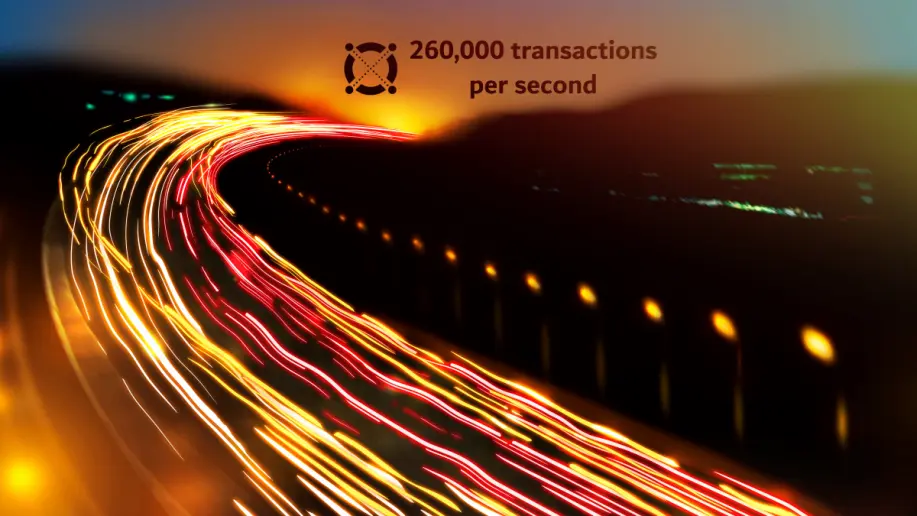
Elrond’s adaptive sharding uses three types of shards to achieve its fast throughput; network/communication, transaction/processing, and state/storage. The shards are dynamically allocated, increasing or decreasing according to the platform’s current workload.
Ultimately, Elrond hopes to recreate the efficiency and reliability of centralized solutions within their decentralized platform. To achieve this goal, the development team focuses on parallel processing, linear scaling, and minimizing the energy required for operations.
Like Ethereum, Elrond supports de-fi and the creation of dApps. However, it also offers cross-chain interoperability and low fees (due to parallel processing) to encourage mass adoption. Elrond uses secure proof of stake (sPoS) for consensus, something Ethereum plans to adopt as well.
Perhaps the boldest claim Elrond can make is that it delivers on the promises of Ethereum 2.0 today. While Ethereum 2.0 “phase 0” should launch between November 2020 and January, 2021, the project has been beset by delays. The final phase of ETH 2.0 is not expected until 2022 or later. This long wait, along with high ETH gas prices may leave the front-runner vulnerable to competition from Elrond and others. However, with a modest market cap of $124M USD, Elrond has a lot of distance to close before challenging Ethereum’s $36.8B USD lead.
What is Maiar?
Maiar is a mobile app created to deliver on the promise of an accessible, borderless, global economy. Elrond created Maiar to be an intuitive interface that performs the heavy lifting of crypto transactions while keeping the user experience simple. The Maiar app gives users “a universally accessible way to buy, store, stake, lend, and spend eGold”. At launch Maiar will support EGLD, BNB, and ETH, with future plans to support other cryptocurrencies including Bitcoin.
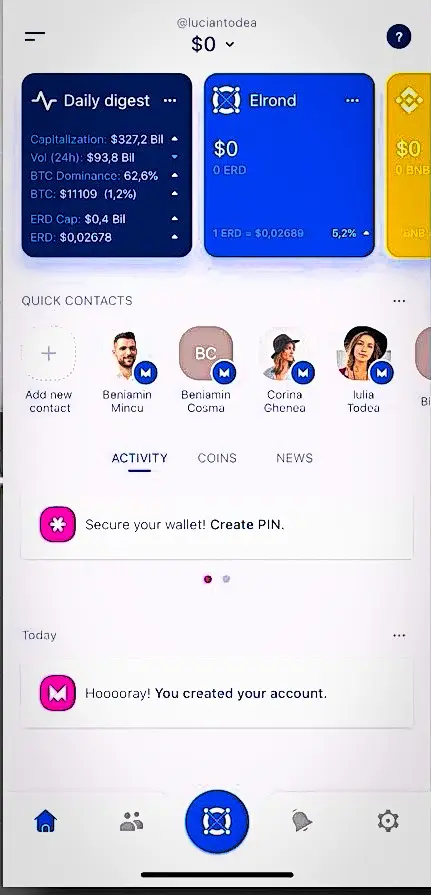
To simplify the user experience Maiar uses phone numbers or user IDs called hero tags instead of wallet addresses to transfer of crypto. This approach streamlines one of the more tedious and risky aspects of crypto transactions. Crypto enthusiasts are comfortable copy-and-pasting wallet addresses and verifying their accuracy, but the process is clunky and likely hinders mass adoption.
Maiar is non-custodial, meaning users create and control their own crypto wallets using the usual passphrase method. It also lets users designate a few trusted contacts who can collectively agree to restore a lost wallet as an alternative recovery method. True to Elrond’s mission statement, Maiar aims to make crypto globally accessible by simplifying transactions and wallet restorations without sacrificing security.
Why Did ERD Became EGLD?
On September 4th, 2020, the long-standing Elrond token (ERD) was swapped to a new eGold (EGLD) standard. The conversion was done at a rate of 1000:1, reducing the total token supply of Elrond from around 200 billion to roughly 20 million. Other changes also put a ceiling on the maximum number of Elrond tokens, capping them at 31 million. Limiting the max supply of EGLD gives them Bitcoin-like scarcity, and increases their desirability as a store of value. However, the switch resulted in a major selloff of EGLD tokens shortly after the conversion.
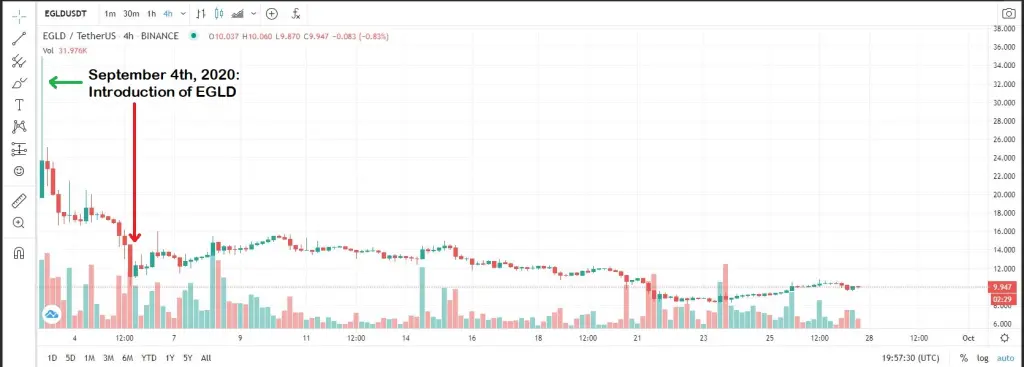
While the short-term price drop of the Elrond token is concerning, the swap was presented as necessary for progress. According to the Elrond site, changing ERD to EGLD “is a prerequisite for the start of the Elrond economy, the integration of more exchanges, staking, delegation, DeFi & others”.
Who is Behind Elrond?
Elrond is driven by a talented team of technology experts, blockchain specialists, and startup gurus. Notable members include:
- Beniamin Mincu – CEO and co-founder of Elrond. Beniamin previously worked with the NEM.io core team and co-founded Metachain Capital.
- Lucian Todea – COO and co-founder of Elrond. Lucian is the creator of Soft32.com, a long time angel investor, and an experienced tech executive.
- Lucian Mincu – CIO and co-founder of Elrond. Lucian formerly worked as an engineer at Uhrenwerk 24, Cetto, and Liebl Systems. He is the co-founder and CTO MetaChain Capital.
- Felix Crisan – Head of Research at Elrond. Felix specializes in payments, telecom, big data, and blockchain. He is the co-founder of Mobilpay.com, NETOPIA System, and BTKO.in.
Elrond is financed by Binance Labs, Maven 11 Capital, Electric Capital, NGC Ventures, and Woodstock. There are a number of companies currently building on Elrond including BetProtocol, ARPA, TailPath, and Nerolabs.
What is the Future of Elrond?
Elrond is a promising project with a few major hurdles in its path. First, the comparatively low market cap of Elrond gives its competitors a significant resource advantage. While some companies rely on star power or name recognition to draw in likely investors, Elrond’s corporate roster is relatively unknown. Recently, the token conversion to EGLD saw short-term price falls of over 50%, posing another challenge for the company to overcome. Elrond could significantly shore up these weaknesses by growing its market cap and forming some strong business partnerships.
Challenges aside, Elrond has accomplished some remarkable things which may pave a path to an incredibly successful future. The Elrond team delivered adaptive sharding, secure proof of stake consensus, and parallel processing two years ahead of Ethereum 2.0. Then, recognizing that their advanced infrastructure is useless without active users, they created Maiar to make crypto accessible to a non-technical audience. Elrond’s dedication to mass adoption is reflected in small details, like renaming the token to “E Gold”. This change was intended to make the concept of crypto intuitive for new users by building upon known terms like email, ebooks, etc.
Overall, Elrond has serious competitive potential. The Elrond testnet has delivered spectacular technical performance. The team has shown that it is laser-focused on its core mission and has a plan for achieving mass adoption. While Elrond is far from being a top ten crypto today it has all the makings of a top tier crypto project.
Further Reading
For more information on Elrond see:
What is Elrond and how important is this project for the blockchain industry