
What is the difference between tactic and strategy? Why do some investors use these terms as the same thing? Why are there successful businesses and others that fail?
Strategy without tactics is useless, but tactics without strategy inevitably lead to defeat.
Japanese proverb
Military strategy is the general approach used by military organizations to try to achieve set objectives.
Military strategy deals with the planning and direction of war campaigns and the movement and strategic disposition of the armed forces. The father of the modern military strategy, Karl von Clausewitz, defined it as "the use of battles to achieve an end to war." He gave priority to political objectives over military objectives, supporting civilian control over military affairs.
In conventional wars, the aim is to direct the troops in the theater of operations until they are brought into the actual battle.
But the strategy is only one of the three variables of the art of war.
The other two are tactics and logistics. All three must work in harmony. When they do, the business is successful.
The tactic consists of the correct execution of the military plans and the maneuvers of the combat forces in the battle. Logistics is concerned with keeping the army perfectly supplied with all the necessary supplies, ensuring its availability and combat capacity.
The military tactic refers to the performance of the commanders and their troops about the enemy and with the missions under their charge. Consider the terrain features, obstacles to movement and visibility, or shelters to use, in favor of rivers, banks, forests, etc.
Thus, the military tactic is an action and the strategy is the design and a series of previous movements.
A person can be a good tactician without being a good strategist, and vice versa. The tactic requires analysis of the enemy, the environmental and geographical conditions, and the scene of the skirmish. That is technical analysis.
Logistics requires a historical study of the provision and existence of resources and their correct distribution in time, form, and quantity.
Strategy requires critical thinking, enemy style analysis, scenario simulation, application of game theory, that is, fundamental analysis.

Image by Amber Clay from Pixabay
Let's look at a couple of examples applied to the crypto-sphere.
Example 1
Strategy: Increase the value of crypto investments by 50% in the next year.
Tactic: carefully analyze which currencies I should incorporate, take out, and exchange, their historical movements, market sentiment, technical indicators in general.
Logistics: make sure you have access to good information and have financial support assigned to the crypto operation, in case you have to buy or sell.
Example 2
Strategy: Go more aggressively into DeFi.
Tactic: analyze the simplest options and progress slowly in complexity.
Logistics: make sure you have ETH and/or BNB to be able to operate and pay for the corresponding gas.
Let's look at a more mundane example.
Example 3
Strategy: Conquer the heart of that woman who drives me crazy.
Tactic: lose weight
Logistics: Making sure you have good healthy food suppliers (and a good wallet full of crypto!)
However. Strategy, tactics, and logistics have an undeniable relationship with the style of financial investors.
There are two clear investing styles, sometimes opposed, although I think they are complementary since one deals with strategy and the other with tactics and logistics. I mean the "fundamental" style and the "technical" style.
Technical analysis is the method of predicting when to buy or sell based on statistical indicators on charts or also signals or figures on them. This technique assumes that any news is reflected in a graph and therefore a careful study of it gives indications of what will happen in the future. It is the typical tactical analysis.
Fundamental analysis is based on the technique of selecting assets, for example, shares of a company based on its financial information. By analyzing the company's assets, sales, profits, and dividends, and above all its growth, fundamentalists seek to arrive at an estimate of its intrinsic value. If the intrinsic value is above the market price it is recommended to buy. The fundamentalist tries not to be swayed by optimism or pessimism and clearly differentiates between the current price of a stock and its true value. It is the typical strategic analysis.
Experience shows that graph analysis is very useful to clearly visualize what has happened or even what is happening, but it tells us little about what will happen in the future.
In any case, what has happened in the past can be useful to us to identify certain interesting things, minimums, maximums, volatility, overbought or oversold, or if the asset is touching a long-term moving average. This information is not enough to invest in, but it can help make decisions such as adding money to a currency, entering or exiting a currency, and the like.
In my particular case, I am more fundamentalist than technical, that is, more strategic than tactical. In no case do I consider technical analysis as a basis for making an investment decision. (For example, the technical analysis clearly says that today I have to buy DOGE, but I would never do a thing like that!). The information of a candlestick chart for me is complimentary, never definitive. It is hard for me to understand the reports of the type "if it breaks the resistance ...", or "if it pierces the support ..." or "what could happen ..." How can decisions be made with so much conditional language?!
But of course, technical analysis should not be discarded, since it can be very interesting to understand history, although never the future. Remember the Japanese proverb from the beginning.
For its part, fundamental analysis is more inaccurate, holistic, heuristic, and dependent on the subject that analyzes, therefore, it is most likely that it will serve him/her more than any other. It is subject to growth expectations that are difficult to test or calculate, and it is very intuitive and instinctive. Fundamental analysis is by no means a guarantee of the success of an investment and is highly influenced by the individual doing the analysis.
I would say that more conservative investors are not attracted to vertigo and so they tend to be more strategists than tacticians, giving every move on the board a lot of thought. On the contrary, risk lovers prefer technical analysis, filling themselves with charts, indicators, and artificial intelligence computer programs to solve thousands of iterations, before making a decision, which usually does not meet the expectations of the start.

Image by Sébastien Lavaux from Pixabay
We always come to the idea that it is best to take advantage of the best of both worlds. It is not bad to train with a chessboard and at the same time, study some typical patterns of the candlestick charts or the meaning of indicators such as RSI, which are used so much by technicians. Ultimately, it's about learning, and in crypto, we're all still in elementary school.
With that said, let's move on to today's two tokens.
HT
Ranking CoinGecko #47
One set of tokens that have been surging since early 2021 are exchange tokens. The top four exchanges that make them stand out and attractive compared to their competitors are BNB, HT, FTT, and OKB.
Exchanges are major players in the crypto sphere. Many of them offer native tokens, so their operators can benefit from additional features. Huobi Token (HT) from the Huobi exchange is one of the most successful tokens.
In a process called IEO (Initial Exchange Offering), some exchanges offer seed tokens to raise funds for their operations. Others, like Huobi, launch their token after a few years of operation to offer better options to their users.
HT was launched in 2018, it is the official ERC-20 token of Huobi Group and has a limited supply of 500M. HT holders benefit from multiple features and options, such as discounts on commercial rates. In addition, Huobi Group offers many types of applications for hodlers to use their HTs in them.
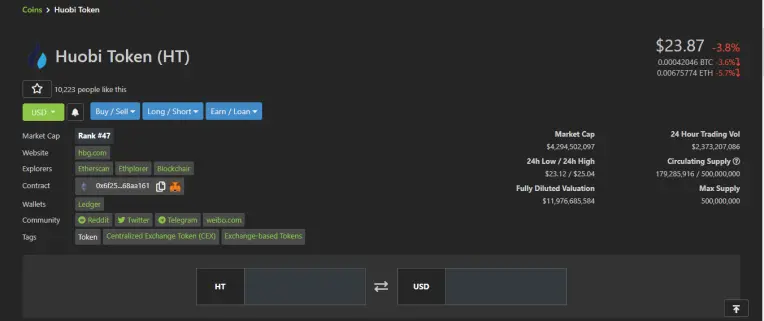
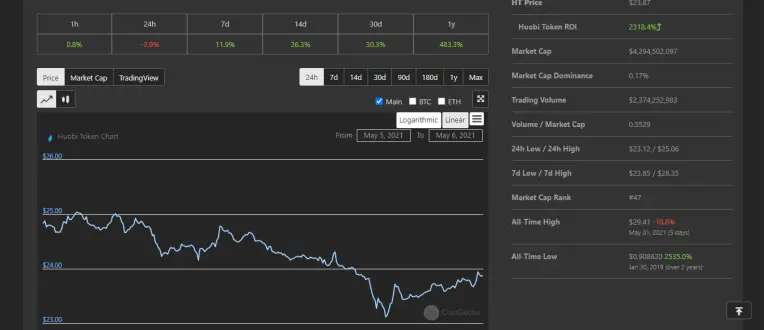
The group has given away 300 Million HT for free to those users who bought "point cards". The remaining HT will be used as rewards for the user and will fuel the operation of the platform. The buyback and destruction of HT help maintain the 500 million HT limit. The group will use 20% of Huobi Contract's revenue and 20% of Huobi Global's revenue to buy back and destroy HT.
Huobi launched its own blockchain inhabited by the HT cryptocurrency. This blockchain uses a variation of the Delegated Proof-of-Stake (DPoS) consensus algorithm. The blockchain offers a wide variety of services and it is being developed to support different crypto assets as well as allow interoperability between chains. The blockchain is also designed to be able to create and execute smart contracts, as well as create sidechains.
A feature called FastTrack was launched in 2019, a service that provides the opportunity to vote for hodlers. They can, for example, vote on the inclusion of new tokens and cryptocurrencies on the exchange. The winning candidate will appear on the exchange, and those who voted for that project can "exchange for a certain number of tokens at a discounted price," according to Huobi Global. The platform uses all FastTrack earnings in the buyback and destruction process.
HT holders also receive exclusive options from Huobi Global. They can become a Huobi VIP and benefit from the multiple features of that option by having 160,000 USDT HT equivalents. Huobi supports HT Cross Margin escrow. Therefore, HT holders have a straightforward process to deposit their tokens and borrow other coins. Some discounts on trading fees can be critical for traders, so many of them are constantly looking for discounts on those fees. The default trading fee for spot trading on the Huobi exchange is 0.2%. HT token holders can enjoy a discount by simply depositing HT to their account. The first level of HT deduction for them is 10% which will reduce the trading fee to 0.18%. The discount rate increases based on the user's HT retention level and goes up to 90% for professional users with 2000 HT or more.
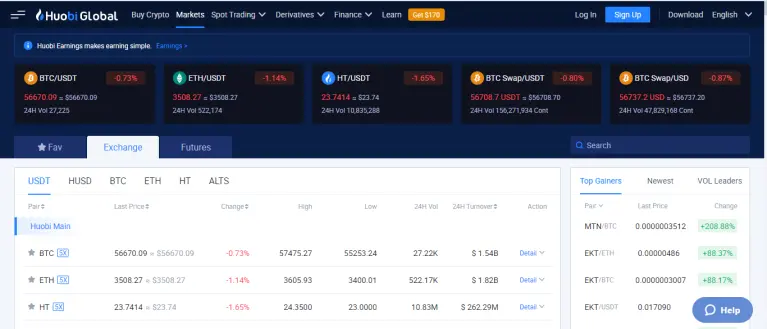
Source
Huobi offers blocking and mining options for HT holders. They can block HT for a preferred period of time (7 days, 30 days, 60 days, and 90 days). You have to block 100 HT at least to start mining. User-selected HT retention will be locked for the chosen period of time. Once the mining contract expires, the obtained HT is available to transfer to the account and trade regularly.
Huobi Token has some similarities and differences from other famous cryptocurrency exchange tokens like BNB. Some of the exchange tokens are required for trading, but HT is not. Huobi Token is more focused on improving the user experience and the satisfaction of traders. By offering multiple rewards and options such as mining, discounted trading fees, VIP membership, and even discount eligibility, Huobi proves to strive to make its platform attractive and grow its ecosystem.
Leon Li founded Huobi Exchange in China in 2013. After some government restrictions, he registered the exchange in Singapore, but the Chinese branch is still active as a blockchain research and consulting company.
Huobi now acts as a holding company called Huobi Global with offices in Hong Kong, Korea, Japan and the United States. It became a publicly traded company in 2018 in Hong Kong and is now one of the largest cryptocurrency exchanges in the world.
Conclusion. The cryptocurrency exchange token is becoming crucial in the cryptocurrency industry. It provides additional benefits to users, and some of them are now among the top cryptocurrencies with regard to market capitalization. I think we're going to see a good exchange token battle anytime soon. The undisputed leadership today is BNB, but HT comes close. Everything will depend on the seduction that exchanges can exert on traders. The battle will be according to the benefits, discounts and additional services that the exchanges provide. Also of course of the amount of currencies that they offer to operate. Huobi has recently stood out as one of the few exchanges that can be traded with FORTH, Ampleforth's governance token that was made famous last month by the airdrop that greatly benefited AMPL hodlers. That made it stand out and I think it gave it an extra score. But the battle is just beginning. There are many exchanges that compete with King Binance and so we are in the presence of the battle of creativity. Welcome to the cryptosphere.
BTT
https://www.bittorrent.com/token/btt/
Ranking CoinGecko #39
BTT is a TRC-10 token, built on the TRON platform. It is designed to integrate with the BitTorrent protocol, which was launched in 2001. BitTorrent was one of the first decentralized networks on the Internet, and it remains one of the most popular, with more than 100 million monthly users. BTT was created with the goal of tokenizing BitTorrent.
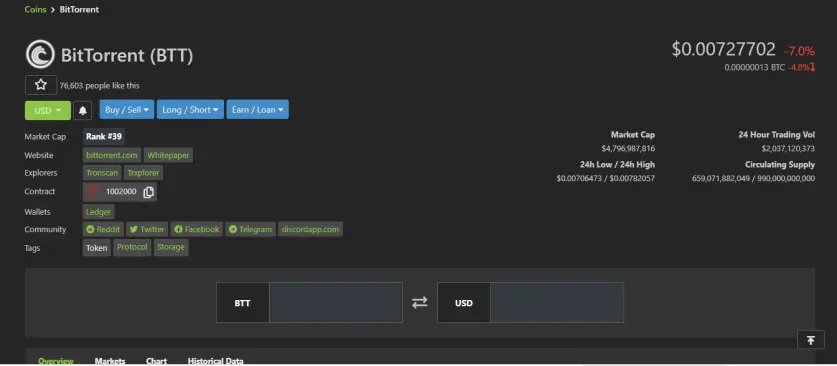
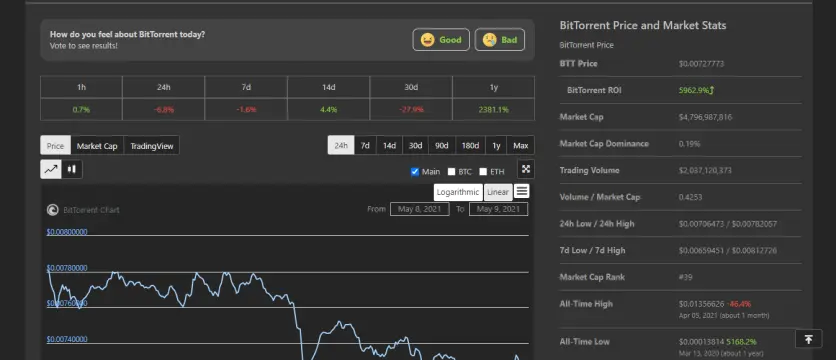
The fundamental reason for a cryptocurrency to exist in the BitTorrent ecosystem is related to the fact that the effectiveness of the protocol is limited, since the seeds are leaving the ecosystem and if they are not incentivized to store files on their computers, the platform will not stay afloat. Many app users, including BitTorrent users, are reluctant to pay for virtual items with fiat money.
BitTorrent Inc. was founded in 2001 by Bram Cohen, a prominent American software engineer, and became one of the first (and now largest) file-sharing sites on the web. BitTorrent works on a decentralized peer-to-peer protocol, allowing several hundred million users to upload and download any file. Large and bulky files are divided into chunks and sent to the recipient over the network, still in the form of chunks, which are then repaired on the recipient's computer. Each user who downloads a file automatically becomes part of the ecosystem and becomes a seed.
Seeds and pairs are the two roles that a user can play on the BitTorrent platform. A seed is a person who shares the complete copy of the file and a colleague receives the requested file in parts. A user remains a seed until he/she has the file on his/her computer and connects to the Internet.
About 20% of all global upstream traffic and 3% of global downstream traffic is related in some way to BitTorrent.
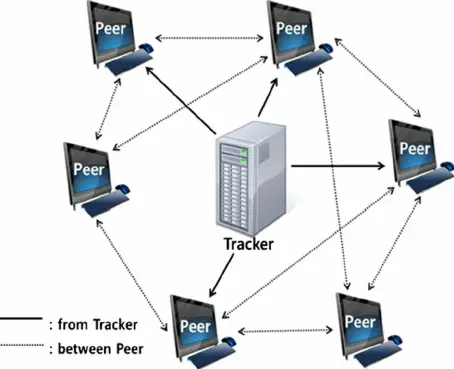
Source
In July 2018, Justin Sun, the founder of the Tron Foundation (TRX) cryptocurrency project, bought BitTorrent Inc. for $ 127 million. Bram Cohen, founder of BitTorrent, refused to continue participating in the project, although Sun offered him that opportunity. In January 2019, Tron held an ICO for the BTT token and raised a staggering $ 7.2 million, selling 60 billion BTTs in a matter of minutes. Those who bought the coin during the crowd sale made a real profit of 800%.
Users who share the full copy of the files stored on their computers (seeds) are rewarded with BTT tokens. They are not required to buy expensive and sophisticated equipment or sign a mining agreement. Users are paid for the mere storage of a file on their computer. You can download a copy of a book or movie on your laptop and earn crypto for sharing it with others. However, you would have to store a lot of those files to get a remarkable amount of BTT tokens.
BitTorrent is traded on all popular exchanges on various market pairs (it has been on Binance since January 2019). You can buy it with TRX coins, other cryptocurrencies, or fiat money. BitTorrent does not have its own wallets. You can use any wallet that is compatible with TRX coins to store your BTT tokens. You can also store and exchange your BTT tokens in any other Tron compatible wallet, such as Huobi Wallet, Trust Wallet, Exodus, Gate.io, etc.
BitTorrent is rumored to cooperate with Netflix, Amazon, and possibly Spotify in 2021. Many experts believe that BTT has a bright future ahead of it and that it will break into the top 10 most popular global cryptocurrencies in the next five years.
The BitTorrent development team is now part of the Tron Foundation. Nineteen people working on the project; twelve of them are developers. Justin Sun is currently the CEO of BitTorrent. Marcus Zhao is the head of the public chain. The main product designer is Pavel Lagutin.
Today, the main purpose of the BitTorrent token is to encourage users to don’t delete downloaded files from their PC and continue to distribute them. They can spend their tokens within the ecosystem and buy licensed content or pay for streams.
Conclusion. The future of BTT looks bright, as BitTorrent is said to cooperate with Amazon, Netflix, and possibly Spotify in 2021, inevitably increasing its price. Some specialists in the crypto industry see this coin in the Top 10 in the coming years. However, many are equally skeptical about BTT, suggesting that the token's trading success could simply be due to a baseless speculative bomb. Questions have been raised about the usefulness and practicality of the token, and there are obvious legal concerns in trying to monetize the theft of intellectual property that is at the heart of BitTorrent.
As if that were not enough, there is also the subject of the eternally controversial Justin Sun. I already talked about this boy in a previous post. Justin Sun has the uncanny ability to create a stir every time he does something or opens his mouth.
For example, Sun got into a fight with Vitalik Buterin on Twitter, saying that Tron's capabilities far exceeded Ethererum's. Sun's incredibly flawed comparison earned it a lot of criticism, both from Tron users and other industry figures. Buterin himself accused Sun of copying the Ethereum whitepaper, an allegation that follows the project to this day.
In 2019, Sun paid $ 4.5 million in a charity auction for the opportunity to have lunch with legendary investor and Berkshire Hathaway CEO Warren Buffett, stating that he wanted to be the first person to get Warren to invest in crypto. Sun invited US President Donald Trump and other industry leaders to have lunch with him, but postponed the whole thing two days before it was supposed to take place due to "health reasons." The cancellation was met with widespread criticism and ridicule in the Tron community, particularly in China. Rumors began to circulate that Sun could not leave China due to an "exit ban" imposed by the government. However, the Tron Foundation denied these claims, saying Sun was recovering from kidney stones at her San Francisco home. But amid the controversy, Sun was photographed at a party for his company.
There is also the controversial issue of Steemit. With a dubious deal, the Tron Foundation acquired Steemit, the most important dApp on the Steem blockchain. In March 2020, members of the Steem community, viewing the acquisition as a hostile takeover, forked the network to create HIVE, an almost exact replica, except that the tokens linked to Justin Sun and Tron were immediately confiscated. In May, Tron's side retaliated by forking Steem again and seizing tokens belonging to 64 people involved in the creation of HIVE.
Justin Sun is one of the richest entrepreneurs in the cryptocurrency industry, his net worth is believed to be between $ 200- $ 400 million. It was included in the Forbes 30 under 30 Asia list of 2017. It also appeared on the Forbes 30 Under 30 China list three years in a row in 2015, 2016 and 2017. But, with the BTT token in the hands of this character, any fundamental analysis is useless . I think BTT could be an excellent project. I have the doubt about the management.
As usual, none of the things written in this post are financial advice and are not intended to replace personal research.
Thank you for reading!
If you have any questions or comments, please feel free to leave them down below
You can also contact me at [email protected]
You can also follow me on






