
It's been said countless times that Bitcoin is the way to save your dollars from inflation - or hyper-inflation, as many call it (despite they have no idea about what hyper-inflation is). Is, however, inflation related in any way with currency valuation? The case of El Salvador provides all the answers.
El Salvador
The country is officially using the US Dollar since 2001, as their national currency. They have no control on how the dollar is valued, they have no control on the US monetary policy, and they cannot print a single US Dollar themselves. If inflation was related to currency, or vice-versa, inflation in the US would be identical, or almost identical to that in El Salvador. Guess what? It isn't!
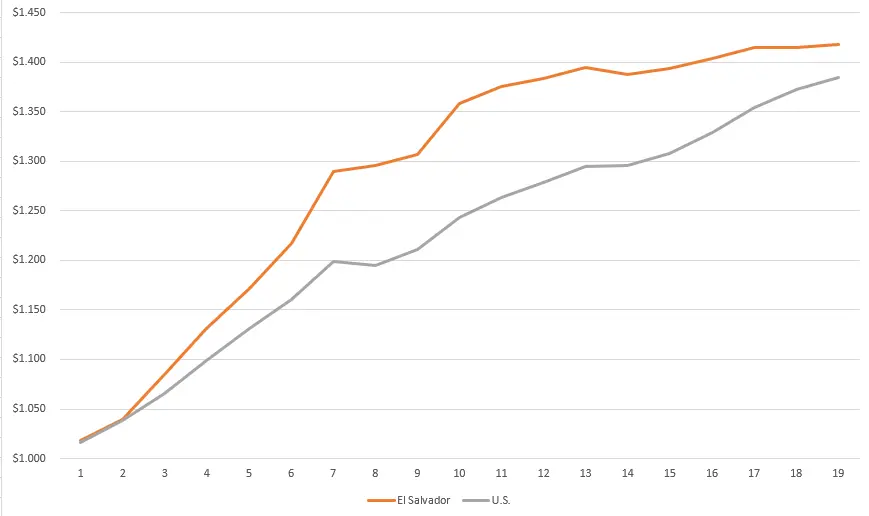
A 2001 US Dollar in the United States would worth today the equivalent of $1.38, while the same 2001 US Dollar would worth today the equivalent of $1.42. The gap is most profound when the year 2015 is examined, when a 2001 US Dollar would worth the equivalent of $1.30 in the United States, but $1.39 in El Salvador. Same currency, different economies.
Would the inflation be worse, if El Salvador had kept using their own national currency? The answer is: probably. Printing money is the easy solution to most governments, since most politicians are as financially illiterate as their voters. And Bitcoin was introduced as legal tender in El Salvador, to make it easier to Salvatorians living abroad to send money to Salvatorians living in El Salvador, not to stop inflation. This may be a financially disastrous decision, though, since fresh flow of US Dollars (in he form of Bitcoin) in El Salvador, will only boost inflation rates, if it goes out of control.
Bitcoin is neither money, nor currency
Although Bitcoin is called a crypto-currency, it actually is not. Currencies are used to measure economic output in any given economy. The problem is that there is no economy based or measured using Bitcoin. The only 'economy' you can find - counting out illegal activities - where Bitcoin is used, is the business of creating, buying, and selling Bitcoin itself. None of those businesses though keep their books in Bitcoin, or paying their employees a stable amount of Bitcoins per year. Why? Because nobody is using Bitcoin as money. They use it as investment.
But even so, Bitcoin cannot be compared to an investment in real assets, such as shares in a company that is creating real value. Take Tesla for example:
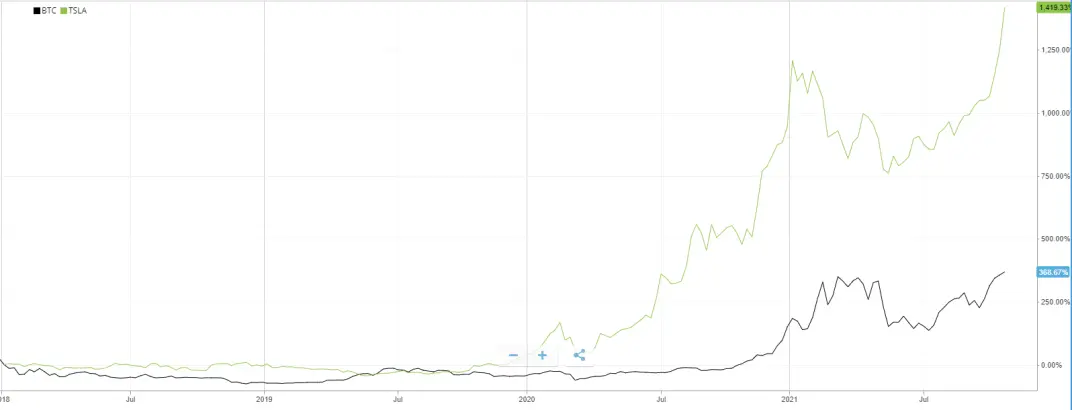
If you had bought Bitcoin valued $1,000, on January 2, 2018, your investment today would worth $3,687. If you had bought Tesla stock on the same date, your investment today would worth $14,193.
Even the most popular digital thin air thing, cannot beat in valuation the stock of a promising, money generating, company.
Disclaimer: None of the above is to be used to buy, sell, or hold any of the assets mentioned in this article. Always consult a licensed financial advisor.






