
After years of decline, the index effect is surging again, fueled by passive funds, market psychology, and recent stock spikes.
For decades, getting added to the U.S benchmark index S&P 500 has been like receiving a golden ticket to the world’s largest capital stage. It’s not uncommon to see a company's stock price spike immediately after inclusion is announced, fueled by a tidal wave of buying from passive funds and institutional investors. But while this so-called "S&P 500 Inclusion Effect" was once a predictable boon for newly inducted companies, its impact had faded in the last decade.
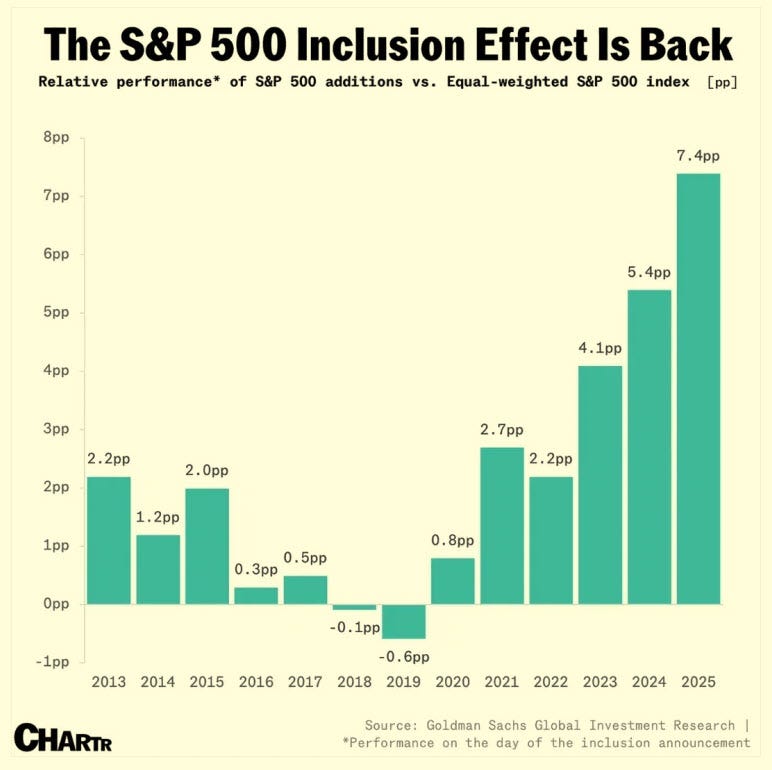
However, recent examples, such as Block’s 10% surge and Datadog’s 15% jump following their respective S&P 500 inclusions, signal the narrative is shifting again. Goldman Sachs data (chart below) now shows that this once-diminishing phenomenon is not only back but stronger than it’s been in over a decade.
What is the S&P 500 Inclusion Effect?
The S&P 500 Inclusion Effect refers to the consistent bump in stock prices experienced by companies upon being added to the S&P 500 index. Historically, this boost came from the sudden influx of buying activity by passive investment vehicles like index funds and ETFs, which collectively manage over $13 trillion in assets.
Since these funds are mandated to mirror the S&P 500, they must buy shares of any company added to the index, regardless of the stock's price at the time. Add to this the psychological weight of being included in such a prestigious benchmark, and it's easy to see why the inclusion effect has long been seen as a lucrative milestone for any company.
The 2010s Slowdown
However, this automatic bump didn’t last forever. A 2023 Harvard study found that the average return on the day of inclusion plummeted from 9.4% in the 1990s to just 0.8% by the late 2010s. This steep drop puzzled many investors, but researchers suggested two key factors behind it:
-
Market Efficiency: Over time, investors and algorithms became much better at predicting which companies were likely to be added to the index. When something is widely anticipated, much of the upside gets priced in before the official announcement.
-
Liquidity and Trading Innovation: Advancements in trading and improvements in market structure allowed funds to absorb inclusion-related shocks more gracefully, reducing the volatility that once accompanied these announcements.
From 2016 to 2020, the effect was particularly muted. According to the chart, which tracks the relative performance of S&P 500 additions vs. the equal-weighted S&P 500 index, inclusion bumps were practically negligible or even negative in some years. For instance, 2018 saw a decline of -0.1 percentage points, while in 2019 it dipped even further to -0.6pp. These numbers reflect a time when being added to the S&P 500 no longer guaranteed a significant market reaction.
Inclusion Effect Reborn
Yet something changed in the early 2020s. Goldman Sachs' latest analysis reveals that the S&P 500 Inclusion Effect has been making a robust comeback. The data shows a sharp rebound in relative performance on announcement day:
-
2021: +2.7pp
-
2022: +2.2pp
-
2023: +4.1pp
-
2024: +5.4pp
-
2025 (so far): +7.4pp
This five-year uptrend suggests a strong return of the inclusion effect, with performance levels approaching those of the 1990s. So, what’s behind this revival?
Drivers of the Comeback
-
Rising Passive Investment Dominance
With over $20 trillion in global assets now linked to the S&P 500, the mechanical buying pressure from passive strategies is stronger than ever. This provides a larger and more immediate demand shock when a new company is added to the index. -
Tighter Supply of High-Quality Stocks
As capital floods into passive strategies and index-focused portfolios, the number of new, high-quality entrants eligible for S&P 500 inclusion remains limited. This makes each addition more impactful and unique, leading to exaggerated price reactions. -
Retail and Algorithmic Amplification
Today's market environment is more reflexive. Algorithmic traders often latch onto inclusion news within seconds, and retail investors—many of whom monitor financial news through social platforms—are quicker to jump into names getting major visibility boosts. -
Broader Market Sentiment
The inclusion effect’s strength may also be partially driven by investor psychology in a market increasingly focused on narratives. Being added to the S&P 500 isn't just a structural change—it’s a signal of maturity, stability, and long-term viability.
In 2025, Block Inc. (formerly Square) and Datadog became standout examples of how S&P 500 inclusion can trigger dramatic market moves. Block jumped 10% on the day its addition was made public, while Datadog saw a 15% surge following a similar announcement. These sharp gains highlight a resurgent investor appetite for companies joining the index, driven not just by mechanical buying from index funds but also by the heightened perception of legitimacy and long-term value associated with S&P 500 membership.
Is the Effect Here to Stay?
While it's tempting to believe the S&P 500 Inclusion Effect is back for good, it’s worth treating these developments with cautious optimism. Markets evolve, and so do investor behaviors. A few years of resurgence don’t necessarily indicate a permanent shift.
That said, the resurgence does reflect some underlying structural truths:
-
Passive investing is not slowing down.
-
Benchmark-linked buying pressure is becoming more potent.
-
Public markets still highly value symbolic milestones like S&P 500 inclusion.
More Than Just a Mechanical Move
The resurgence of the S&P 500 Inclusion Effect is a reminder that psychology, structure, and capital flows all intersect in today’s markets. While the effect may wax and wane over time, its current revival speaks volumes about the growing power of passive investment, the premium placed on legitimacy, and the dynamics of modern capital markets.
For investors, the key takeaway is this: Inclusion in the S&P 500 still matters—and perhaps more than it has in years. Whether this trend continues or fades once again will likely depend on how predictable these additions become and how efficiently markets adjust. For now, though, being added to the S&P 500 is once again proving to be a fast track to market momentum.
Originally Published on Substack.








