
As markets tumble under tariff pressures, gold reasserts its ancient dominance over Bitcoin in the battle of risk hedges.
In the past 48 hours, financial markets have plunged into chaos following the announcement of sweeping U.S. tariffs. What began as a ripple of concern swiftly morphed into a full-blown sell-off, leaving major stock indices reeling. The Dow Jones Industrial Average plummeted by over 2,200 points in a single day today, compounding the losses of the previous session.
The S&P 500 and the Nasdaq Composite followed suit, each registering its most significant daily declines since the height of the COVID-19 pandemic in March 2020. While Dow and the S&P 500 are firmly in correction territory, Nasdaq has already entered the bear market (over 20% losses from the recent high). This abrupt shift underscores the profound unease permeating investor sentiment as the specter of a global trade war looms large.
Gold Shines Brighter Than Bitcoin
Amidst this equity market carnage, Bitcoin, the flagship cryptocurrency, offered some semblance of resilience. While not entirely immune to the risk-off sentiment, Bitcoin's decline was notably less severe than that of traditional stocks. This relative outperformance could be attributed to the nascent, but increasingly clearer, regulatory landscape emerging for digital assets, providing a degree of certainty that traditional equities currently lack in the face of unpredictable trade policies.
However, while Bitcoin held its ground better than equities, it has been decisively outperformed by gold, the time-honored safe-haven asset, in this extreme risk-off environment. Gold’s outperformance can be attributed to its historical role as a store of value during times of crisis. Unlike Bitcoin, which remains a relatively new and volatile asset class, gold has a centuries-long track record of preserving wealth in the face of inflation, currency devaluation, and geopolitical uncertainty.
The current market environment, characterized by U.S. tariffs and mounting geopolitical risks that threaten to exacerbate inflationary pressures, has only amplified gold’s appeal. Investors are seeking assets that can reliably protect their purchasing power, and gold’s tangible nature and lack of counterparty risk make it a natural choice.
The Correlation Shift
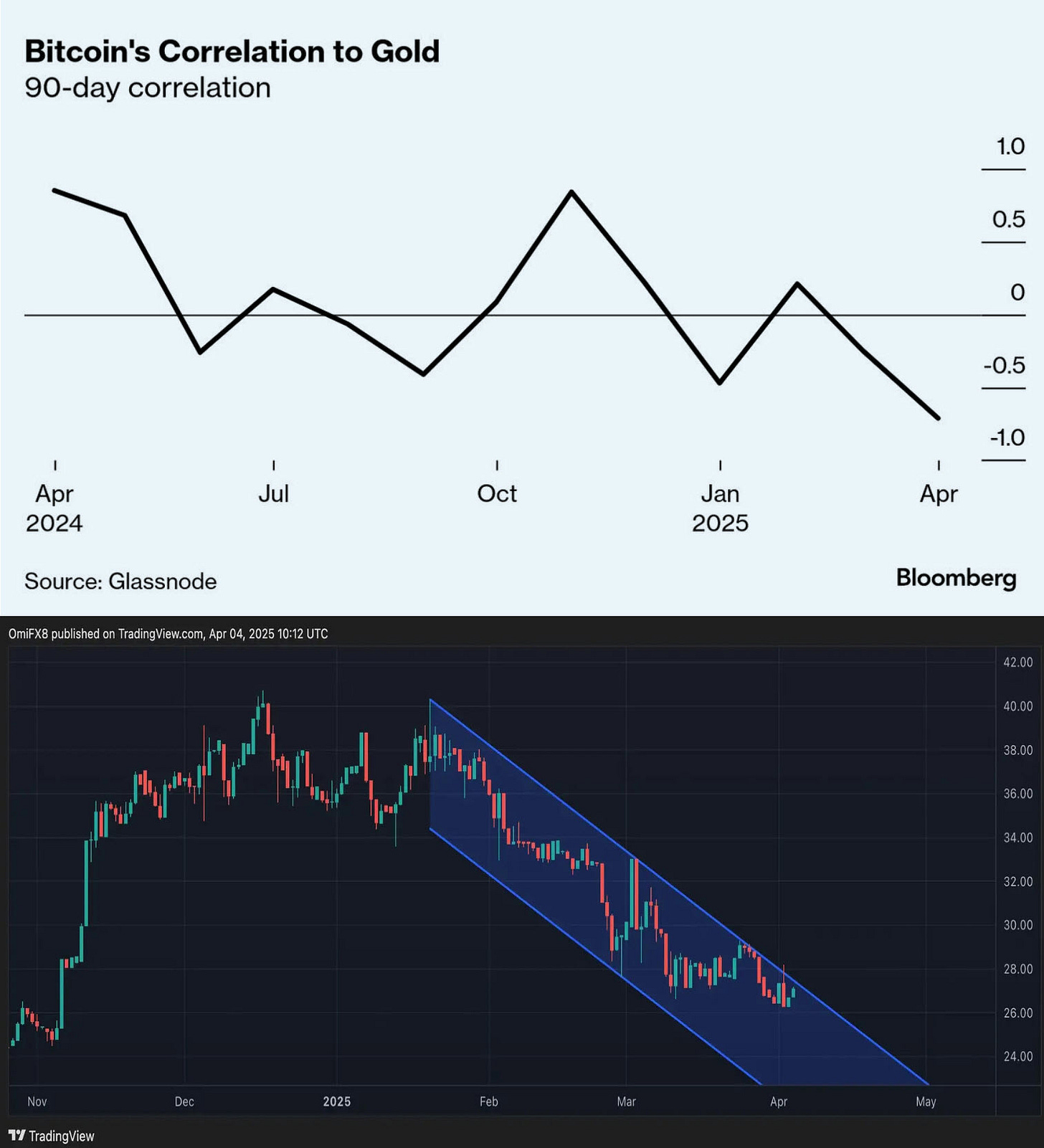
The Bloomberg chart (below) tracking Bitcoin's 90-day correlation to gold reveals a telling story about their relationship as inflation hedges. Since April 2024, this correlation has fluctuated dramatically, moving from strongly positive (around 0.7) to deeply negative (approaching -0.8) by April 2025.
This pattern suggests these assets respond differently to market stressors, particularly during crisis periods. The correlation data shows a notable divergence beginning in late 2024, with the relationship turning increasingly negative through early 2025. This negative correlation reached its nadir in April 2025, precisely when investors needed risk protection most urgently.
BTC-Gold Ratio Decline
The second chart, displaying price action from TradingView, further illustrates Bitcoin's underperformance relative to gold in recent months. While Bitcoin has been trapped in a consistent downward channel since January 2025 (as indicated by the blue trend lines), gold prices have surged. The steep decline from roughly 40.00 to below 28.00 on the Bitcoin-Gold ratio chart demonstrates gold's significant outperformance during this period of heightened market stress.
As U.S. tariff announcements triggered panic across financial markets, gold fulfilled its historical role as the ultimate safe haven. Investors flocked to the precious metal, driving its price up substantially while Bitcoin continued its downward trajectory within its established channel. This divergence underscores gold's enduring appeal during extreme risk-off environments.
Evaluating Hedges Against Risk
The current market conditions provide a valuable case study for evaluating different inflation hedges. While Bitcoin has been promoted as "digital gold" and a potential store of value during inflationary periods, the recent market behavior suggests it hasn't yet achieved the same safe-haven status as its physical counterpart. Gold's millennia-long history as a reliable store of value continues to make it the preferred refuge during times of acute market stress and inflation concerns.
Bitcoin's correlation to gold, which has now turned strongly negative (approaching -0.8), indicates these assets are currently moving in opposite directions. This negative relationship suggests that despite Bitcoin's potential as an alternative investment, it may still behave more like a risk asset than a reliable inflation hedge during periods of extreme market volatility.
As financial markets navigate the implications of U.S. tariffs and resulting economic uncertainty, the divergent performances of gold and Bitcoin provide important insights for investors seeking protection against inflation and market volatility. While Bitcoin continues to evolve as an asset class, gold's performance during this recent market turmoil reinforces its status as the premier safe-haven asset when economic conditions deteriorate rapidly.
Originally published on Substack.






