
Both gold and Bitcoin are seeing inflows, but gold is leading with its strongest surge of ETF inflows of the year, signaling a powerful return of hard assets.
In the ever-shifting landscape of global finance, investors are once again turning toward hard assets. Gold and Bitcoin, two of the most closely watched alternatives to traditional financial instruments, are attracting significant inflows. Yet the latest data suggests one is pulling ahead: gold is outpacing Bitcoin.
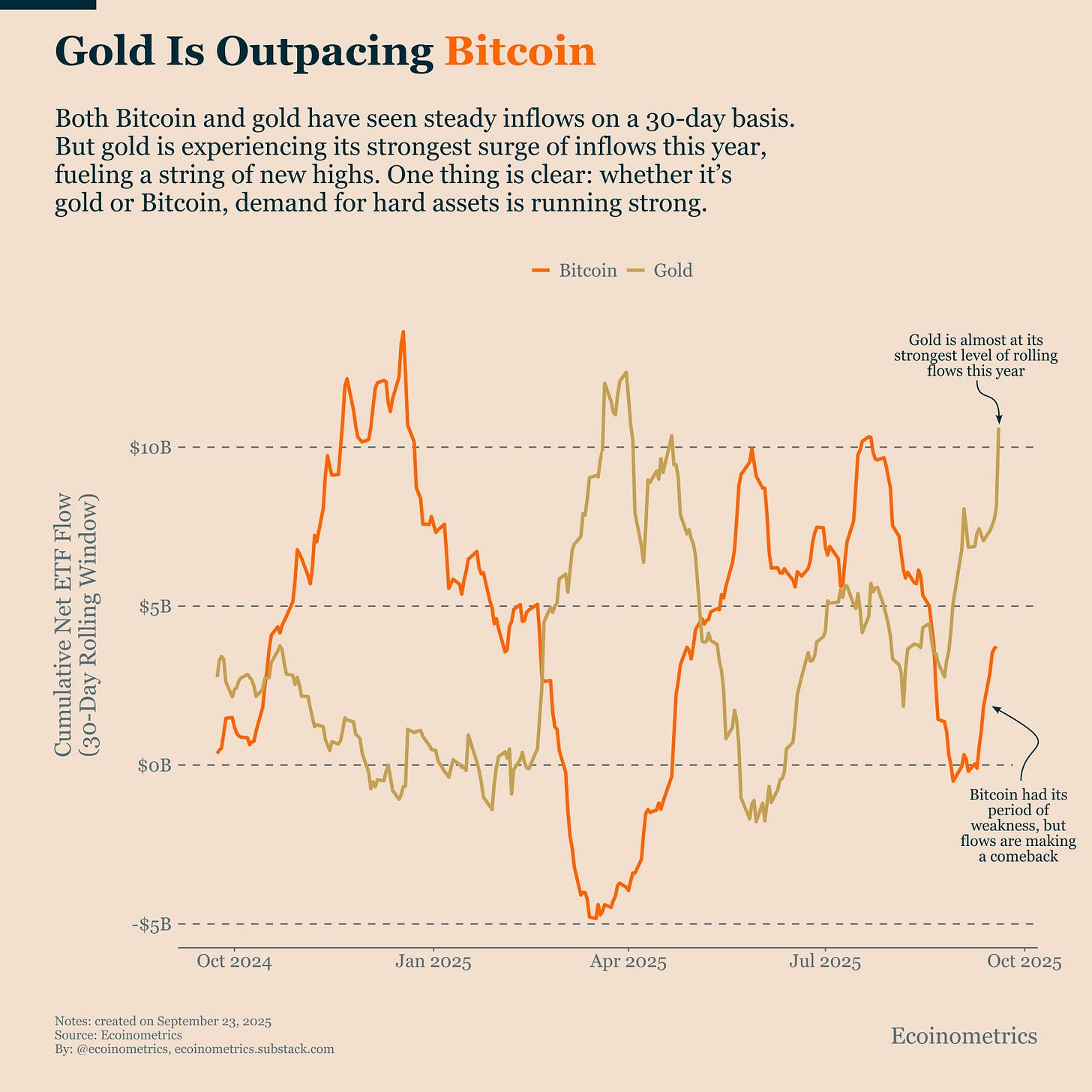
According to data from Ecoinometrics (chart below), both gold and Bitcoin exchange-traded funds (ETFs) have seen steady inflows on a 30-day rolling basis throughout 2025. However, gold has surged in recent months, experiencing its strongest inflows of the year. This momentum has pushed the yellow metal close to record levels of cumulative ETF buying, highlighting the renewed appetite for tangible, historically trusted assets.
Bitcoin, by contrast, has been more volatile, experiencing strong gains earlier in the year, followed by a period of weakness, and now making a modest comeback. The bigger picture is clear: demand for hard assets is running strong, and the macroeconomic environment suggests that this trend is unlikely to fade anytime soon.
The Case for Gold’s Outperformance
Gold’s resurgence in 2025 is not happening in isolation. The surge in ETF inflows comes amid a broader market environment characterized by three interlinked factors: monetary policy easing, economic uncertainty, and persistent inflation concerns.
First, the Federal Reserve has signaled more rate cuts ahead, citing slowing job growth and the need to stimulate investment. Historically, lower interest rates reduce the opportunity cost of holding non-yielding assets like gold, making it more attractive to institutional and retail investors alike. As rates move lower, gold tends to benefit, often acting as a hedge against both inflationary risks and monetary debasement.
Second, geopolitical and economic uncertainty remain central drivers. From trade tensions to global supply chain realignments, investors have been drawn to gold’s centuries-long reputation as a store of value. The fact that ETF inflows are surging confirms that demand is not just speculative—it is structural.
Third, inflation expectations are still elevated compared to pre-pandemic norms. While consumer price growth has moderated from its 2022 peaks, many investors remain skeptical that inflation will stabilize at the Federal Reserve’s 2% target. Gold, as a traditional hedge against inflation, remains a preferred allocation in portfolios aiming to preserve purchasing power.
The chart illustrates these dynamics vividly: by September 2025, gold ETF inflows were nearing their strongest rolling levels of the year, pushing cumulative inflows above $10 billion at times. This steady climb underscores the strength of conviction behind gold allocations.
Bitcoin’s Volatility: A Comeback in Progress
Bitcoin tells a more complex story. Inflows into Bitcoin ETFs surged dramatically in late 2024 and early 2025, briefly outpacing gold and highlighting the enthusiasm around crypto-based investment vehicles. Yet by the spring of 2025, Bitcoin ETF flows fell into negative territory, reflecting both market corrections and investor hesitation.
The reasons for this volatility are multifaceted. Bitcoin remains far more sensitive to regulatory developments, liquidity cycles, and investor sentiment than gold. While the launch and growth of spot Bitcoin ETFs in the U.S. and abroad have broadened access, the asset class remains vulnerable to sharp swings tied to broader market risk appetite.
That said, the recent data shows Bitcoin ETF inflows staging a modest recovery heading into the final quarter of 2025. While still lagging gold in cumulative strength, Bitcoin’s resilience suggests that it continues to hold a firm place in the modern portfolio, especially for investors seeking higher-risk, higher-reward exposure to digital assets.
The divergence between gold and Bitcoin ETF flows may reflect a simple reality: gold is still the safer choice for institutional allocations, while Bitcoin remains a more risk-on play.
Hard Assets and the Federal Reserve Factor
The common denominator uniting both assets is the broader investor demand for hard assets. With the Federal Reserve expected to continue cutting interest rates, liquidity is being injected back into the system. This dynamic tends to weaken the U.S. dollar and lower yields on government bonds, creating a favorable environment for both gold and Bitcoin.
In fact, one might argue that the real story is not about gold versus Bitcoin, but rather gold and Bitcoin. Together, they represent a reallocation trend away from traditional assets—equities that are vulnerable to slower earnings growth, and bonds offering diminished yields—toward alternatives that promise either stability (gold) or asymmetric upside (Bitcoin). As the data suggests, whether it is digital gold or the real thing, demand for hard assets has rarely been this strong.
Looking Ahead: Complementary, Not Competing
The debate over whether gold or Bitcoin is the superior asset often misses the point. While both attract comparisons as “stores of value,” their roles in the investment landscape are distinct. Gold remains a universal hedge, with millennia of history behind it, while Bitcoin is still establishing its role as a digital counterpart, a volatile but increasingly institutionalized asset.
For investors, the lesson may be diversification. Gold’s relative stability and Bitcoin’s potential upside can complement one another in a portfolio. As central banks pivot to looser monetary policy and investors look for ways to shield themselves from both inflation and volatility, the demand for hard assets is likely to remain robust. The latest ETF data confirms what markets have sensed all year: gold may be outpacing Bitcoin right now, but both are riding the same underlying wave of demand.
What’s Next?
Gold’s surge to near-record inflows reflects investors’ enduring trust in the metal as a safe haven. Bitcoin, despite setbacks, continues to draw capital and remains a critical part of the hard-asset narrative. Together, they underscore a broader shift in investor psychology: skepticism toward fiat stability, heightened awareness of geopolitical risks, and recognition of the need for inflation hedges.
With the Federal Reserve signaling further rate cuts, the stage is set for continued inflows into both assets. Whether one favors the timeless shine of gold or the digital allure of Bitcoin, the message is unmistakable: hard assets are back in the spotlight.
Originally Published on Substack.






