
From Rust Belt to Silicon Shield, America’s manufacturing evolution story offers a glimpse into the future of the U.S economy.
The industrial landscape of the United States is undergoing a stark transformation. Recent data reveals a striking divergence - while the production of semiconductors and other electronic components has surged to unprecedented levels, total U.S. manufacturing output has largely stagnated. This disparity underscores the challenges and opportunities faced by the U.S. economy as it shifts away from traditional manufacturing toward high-tech industries.
Understanding Data
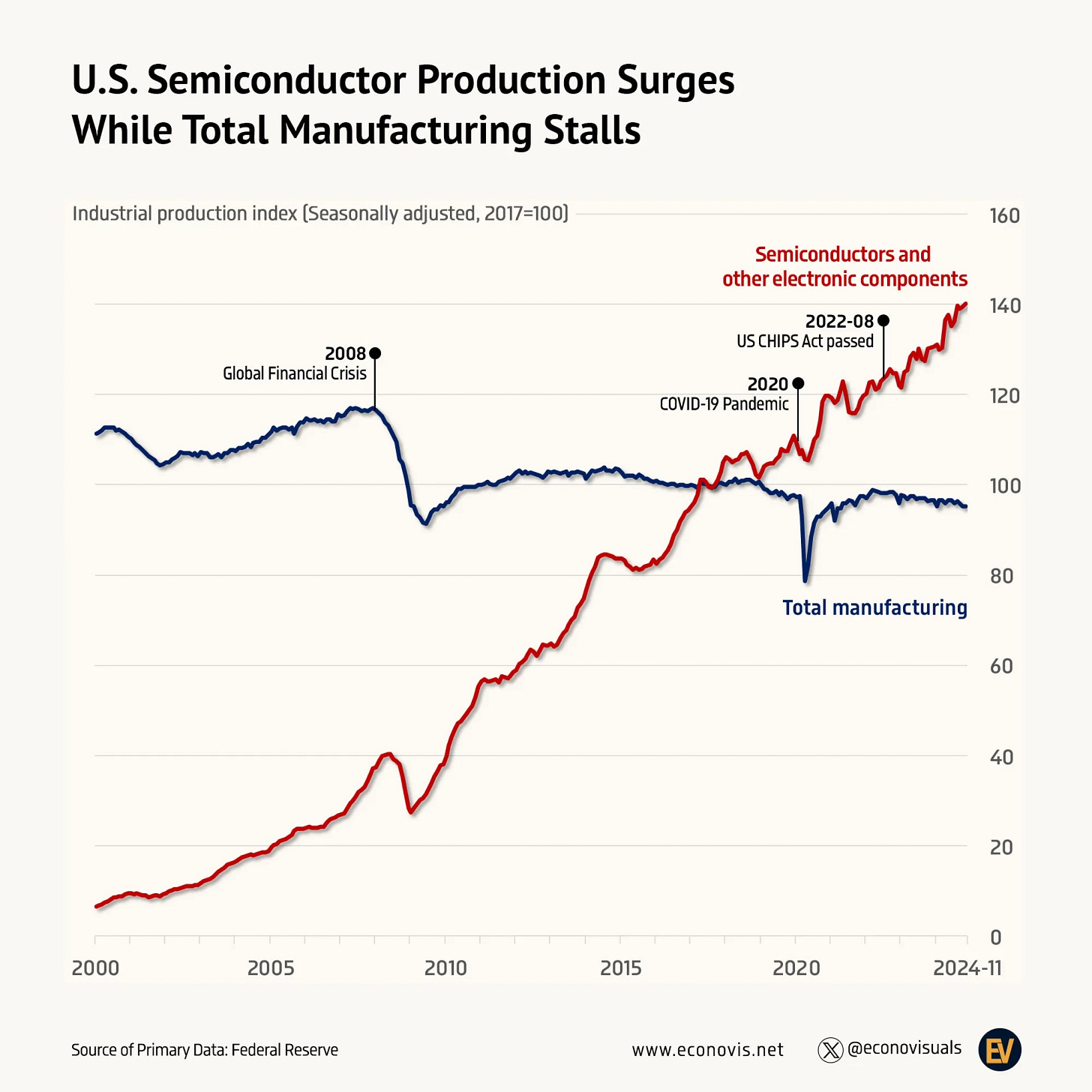
The chart below, based on Federal Reserve data, highlights two contrasting trends over the last two decades. Semiconductor and electronics production, marked in red, has shown robust and consistent growth, particularly since the mid-2010s. This upward trajectory gained further momentum following the passage of the CHIPS Act in August 2022.
In contrast, total manufacturing output, depicted in blue, has remained relatively flat since the early 2000s. It experienced notable declines during the 2008 Global Financial Crisis and the 2020 COVID-19 pandemic. Although there have been slight recoveries, total manufacturing has failed to achieve the dynamic growth witnessed in the semiconductor sector.
Key Factors Driving the Divergence
❖ Geopolitical Concerns & Policy Support: The ongoing geopolitical tensions with China have prompted a push to bolster domestic semiconductor manufacturing to reduce reliance on foreign suppliers. The U.S. CHIPS Act, passed in 2022, allocated $52 billion to boost domestic semiconductor production and strengthen the supply chain. This legislation reflects a strategic recognition of semiconductors as critical to national security and economic competitiveness. The act incentivized investments, resulting in significant growth within the sector.
❖ Global Demand for Electronics: The pandemic-induced digital transformation, coupled with the rapid adoption of emerging technologies like 5G, artificial intelligence, and electric vehicles, has fueled demand for semiconductors. U.S. firms, leveraging advanced technology and robust R&D capabilities, have capitalized on this demand.
❖ Challenges in Traditional Manufacturing: In contrast, traditional manufacturing has faced persistent headwinds that have hindered its growth. Globalization and offshoring have driven many U.S. manufacturers to relocate operations to countries with lower labor costs, resulting in an erosion of domestic production capacity.
While automation has enhanced efficiency and productivity, it has also caused significant job displacement and reduced employment opportunities in traditional manufacturing sectors. Additionally, U.S. policymakers and investors have increasingly prioritized high-tech and service-based industries, often at the expense of traditional manufacturing, further contributing to its stagnation.
❖ Economic Shifts Toward Services: Over the past several decades, the U.S. economy has transitioned from a manufacturing powerhouse to a predominantly services-driven economy. This shift has been driven by several key factors. Higher incomes have altered consumer behavior, leading to increased spending on services such as healthcare, education, and entertainment rather than physical goods.
Technological innovation has also played a significant role, with the rise of Silicon Valley and the dominance of tech giants shifting the economic focus toward software, data, and digital services. Additionally, trade liberalization has facilitated the import of manufactured goods, reducing the reliance on domestic production and further accelerating the move toward a service-oriented economy.
Implications for the U.S. Economy
The surge in semiconductor production presents both opportunities and challenges for the U.S. economy. On one hand, it solidifies the nation's leadership in cutting-edge technologies and creates high-paying jobs in high-tech sectors. Additionally, it enhances economic security by reducing reliance on foreign semiconductor suppliers.
However, this growth is concentrated in specific regions, potentially exacerbating economic inequality. Furthermore, the stagnation of broader manufacturing raises concerns about the erosion of a diversified industrial base. Retraining workers from traditional manufacturing roles for high-tech industries remains a critical challenge.
Ultimately, the semiconductor boom serves as a reminder of the need for a balanced approach. While supporting the growth of high-tech industries is crucial, policymakers must also focus on revitalizing traditional manufacturing, ensuring inclusive growth, and building a resilient economy for the future.
Originally published at Substack.






