
Massive outflows hit Bitcoin ETFs as market volatility spikes amid tariff threats, raising questions about the future of crypto investments.
Bitcoin spot ETFs, which were approved for trading in the United States in January 2024, represent a pivotal development in the mainstream adoption of cryptocurrencies. These financial instruments allow investors to gain exposure to Bitcoin’s price movements without directly holding the cryptocurrency, offering a regulated and accessible avenue for institutional and retail participation. The performance of these ETFs since their inception provides valuable insights into market trends, investor sentiment, and the broader dynamics of the cryptocurrency ecosystem.
The broader financial markets, including risk assets such as Bitcoin and equities, faced a sharp downturn this week following U.S. President Donald Trump's reiteration over the weekend that tariffs on Canadian and Mexican imports would be implemented as planned on March 4, 2025. This announcement intensified fears of a global trade war, leading to capital flight from risky investments.
As a result, Bitcoin exchange-traded funds (ETFs), which had been experiencing robust inflows since their inception in January 2024, recorded their second-largest outflows on Monday. But before we get into the bad news, let’s analyze the performance of Bitcoin ETFs over the past year or so.
Bitcoin Spot ETFs: A Year in Review
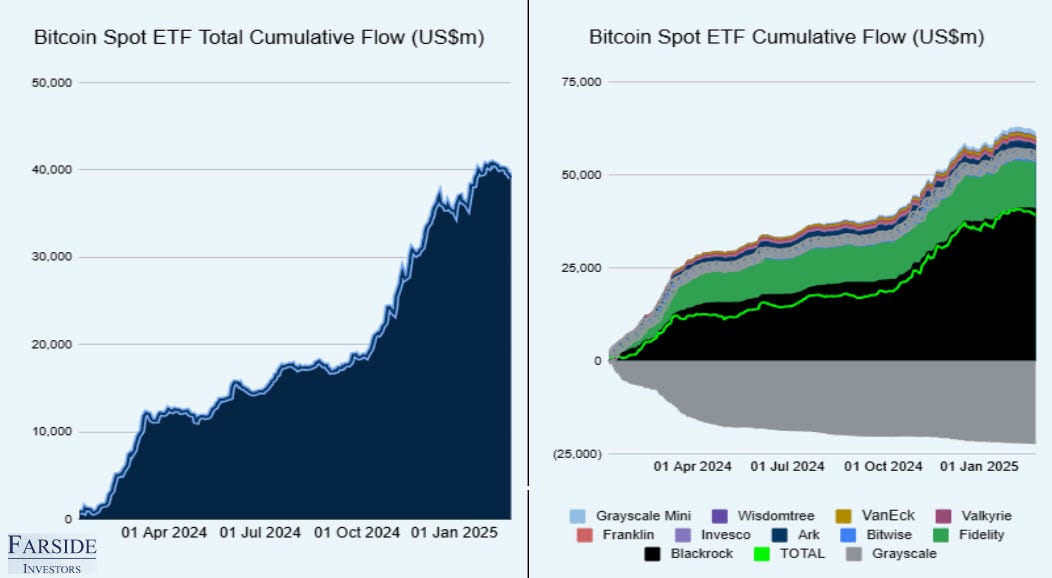
Since their approval and launch in January 2024, Bitcoin spot ETFs have seen significant capital accumulation. According to data from Farside Investors, the total cumulative flow into Bitcoin spot ETFs surged past $40 billion by early 2025, marking an unprecedented investor appetite for regulated Bitcoin investment vehicles.
The first chart (left) in the dataset illustrates the steady rise in cumulative inflows, with notable accelerations occurring in mid-2024 and late 2024. The growth trajectory aligns with broader market optimism around Bitcoin as a long-term store of value and an alternative investment class, particularly among institutional investors, along with a friendlier regulatory regime taking shape in the U.S.
The second chart (right) provides a more granular view, detailing individual Bitcoin spot ETF flows by issuer. BlackRock and Grayscale have dominated inflows, with BlackRock's iShares Bitcoin ETF contributing a significant portion of the total. However, the chart also highlights outflows from Grayscale, which saw a net reduction in assets under management (AUM), due to conversions from its high-fee trust structure to lower-cost ETFs.
Recent Outflows and Market Impact
Despite the positive trajectory throughout 2024, Monday's trading session saw Bitcoin ETFs experience their second-largest single-day outflows since their inception. This downturn is largely attributed to macroeconomic uncertainty stemming from the impending trade tariffs, which could disrupt global supply chains and investor sentiment.
Historically, Bitcoin has demonstrated resilience in the face of geopolitical and economic shocks. However, in the short term, such macroeconomic pressures tend to create significant volatility, leading to sharp corrections in Bitcoin prices and associated investment vehicles. The looming trade war concerns have triggered risk-off sentiment, causing investors to rotate capital away from Bitcoin and other high-risk assets into safer alternatives like U.S. Treasuries.
Fundamentals vs. Macroeconomic Headwinds
While the fundamental outlook for Bitcoin remains strong—bolstered by institutional adoption, increasing regulatory clarity, and growing demand for decentralized financial assets—external macroeconomic shocks can overshadow these tailwinds in the short term. The sharp outflows from Bitcoin ETFs underscore the susceptibility of crypto markets to broader economic developments, despite the underlying asset's long-term bullish case.
Like any mainstream asset, Bitcoin requires strategic portfolio management, particularly during periods of heightened volatility. Investors should remain vigilant in assessing macroeconomic risks, adapting their allocation strategies, and considering diversification to mitigate potential downturns. While short-term turbulence is inevitable, a well-informed and disciplined approach will help investors navigate market uncertainty and capitalize on long-term growth opportunities in the crypto space.
Originally published on Substack.
Disclaimer: The information provided in this article is for informational purposes only and should not be considered financial or investment advice. Readers are encouraged to conduct their own research and consult with a professional financial advisor before making any investment decisions.






