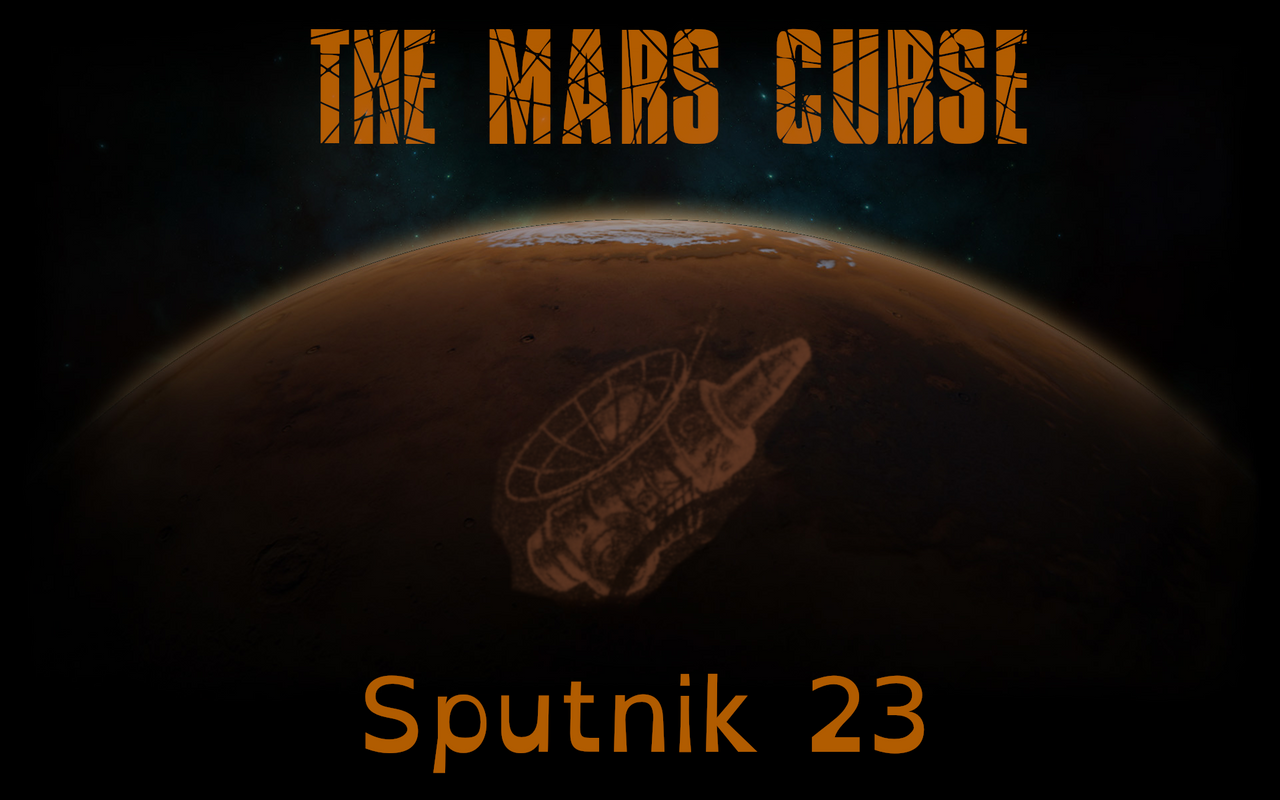
In the early days of space probes, there were many attempts to make it to the martian planet. Though many failed to make it there, here is another account of a failed space probe on its way to mars. Though in this case it did leave earths orbit and was well on its way to another world. The Soviet Union was hoping this time around it would have better progress making it to mars.
Mars 1 / Sputnik 23:

Mars 1 Space probe
Source: Wikipedia
On November 1st 1962 Mars 1 was launched in the direction of Mars. With the intent of doing a fly by of Mars at a distance of 6800 miles. It was designed to photograph the surface and send back information on cosmic radiation, micrometeoroid impacts and Mars magnetic field, radiation environment, atmospheric structure, and possible organic compounds. There was much to be found out about the red planet, and even the environment outside of Earths atmosphere. The data collected by this probe collected magnetic field measurements in interplanetary space. The solar wind was detected as well, along with the radiation zones around earth were detected as well. Along with their magnitude confirmed.
After leaving Earth orbit, the spacecraft and the Molniya rocket booster 4th stage separated and the solar arrays were deployed. Early data from the spacecraft indicated that there was a leak in one of the gas valves in the orientation system, so the spacecraft was transferred to gyroscopic stabilization. It made 61 radio transmissions, initially at 2 day intervals and later at 5 days, containing alot of interplanetary data.

Mars 1: Other spacecraft in the 2MV series were similar.
Source: astronautix.com
Communications were via a decimeter wavelength radio transmitter mounted in the orbital module which used the high-gain antenna and omnidirectional antenna. A transmitter mounted in the experiment module was designed to transmit the television images. Temperature control was achieved using a binary gas–liquid system and hemispherical radiators mounted on the ends of the solar panels. The spacecraft carried various scientific instruments including a magnetometer probe, TV photo equipment, a spectroreflexometer, radiation sensors, gas-discharge and scintillation counters, a spectrograph to observe ozone absorption bands, and a micrometeoroid instrument.

Mars 1 stamp in Soviet Union dated 1964
Source: Wikipedia
On March 21st 1963, when the spacecraft was at a distance of 66,340,000 miles from Earth in its transit to Mars, communications ceased, probably due to failure of the spacecraft's antenna orientation system back to Earth. Mars 1's closest approach to Mars probably occurred on June 19th 1963 at a distance of approximately 120k miles, after which the spacecraft entered an orbit around the Sun.

Source: Wikipedia
Many attempts were made by the Soviets to get to Mars, but all have failed up to this point in 1962. Five spacecraft attempts to get to mars and all have failed. Though on the horizon there is a success on the way. But made by the Americans and not the Soviets.
Ever since the first attempts to get a probe on or even near the planet has ended in disaster over and over again. From the 1960s through the 1980s there 20 out of the 30 total missions to Mars failed and its one of its moons Phobos during those decades.

Even into the 1990s issues were still occurring on space craft with the destination of Mars.

Charts can be found on Wikipedia under "List to missions to Mars"

Above is a chart starting in 1960 through 2016 showing failures, partial success, success, and scheduled.
Sources: https://en.wikipedia.org/wiki/List_of_missions_to_Mars
Addresses below to help me buy better camera equipment and support me to travel to locations to do photo and video and overall great blogs in new places. I would be happy to list some of the contributors in my posts for donations that help me along the way.
Coin
Address
 BTC:
bc1qhfmvd2gywg4fvrgy2kkkkyqta0g86whkt7j8r7
BTC:
bc1qhfmvd2gywg4fvrgy2kkkkyqta0g86whkt7j8r7
 LTC:
ltc1qdyzm5cwgt8e2373prx67yye6y9ewk0l8jf3ys9
LTC:
ltc1qdyzm5cwgt8e2373prx67yye6y9ewk0l8jf3ys9
 DASH:
XkSqR5DxQL3wy4kNbjqDbgbMYNih3a7ZcM
DASH:
XkSqR5DxQL3wy4kNbjqDbgbMYNih3a7ZcM
 ETH:
0x045f409dAe14338669730078201888636B047DC3
ETH:
0x045f409dAe14338669730078201888636B047DC3
 DOGE:
DSoekC21AKSZHAcV9vqR8yYefrh8XcX92Z
DOGE:
DSoekC21AKSZHAcV9vqR8yYefrh8XcX92Z
 ZEN:
znW9mh62WDSCeBXxnVLCETMx59Ho446HJgq
ZEN:
znW9mh62WDSCeBXxnVLCETMx59Ho446HJgq





