
According to analyst CipherTrace, more than half of cryptocurrency exchanges have weak KYC / AML protocols and do not meet industry standards and local regulations.
CipherTrace analyzed more than 800 decentralized and centralized cryptocurrency trading platforms, in addition to automated market makers (AMM).
According to the survey, 56% of these platforms do not meet KYC and Anti-Money Laundering (AML) requirements. Interestingly, most of these exchanges are located in Europe, in regions highly regulated by local laws.
More intriguing, earlier this year, the Fifth European Union Anti-Money Laundering Directive (AMLD5) came into force to combat the financing of terrorism.
Despite this, 60% of European virtual asset service providers (VASPs) have weak KYC protocols. The largest number of exchanges that do not meet customer identification requirements are in the United States, United Kingdom, Russia and Singapore.
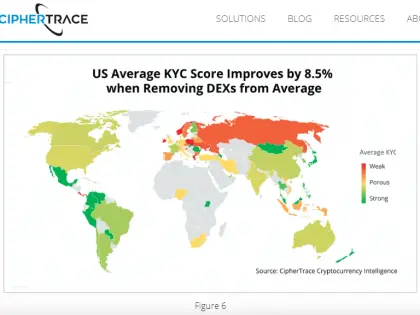
In addition, many exchanges do not indicate the country in which they are registered on their website, which ensures that markets can hide their jurisdiction to avoid the need for registration and regulatory compliance or restrictions.
According to a report by CipherTrace, 70% of centralized exchanges are not KYC compliant. As such, exchanges could be becoming a focus of services that launder money through cryptocurrencies.
Regarding decentralized exchanges, of the 21 institutions analyzed, 81% of them presented weak KYC policies or did not apply this procedure to all their users.
Currently, the dollar value blocked in DeFi protocols grew exponentially in 2020, creating new potential money laundering risks.
As they have no centralized entity, they generally lack any clear regulatory compliance.
Anyone in any country can access DeFi with little or no KYC information collected. As a result, DeFi can easily become a haven for money laundering crimes.
If the craze picks up, many exchanges could be banned from operating in countries around the world.
The question is: Will actions against the crime of money laundering be brought against all financial institutions? Including banks?






