
Smart people, figured out long time ago that differences in people’s opinions create a lucrative, stable, risk-free universal source of income and profit.
The ancient Greeks, inventors of the Olympic Games around 800-700 BC, monetized differences in people’s opinions, by placing informal wagers on the winners.
The ancient Romans, monetized differences in people’s opinions about who will win in gladiators fights, chariot races, etc. Crowds placed wagers on gladiator matches, chariot races, and political outcomes, but spreads in the wagers created a stable risk-free source of income and profit for organizers and governments.
In early modern Europe, people bet on political events through letters, broadsheets, and tavern chatter. Wagers about royal deaths, alliances, and military outcomes were common in London and Paris.
During the Industrial Revolution, horse race betting, organized by early bookmakers, grew popular in the United Kingdom, particularly among the aristocracy.
In 1867, Joseph Oller introduced the pari-mutuel system in Paris, a system where bettors play against each other and share winnings, which became the standard for horse racing worldwide.
By the early 1900s, political betting in the United States had matured into a semi-organized system. Wall Street ran informal betting markets on presidential elections, where odds were printed in financial papers. Bets on sports, also were popular. Even organized crime groups used monetization of differences in people’s opinion as a stable, risk-free, and important source of income.
In 1990s, Iowa Electronic Markets allowed users to trade real-money contracts based on political outcomes. Online sports betting sites were spreading over internet and become very popular.
Further innovations, around the turn of the millennium, included peer-to-peer betting exchanges (Betfair, Flutter, Smarkets, Matchbook, etc.) and live, in-game betting, which also become very popular.
Bookmakers of Las Vegas, Monte Carlo, Atlantic City, Macau, etc. get their risk-free income from monetization of differences in people’s opinions.
In the 21st century, companies like Intrade, PredictIt, Agur, HedgeHog, DexWin, Gnosis, Polymarket, Kalshi, etc., innovated monetization of differences in people’s opinions via internet and blockchains.
Kalshi’s cofounder -Luana Lopes Lara, went from a professional ballerina to the world’s youngest self-made woman billionaire. Kalshi, which was founded in 2018 by Tarek Mansour and Luana Lopes Lara, is now worth about $11 billions, making both its founders billionaires and Luana Lopes Lara the world’s youngest self- made woman billionaire, at age 29. Kalshi’s valuation more than doubled from its previous $5 billion valuation, just two months prior in October 2025, which demonstrates growth of the value is over 100%.
Polymarket CEO Shayne Coplan, the college dropout who founded Polymarket in 2020, is now the youngest self-made billionaire, at age 27. Coplan went on to study computer science at NYU, but dropped out in 2017 to work on various crypto projects that never took off. In 2020, he founded Polymarket. He built it fast, in just three months only, and didn't seek regulatory approval, as the law required. One year ago, the FBI raided his apartment. Now, the college dropout is a billionaire, at age 27. Polymarket is worth about $8-9 billions, now, and it is expected that the valuation may reach $12-15 billions, in the coming months.
You, also can monetize differences in people’s opinions (your friends, relatives, etc.) and earn some risk-free income, using “friendly arbitrage”. See [1-5]. Most volatile cryptos like BOB, LIFE, DIGI, RAIN are ideal instruments for “friendly arbitrage”. BOB (ETH) recorded a one-month volatility of 58,306.64%. Life Crypto (LIFE) had a one-month volatility of 51,609.07%. MineD (DIGI) showed a 24-hour change of over +110%, contributing to high overall cryptos volatility (see [6]). Popular cryptos like BTC, ETH, SOL, etc., also may be used for “friendly arbitrage”.
Let us consider a simple example.
John believes that the price of LIFE will increase 5% or more in the next two days, but David believes that the price of LIFE will decrease 5% or more in the next two days. Julia opens a web browser on her smart phone and points it to this URL: https://0602201.xyz. She enters 5 into the first two input fields and 1000 into the third input field, then she clicks on the button “Show the deals!”.
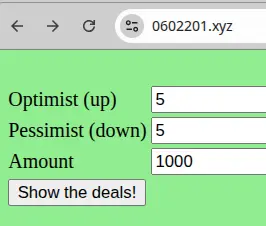
Fig. 1
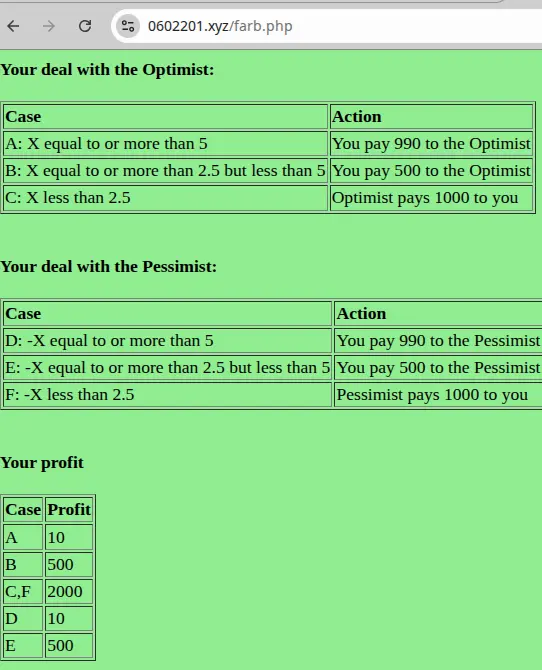
Fig. 2
Julia offers to John the following deal: “If the price of LIFE will go up 5% or more, two days forward at noon then I will give you $990. If the price of LIFE will go up 2.5% or more but less than 5%, two days forward at noon then I will give you $500. If the price of LIFE will not go up more than 2.5%, two days forward at noon then you will give me $1000.”
John accepts this deal, because he believes that the price of LIFE will go up 5% or more, two days forward at noon.
Julia offers to David the following deal: “If the price of LIFE will go down 5% or more, two days forward at noon then I will give you $990. If the price of LIFE will go down 2.5% or more but less than 5%, two days forward at noon then I will give you $500. If the price of LIFE will not go down more than 2.5%, two days forward at noon then you will give me $1000.”
David accepts this deal, because he believes that the price of LIFE will go down 5% or more, two days forward at noon.
Only three outcomes, two days forward at noon, are possible:
1) the price of LIFE will go up 5% or more (case A in the second table of Fig. 2);
2) the price of LIFE will go down 5% or more (case D in the second table of Fig. 2);
3) neither case 1 or 2.
In case 1, Julia will get $1000 from David and will pay $990 to John, which will give her $10 in profit.
In case 2, Julia will get $1000 from John and will pay $990 to David, which will give her $10 in profit.
In case 3, Julia will receive $1,000 from John and $1,000 from David, if the price of LIFE will not go above 2.5% up or down, which will give her $2,000 in profit (cases C, F in the second table of Fig. 2). If the price of LIFE will go above 2.5% but less than 5% up or down then Julia will get $1,000 from one party and pay $500 to the other party, which will give her $500 in profit (cases B, E in the second table of Fig. 2).
Such type of games is much better than all other crypto, sport betting, gambling, trading, investing, etc. games, because in this game you are in the complete control over the process and risks, while in other crypto/gambling games you have no the complete control over risks and the process. It costs you nothing (except some time and efforts); no initial investments, which can be lost; no hard work, which requires high efforts and a lot of your time.
Conclusions:
1. You do not need to be a start-up or a corporation to monetize differences in people’s opinions.
2. “Friendly arbitrage” allows to monetize differences in people’s opinions, without any investments, financial risks, and hard work, for any person, regardless of levels of education, experience, talents, social status, geographic location, etc.
3. Income from “friendly arbitrage” may be comparable or even higher than income from a full time job.
4. You do not need to rely on any third party, external platform, paid services, etc. to practice “friendly arbitrage”.
References:
6. https://www.tradingview.com/markets/cryptocurrencies/prices-most-volatile/






