
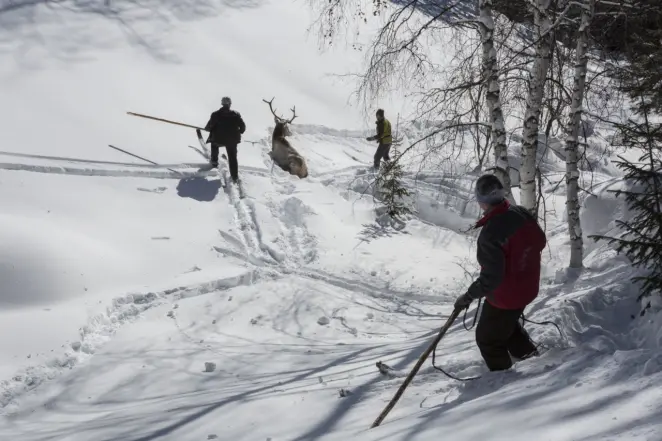
The chief and I, our five scouts, spent a much more active winter. When weather permitted, we set off with guns to hunt and explore the surrounding hills. We constructed snowshoes, and soon after wooden skies, as much for our amusement as for travel. We made expeditions down the road to check on the condition of our equipment, or back thirty miles to check our supply lines. We made many expeditions to steep hillsides, with no other business than to ski down them. All in all it was a healthy and enjoyable winter.
When the snow had all but melted and we were packing our gear, waiting only for the fresh recruits from the city to resume our work, a high commissioner arrived, all the way around through White Seat from the East, with urgent information.
He came by ship from White York with a disturbing report of a deadlock facing the crews that were pushing towards us from the East. Apparently, they’d run into a bloody battle the previous fall, at the outskirts of a large and supposedly abandoned city by a lake. From what he said I assumed it must have been Buffalo or Detroit. It had been six years now since the Church pulled out of that area. They’d foolishly assumed the region would be deserted, that no one outside their organization could possibly survive so long. They’d just found out that not only people, but armed and organized people, stood in their way.
The principal aim in building the highway was to regain control of this region, a place that they early on designated as the land of the Seven Cities. It must have been quite a shock when the highway crews rolled up to the first of these gems, its skyscrapers still gleaming from afar. Our commissioner reported that when they came into the suburbs they met with a barricade, and as they climbed over it volleys were fired, and more than twenty were killed.
In the next few weeks a hastily formed squad was sent up, armed with all sorts of guns and several artillery pieces. Meanwhile a few priests were sent ahead as negotiators. They waved their white flags and approached the barriers, until gunfire sent them running away.
When the artillery arrived the barrier was blasted to pieces, from a safe distance, but the armed squad found it prudent to do nothing more. The place with all its buildings and underground was far too defensible. They had no idea of the strength of the enemy and finally decided to skirt the city by some twenty miles, and continue building the road, with the armed men now a permanent part of their advance crew.
It was at this stage that our commissioner was sent to us, with instructions for us to avoid the large cities in our way and organize a little army in case of attack. When the commissioner arrived, the first thing he did was to thank me for the work I’d done, and for a foresight that might have saved the lives of the eastern workers. For this I was awarded the command of a new force on its way, a militia of two hundred men, fully equipped, and ready to be trained by me and shaped into a regular army.
Our commissioner had to leave soon, but not before he sat down with the engineer and me to plan a new set of tactics for our advance. Every twenty miles along the highway we would build not only cabins but small stockades, places where we could retreat in case of attack. They would be permanently manned posts helping in the movement of supplies and people.
It would be the task of my men to build these forts, and also become the soldiers who would guard them. Our commissioner left us as quickly as he arrived, telling us he was confident in our abilities, and that he’d be back by mid-summer, to oversee our army and bring word of the location of the eastern crews. He promised to be present and riding on a horse at our sides, on the grand day when our two great highways would meet.
From the moment I accepted this commission to the arrival of the new recruits, I remember well how I indulged many an hour in my imaginary exploits as a general. I had read much as a youth in the military histories of the ancient world. Now the pages of Livy and Xenophon crowded my head. I recalled many details of how men were drilled and marched into battle, and with this lore I felt ready for the job.
When the men did arrive, I realized with frequent sighs what a load of work and expectations had been placed upon me. I was now of a stature pretty much equal to the engineer, as the force under me was almost exactly the same size as his own. We decided to integrate our troops and work together as much as possible. I’d need all his help in building stockades and he could well use my men in the heavier aspects of the road work. Pressure was put upon us to make even faster progress than before. The Church was expecting that the two highway crews would reach each other by Fall and was putting all its resources towards this goal.
We could see this in the very appearance of the new men sent to us. Many of the workers who’d gone back the winter before had been replaced. The new recruits seemed to be both stronger and younger. The equipment they brought with them, in long supply trains, was also better than before. It was as if the Church had decided to gear up the whole project. Perhaps the unexpected discovery of rebels had struck a fear into the High Council. With a well fortified highway connecting East and West, they would lay the groundwork for the extermination of this new enemy.
After I reviewed my troops and inspected their uniforms and gear, I had them set up their tents in a field and sit idle for three days, while I made up a staff and a plan. My soldiers were all in their mid-twenties. These were the youngest of the generation that had survived the plague. There was a near absence of youths younger than them, and only the first hint of the next generation, babies of the last few years. So these were the ones which the Church decided to trust with guns, and they hardly knew which way to point them.
For some odd reason, the Church didn’t fully trust its older members, however devout, those who had experience in either police or military work before the revolution, and so they sent none along to help me. For my staff, I was given two secretaries by the engineer to handle the requisitions and records of my company. The five scouts I’d trained were instantly promoted to the rank of lieutenants and ten of the men who’d been taught some marksmanship were picked out to lead squads of twenty and teach them the use of their rifles.
Though we carried guns, the final form of our army resembled a miniature Roman legion, which was the only model I knew. But it worked well enough, in appearance at least, being untested in actual combat, and gave a fine impression that we were well prepared against any danger. We drilled the men daily, especially in target practice, and stationed a part of my force each morning ahead of the road crews in interesting formations, to move along with them as they worked on the highway.
But I placed the most care on intelligence. I sent out mounted parties, far ahead of our crew and on our flanks. I picked out the best horsemen available and had to learn that art myself. I went out with them daily and taught them all I knew about scouting. By this I formed a select cavalry of some thirty men, and we must have made a fine spectacle riding back and forth in three units across the naked Dakota hills. I even equipped these horsemen with spears, but we discarded these later, finding no use for them.
There’s nothing easier than to be a general in time of peace, and our exercises and target practice improved at a respectable rate. By the late spring several inspectors had arrived from White Seat to review my army, and they went back full of praises for me and my aides. Our ranks were orderly, and our maneuvers impressive.
Our second duty was to build garrisons. These consisted of a wall of posts about ten feet high, sharpened at both ends and driven solidly into the ground. Outside the wall was a ditch, and the same dirt was used to make a mound inside the wall, from which the men could see over and fire their guns. For a gate we used a wagon, reinforced on one side to look like the wall. It could be rolled back and forth and also fastened tightly into place. Inside each fort there was space enough to pitch our tents and crowd all our men.
Every third fort we built on a larger model and on land that could support a colony. The crews that came behind us would build cabins and even populate these places with some ten or twenty colonists, including women and children. As I was the only one training soldiers, I was sent more recruits every week and would pick out some trained ones, always the worst, to man these stations. If there were ever a war, we decided, an empty fort would be just as valuable to the enemy as it was to us. But even a skeleton crew could hold out a little while, and probably get word to others of an attack.






