
“I am continuing my narrative,” (he wrote) “after a two-week delay, caused by my running out of paper. I now have a plentiful supply, but also a small group of followers to superintend, such is the twisting of fate. But I expect to finish this history without further delays.
I left off with my promotion to the world of speech, in the seventh year of our Church and the abolishment of time. Once I had use of that faculty I quickly became a sort of aide-de-camp to our captain in the forward crew of the Western Expeditionary Highway Force.
My duties as captain of the lickers were now very slight once we’d built three of the wheelbarrows for laying out lines. This invention sped the progress of our crew, until we reached a more mountainous and wilder region, where the old highway needed more clearing, and reconstruction where erosion had taken its toll. In a few places we had to excavate the road, and the larger crew behind us caught up. Then they would assume this labor and we would push ahead, until the next landslide.
We were now in the steep and forested regions of Idaho, and my advice to our engineer in laying out our camps became more valuable. He often wondered how I knew so much about this area, which I attributed to boyhood rambles. But one long segment of this highway was the very same route we’d followed in our westward trek, two years earlier.
When it became troublesome to supply our camp with food, I convinced our chief to have a crate of rifles and ammunition sent to us from the city. Even though the Church had no need for weapons, or even police, it was deemed wise to put away all such stores, just in case, and so a regular arsenal lay beneath many a temple.
Besides the hunting of fresh meat, I convinced him that we might run into renegades, or even Indians in these remote parts, and it would be folly to encounter them without firepower. He thanked me for the advice as if I’d just saved his life. I was thinking more in terms of my own needs. I was still planning to slip away any day and I wanted a rifle on my back when I did so.
He told me that he hadn’t run into a single human being in his first highway project down the coast, and that the thought had never occurred to him. But when I expressed it a visible terror crossed his face, like a tremor, quivering his lip. The word "Indian" seemed to strike a fear, as if two hundred years of history were suddenly negated, or worse, that our crimes of the past might be revenged. We received twenty rifles soon after, and I was told to train a group of soldiers.
At the same time I convinced him to send scouts ahead several days, instead of several hours. I was able to put my old duties into the hands of one of my assistants, eager for promotion. From now on I spent my time on this new project, teaching a few of our road crew to be scouts and hunters.
On our first excursion with the rifles I took two of our engineer's assistants some twenty miles ahead of the group. We returned in two days with crude maps, two deer and some bear meat, much to the delight of our crew, who had their first taste of venison, and ideas of conquering the wilds.
I had a strong urge to escape, but a stronger urge kept me there, a desire to show our captain what I knew. On our next excursion I convinced him to come along with us, and showed him my knowledge of guns and traps, which got us all sorts of small game. From then on our friendship grew quickly. I found him to be skilled in many ways, as ready to learn and listen as he was to lead. He was a few years older than me, and greater in size and stamina and expert in questioning the details of anything half-explained. He was curious to a fault, and lightning fast in grasping the concepts and possibilities of woodsmanship.
I asked him where he got his training, and he told me that before the disaster he’d been schooled as an engineer and had experience in putting up the very buildings he was a few years later assigned to take down. He soon headed the civil list in honors and was awarded the first command of the highway project down the coast to White Port. His success on that project made him an instant choice to lead this crew, on the highway to span the continent.
Though he owed his promotions to being a good organizer and administrator, he was also a pragmatist and several times lamented to me the loss of scientific knowledge that happened with the revolution. I shared the story of my own university background, and we became closer friends, two souls swept up in a storm, and deposited in a strange, new land, where our talents were both appreciated but suspect, used but watched, and never trusted.
Our talks became so frank, once I got him out in the woods, that I told him how I’d roamed this area in the early years of the revolution and knew a place, not far off course, where a computer had been buried, with some engineering and mathematics on it. He told me he’d love to recover such knowledge, but would have to think on it, on a way of preserving it without offending his superiors.
In the following weeks we discussed the possibility of translating such lore onto waxen tablets, in the official language. But we foresaw so many obstacles in this process we decided any transcription would absolutely reek of the past and meet with the harshest rejection.
But at least we cemented our friendship and I taught him how to hunt. In his reports he recommended me so much that I was given a commission as a permanent part of his staff. Our work went on smoothly through summer and fall. We made good progress until we reached a large, decayed bridge. The crews were held up, while I spent most of my time in a familiar role, wandering through hills with a gun in hand, encountering only nature, in the wilderness of the West.
The more we proceeded east, the more intact were the ruins of the towns that dotted the highway. I sometimes came across whole structures, especially brick ones, that hadn’t been completely burnt, standing like tombstones. Exploring a few of these I found lots of artifacts. These buildings had been pillaged and torn apart for the last scraps of food. The furniture and windows were smashed, the roofs half gone and the doors kicked in. In some there were human bones scattered about. But there were also papers and magazines, old radios and television sets, moldy books and clothes and ornaments, all rotting in heaps upon rain-soaked floors.
I had few chances to act, but I did manage three private expeditions to collect armfuls of old books and bury them away from the buildings, wrapping them up as best I could with whatever was at hand. I knew the crews behind us would finish the job nature had started. They’d burn all they could and bury the rest in one common grave of rubble. It was not only their task to build the highway, but to landscape it for Church use. I didn’t have any plans for what I hid, but I wouldn’t, at this stage, be even a minor accomplice in the destruction of the past.
We shored up our bridge with the help of the large crew and then moved ahead of them, making good progress through late fall. We made no plans for winter until it struck in one great storm. Stages had been built every thirty miles or so, in the form of log cabins, with stables for horses, where food and beds would be provided for travelers. We retreated to the last of these cabins as our tents were no match for the wind and snow. It was a long day's march. We abandoned our equipment along the way.
We made this trek on the third day of the storm, just as its violence was slowing. The other crew was there, with their wagons and heaps of supplies forming a larger enclosure, and tents pitched inside like a fort. It took us days to clear the road behind so that supply wagons could reach us. Many needed furlough, so we sent over half the men back. Then we counted our provisions and ordered what we’d need to hibernate here another four months.
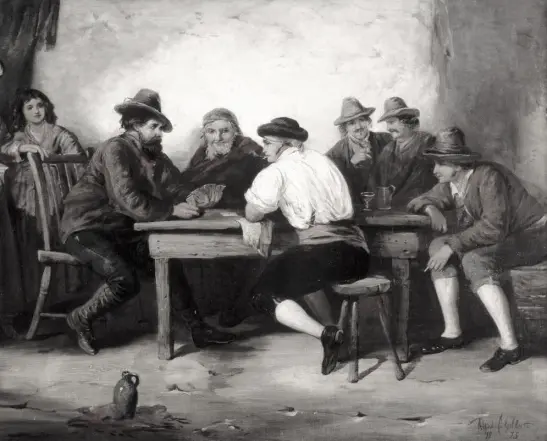
Most of our crew did just that. They ate and slept and played at cards and dice. The Church looked down upon these games. Only the lower classes indulged in them. But the Church knew that it couldn’t outlaw such amusements, as it had nothing to supply in their stead, and it probably saw that without them worse vices would prevail. So decks of braille cards were common, and dice just like the old ones, except that the indentations on each face were now silver.
This was a blind man's paradise, our new world, and a strain on the eyes of everyone else. Indeed many people were rendered blind, their vision done in by the constant stress of trying to discern between the slightest shades of white, compounded by the radiation that filtered through the clouds, and the drops we used to protect our eyes.
But the Church took good care of these victims, as if they were especially holy and faithful. They lived in special buildings and did manual labor at long tables. They were tended in their dim workhouses by those who were going blind; those who could no longer venture outdoors and were soon to practice the very tasks they taught.
last post ...
next post ...






