
I write my first novel:
 Our first rented house September 1991. I'm not that happy with it.
Now Sanita decided, through some circuitous reasoning of hers, that we should move to Seattle, the furthest place in the continental United States from St. Croix. We knew no one there. Maybe it was something she read in a woman’s magazine, (all she ever read) but once again I agreed and we left. We sold the Volvo there for the price we paid for it, flew to Dallas and made plans.
She flew to Seattle to buy a car and rent a house. I would load up a U-Haul with all the many furnishings we’d left in her sister's garage before we went to St. Croix. They filled up one-half of her double garage. We’d only brought a few suitcases to the island, not knowing how long we would stay. I’d have Willie and with me to make a leisurely four day trip across the continent. That worked out great, driving eight hours a day and stopping at motels with swimming pools each evening. I bought him a few simple learning boards with games which he’d play with for hours, sitting quietly beside me through the strange and mostly barren scenery of West Texas, New Mexico, Utah, Idaho, eastern Oregon and finally Washington.
He was the most docile and obedient child by nature of any I’d ever seen, a little angel. Many of our friends also remarked this. We could take him to the finest restaurants, where children were frowned upon, put two chairs together at our table and tell him to lay down and he would, perfectly quiet till he fell asleep, amazing all the customers and waitresses who witnessed it, often expressing their wonder.
When I arrived in Seattle she’d already purchased a terrible car that had engine trouble and barely ran, (something like my old Volare), and which we traded in right away at a used car dealership for another dependable Volvo station wagon. Then she showed me a plain, ugly, ranch style house in a lower middle-class neighborhood on a flat street, lined with other bland houses much like it, almost row houses. She’d signed the lease with the down payment, then she told me it wouldn’t be vacated and ready for us until September.
Once again I didn’t say a thing, just nodded ‘okay’ in disbelief, secretly reassessing her mental handicaps, that she would rent some place we couldn’t move into for a month, when so many other places were available immediately. Yet I made the same stupid error exactly a year later, putting her in charge of finding us a home in Puerto Rico, while we were temporarily staying with her brother and his girlfriend while we were going to work everyday for long hours on the other side of the island, and with the same disastrous results.
I realized later that I let Sanita make major decisions for our lives, all of our moves and homes, to give her a feeling of importance and because it didn't matter to me where we lived, as long as it was wholesome for Willy. My two projects were study and raising him, which could be done anywhere, equally.
But money solves many things and in this case, the one month hiatus turned into one of the most pleasant times of our lives. It was even romantic for us, another honeymoon. We put our furniture into storage and loaded the Volvo with a few suitcases. It was late July and in the distance stood the snow-capped mount Baker, a majestic presence, as if calling to us from the hot lowlands. We drove up its winding roads and halfway up, in a thickly forested wonderland, with the most refreshing air and temperature, we found a small motel with separate cabins built of logs, Swiss looking, and right away we booked one of them for a week.
There were creeks and streams everywhere, tall pine trees and fine vistas. We took hikes every day exploring the woods, all three of us delighted with the splendor of the mountain. Most of all, we were refreshed and invigorated by the cool temperatures, often in the fifties and sixties, after sixteen months in the constant, sweltering heat of St. Croix. We continued our stay there another three weeks. Sometimes we drove to the top of the road for snowball fights.
A half an hour drive down the road brought us to the nearest grocery stores and restaurants, and their quality and range of choices, far above anything on St. Croix, delighted us. We were in civilization again. The motel itself was nearly vacant. Most days we were the only guests. Maybe few people knew of it, being in the middle of nowhere, and on our daily hikes we encountered no one. Here’s what we had, all to ourselves:
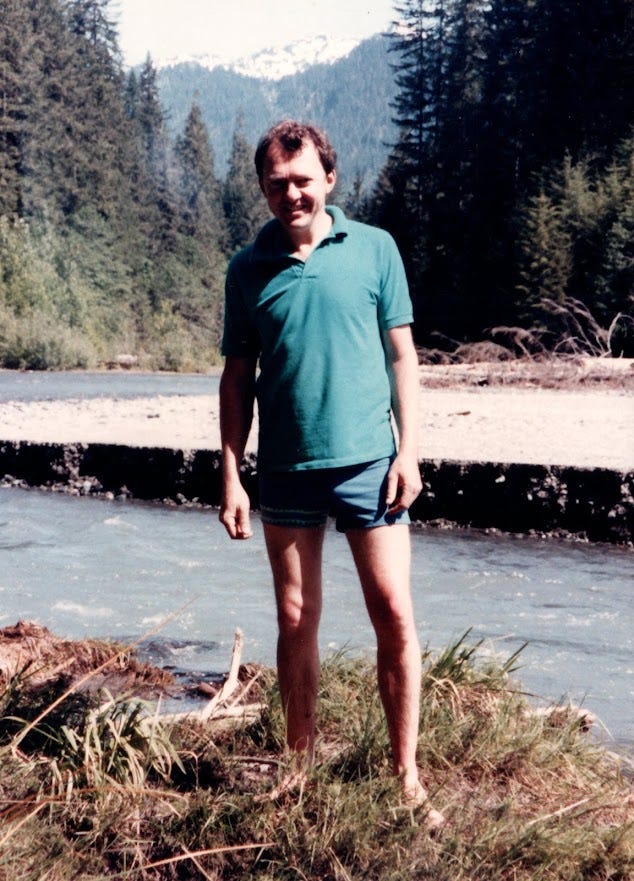 August in the mountains.
After four weeks in this lodge and having explored the sights of Seattle we moved into our house. Since I’d worked a physically hard job for a year I was ready to sit down to a desk again, setting up a study in the basement and writing four or five hours every morning on my first novel, ‘The Whitening’.
The idea for the story had come to me two years earlier, in Piedmont, in mid-April. Sanita and Willy and I had just taken a four day camping trip with Steve up the coast of Oregon. He loved ocean fishing and did very well. We set up tents and cooked the fish by campfires every night, checking out a new location each day. I caught a chill on the last day and the afternoon we came home foolishly called Ted for some speed and an all-nighter. The next day I was in an almost delirious fever. While laying on the couch that afternoon, while Sanita was out shopping with Willy, a story came to me in vivid scenes, while I was in a brief dream state, which I wrote down as fast as I could upon waking, filling fifteen pages. It was a complete story, the outline of ‘The Whitening’. I did nothing with it at the time, and it took a week to get over the flu, but it was so vivid and strange a story I knew someday I should make a novel out of it and now was my chance.
Sanita stayed upstairs and practiced yoga for hours. Will was in the Montessori school. In nice weather, (rare in Seattle) I’d walk him the ten blocks there, taking our time, talking and checking out trees and rocks and puddles. Then I’d go to my writing desk and easily manage five or six pages a day. There were no stumbling blocks, no indecisive pauses or dead ends, the writing of the story just flowed along smoothly, ideas and expansions of my bare outline coming to mind just as I needed them, filling two notebooks.
 While Sanita took it easy.
It was a pleasant task I very much enjoyed. After five months I had the story finished, with only some editing and a type-written copy left to complete. As our house was so lackluster we moved to a quaint cottage in January. It had a beautiful back yard with shrubs and trees and behind its wooden fence was a bike path that led to the university, miles long. In the Spring we found that the lush, wooded sides of this trail were full of blackberry bushes, which Willy loved to pick and eat.
The cottage was small but cozy. Sanita took up sewing but there was no room for me to edit and type my novel and we were too cramped and too much together again. She told me this after one week so I rented a very cheap room in a run down boarding house near the school. The other tenants were a ragged lot, one step above vagrants. We shared a common area and kitchen and bathroom. My neighbor in the next room was a Viet-Nam vet living off his disability check, barely scraping by, with one small T.V. set as his only entertainment. He could barely walk. We talked a few times and I fixed one broken outlet in his room, much to his relief as he had only two.
But all I needed was a desk, my T.X. computer and a roller-ball printer. I never slept there. I’d walk the mile each morning leaving Sanita the car and return home by evening. On weekends I’d bring Willy along, to give her space, which she seemed to demand more and more. I’d only get half the work done because we spent half the day wandering around, buying toys which he kept there, and lunching out. He was now at an age that delighted me, our conversations revealing his imagination at work, and most of all his fast-expanding vocabulary, full of questions, taking in the world.
The task editing of the book and typing it out and constantly making corrections was actually harder work than writing out the first draft. But in five months I was done. I took the pages to a ‘Kinkos’ and had ten copies printed and bound, ready to send out to publishers.
This wasn’t my sole project. Marjorie visited us for a week from St. Croix in our first house and helped me collect and organize sixteen finished poems and make a little chapbook out of them. Then I revised and finished coloring the pictures of my children’s book ‘Ryan’s Day’, had it copied and bound and sent out five copies to publishers of such works. They all came back with rejections but one came close. A woman in San Francisco said she loved the rhymed story but that they just didn’t have the funds to publish it now. It even had some smears of red lipstick on a few of the pages. I wondered what she looked like and where she read it. The way she phrased the letter almost begged a reply, which I should have sent her, along with my poems and novel. She might have been able to help me, being in the business of publishing.
This was in June. But Sanita was antsy to move again. She was growing more and more short-tempered with me the few hours I was home in the evenings and visibly unhappy with her own life. Nothing I could suggest or do changed that. Her problem was that she had no occupation and unlike every other place, hadn’t made a single friend. In the Fall the year before she applied for a job as a school bus driver. She was paid the two weeks of training but in the next two weeks on the job she hit two cars. The second was an expensive sports car. She took a corner too tight and clipped the rear bumper.
The screaming children didn’t help. But she was terminated. Then she tried painting some rooms in a rich lady’s house but that ended quickly too. So she did her yoga and some gardening. With a little effort she could have easily found one of many jobs, probably even a career, but she didn’t try. Two signs of depression are a general apathy and lassitude. She had them both. I should have recognized this but I was too wrapped up in my novel and playing with Willy. Then again we never had serious talks anymore about our feelings, our hopes or our completely lackluster and unsatisfying sex life.
I say this with a little bit of anger because we still had thirty thousand in the bank, and if I’d have been able to send out my manuscripts for another half-year, learned the tricks of promoting oneself through trial and error, I might have been published and started on the literary career I always dreamed of. But I was too compliant once again, too much a slave to her fickle desires. I was still in love and thought of her as my life-long partner, even though the years had shown me more and more faults in her. If she’d just told me she was no longer in love with me we could have called it quits, split the money and gone our separate ways, with provisions for sharing Will.
Jaime had been calling us, (mostly her) from Puerto Rico and said business was booming and there was easy money to be made doing store build-outs. He had a new girlfriend and house where we could stay in Rincon, a small, beautiful surfing community. Jaime bought us a P.O. box and address in Rincon and I packed up twenty three boxes of books and sent them there, costing only twenty dollars a box by weight. We packed up the rest of our belongings on a small trailer hitched to the Volvo. We then drove down the coast, gave our nice furniture to Consuelo, living in Oregon with her new boyfriend, (the century-old wood dental cabinet and dresser). We’d visited her there a year before. That got rid of the trailer. The rest of our station wagon was packed to the gills, including a new puppy, a small sheltie, bought a month earlier as a companion for Willy, now old enough to enjoy a dog.
Then we drove to the Bay Area to say goodbye to all my old friends. I handed out several copies of my novel, one to Steve and Bruno and Hiram. It was the last time I saw any of them except the last two, whom I met briefly on a trip there in 2005. I said goodbye to Bones and May, Steve and Eddie and Roy, John Seebach and Jim H. forever.
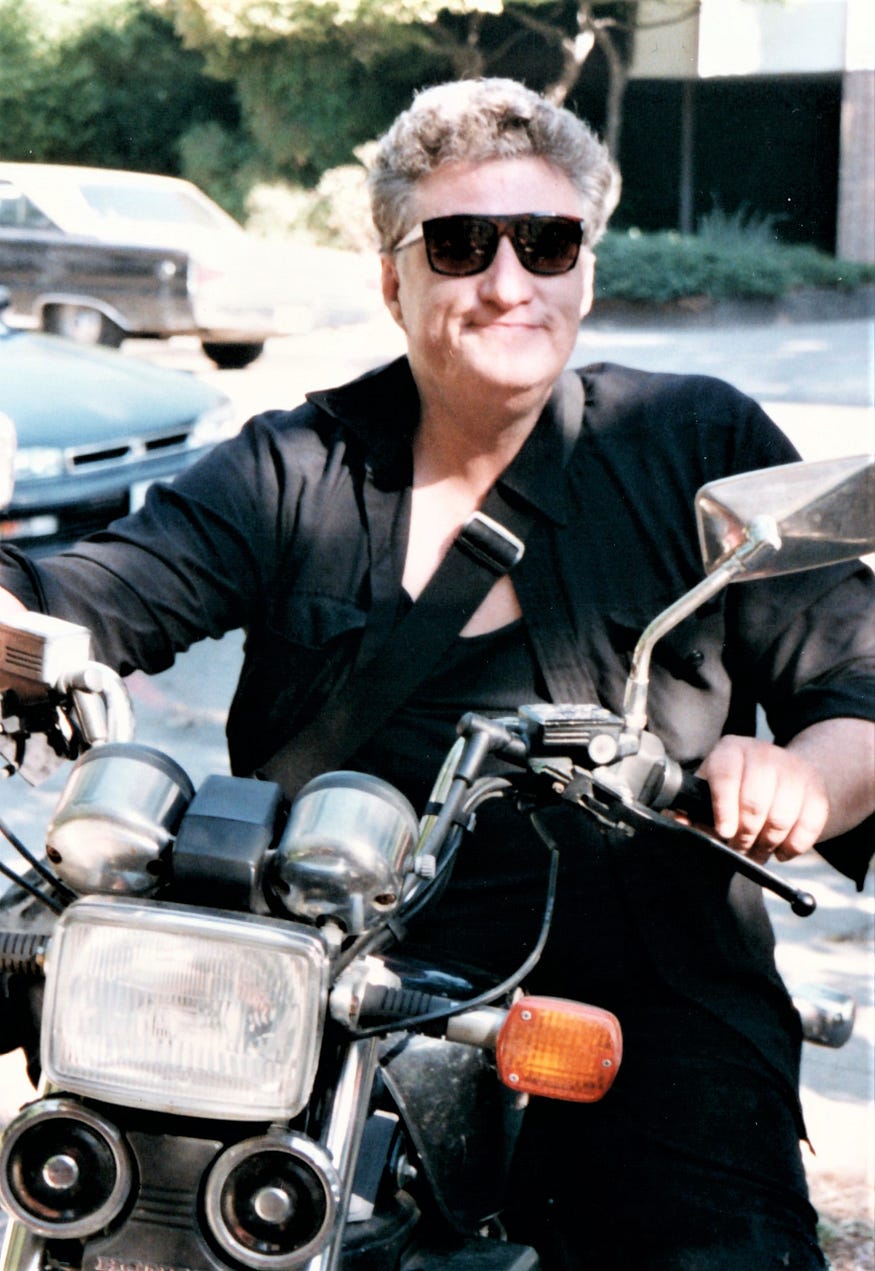 John, the friend who understood and appreciated me more than anyone.
John died seven years later in 1999. He’d had Leukemia as a boy, growing up near some of the nuclear test sites in Nevada in the fifties, with poor health ever after. Of course the huge drug binges we went on together over many years didn’t help.
But as a friend, I can honestly say he was the luckiest acquaintance I ever made, and from our long, intimate conversations, spanning twelve years, the person who knew me best. I know I was the same to him.
In life, nothing is more rare or more valuable than a perfect friendship. It's a candlelight in your soul that never dims. Without close friends life is dark and existence bleak.






