
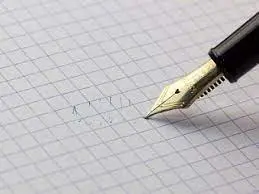
At this point Jonathan paused in writing his narrative. He noticed that the last few lines were lighter than the others and realized with a start that his pen was running out of ink.
"Oh what a fool I am," he said to himself loudly. "Here I am using up my only pen in recording petty talk when I should be writing world history and now I'm out of ink!"
He pondered this development a few more minutes, staring at a half-empty page. Then he said to himself, "I'd better wrap it up," and he wrote:
“The next day I set out for Europe and spent many years there, learning several languages. I had a commission to hunt for books with a group of four others. We found many and had a pleasant life, journeying from village to village. I sometimes buried the books I found when chance allowed. The manners of people were different in the more remote regions, less had changed and…”
Here Jonathan's pen expired. He scratched with it frantically, but nothing came out. He grew angry and threw it on the floor in disgust, as if it had betrayed him or should have given more warning of its end.
"Is this any way to end a history," he thought, "or even a journal? What about all my social theories, my parallels, my chronology? What a fool I am for jotting down the first things that come into my head, and now all the ink gone! Where shall I get more? What a tragedy this is. What a bad comedy!"
Jonathan spent the next hour searching every corner of his basement with his lamp for another writing devise, of any sort. He knew it was futile. He’d poured over every inch of the place when he first moved in and had organized each item and catalogued it in his head. At that time he’d found two pens, the one on top of the desk which he’d just used up, and another in a drawer. But he found that one was broken and had thrown it in a fire with other trash when he first cleaned up the place. Now he remembered and regretted that act. He might have been able to salvage some ink from the thing.
He came back up and sat down again before his papers, sadly perplexed. This was the week he’d sent three of his followers back to town to fetch more supplies. The other three were kept busy with the numerous tasks of cabin making. He worked with them just a few hours each day, keeping to his room in an effort to finish his history, as he knew he had other projects beckoning him outdoors.
He’d even toyed with the idea of training one of his disciples to be a scribe, once the housing was built, to make several copies of his book. Now that plan was dashed to pieces by lack of ink. He sat there and pondered long, almost dreamily, on the possibility of making ink, and his mind drifted back to his childhood days and a small chemistry set he once owned. He recalled no distinct formula, only the vague notion that maybe tea, or rust scraped into water might be a substitute.
Then he remembered playing with lemon juice and the magic, invisible ink that it made, which when heated up by a light bulb or candle would turn brown. This thought cheered him a little and he decided to call it a day. He put his papers away and then strolled down the hill. He’d try to remember more tonight and begin experiments tomorrow.
The results of his experiments the next day were sadly disappointing. He built a fire and brewed and boiled various combinations of tea and rust and even the dark covers of some of his books, but all to no avail. Each time there remained only a sticky syrup or a running color that blurred or didn’t dry. The next two days he experimented with saps and barks, and trying to distill the ink of printed pages, with no luck. Then his disciples returned and he gave up his chemistry in a huff.
Now, almost to forget his plight, he put his full energies into the construction of the camp. His followers had brought more tools and building supplies, such as nails and hinges for doors. They’d also brought more kitchenware and bedding, and four large vessels of white paint, which he didn’t want, and another ream of white paper, which only mocked him now.
They returned with word that the old priest was more eager than ever to see the shrine. So Jonathan determined to construct a site worth seeing. He directed his followers in the construction of a long, stone stairway up the hill, and showed them how to cut and chisel some larger stones to make three benches around the fountain. The grotto was carefully manicured to give the overspread branches a rude symmetry. Then the lawn was weeded and closely cropped, pathways of pebbles were arranged from the basin to each of the benches and the staircase. Then everything, including the rock face behind the spring, was carefully painted white.
They spent more time at work on the cabin and garden. They all worked hard, Jonathan too, and he spared no time except for practical lessons on working the materials they had in hand. The historical lore he wished to impart would have to wait.
"Shelter before culture," he told himself. "The knowledge of civilization is only a bitter pill to those living like savages. A warm fireside and a comfortable chair and a full belly are the necessary prerequisites to a good story, especially such a long and intricate one as I intend to tell."
In one moon's time Jonathan and his six helpers had completed a good deal. They’d embellished the shrine and finished the shell of the long cabin. They were now busy on finishing its interior and building furniture. In another few days Jonathan himself would lead the pack animals back into town, taking Mary and Simon, his favorites, with him, more for company than needed assistance.
He’d even bring back the head priest, he thought, to satisfy an old man's yearnings. He realized that to promote the shrine's prosperity he’d have to encourage visitors and pilgrims, induce them to bring gifts to adorn it, and comfortably lodge them in return for their patronage. Otherwise it was a purposeless thing, his own idle and selfish project, which the world would hardly tolerate and which his followers would sooner or later desert, as something that had no future in it.
On the day before he set out a strange accident occurred. It was the custom of Mary to come and knock on his door and rouse him each morning. On this particular day he’d risen early and walked off for a moment, while Mary tapped at the door. Hearing no response she let herself in, wondering if he was ill. When he returned with an armful of wood, he saw her standing there, the door ajar, inside the room, transfixed and staring at his table. He’d been going over his papers the night before and left them there, along with the tinted picture of the dairy farm, which he now kept with his writings, in plain view on top of the pile.
She’d never seen a thing so strange or beautiful in all her life. Time ceased as she gazed, mute and motionless, into those deep pools of color. Jonathan entered the room and looked over her shoulder before she even noticed his presence. A bit startled, she looked up to his face for an explanation.
"What is this wondrous thing and why in all my days have I seen nothing like it," her eyes questioned.
"It’s a picture," Jonathan answered, breaking the silence. "It comes from the old world, the one of my childhood, the one you've been told never to ask about. But I’ll tell you of it. Though they say it was evil there was beauty in it too, as you can see."
Mary looked again at the thing and now touched it with her fingertips and looked at them, still speechless.
"Come," said Jonathan, "let’s return to the others. I’ll tell them of this object in good time, after we return from our trip. For now don't mention it. It must be presented carefully so that they don’t see it as pollution, which it isn’t."
Mary nodded in agreement with the secret but acted in a strange, altered manner after they joined the others, for the rest of the day.
last post ...
next post ...






