
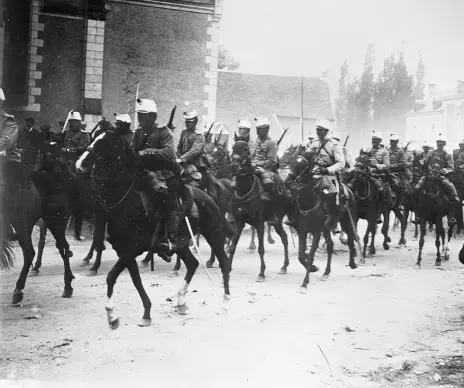
It was at this unlucky juncture that I rode up with my cavalry force, in my path around the lakes. The instant I arrived it came into our Marshall's head to try a cavalry assault before the other army arrived, so that all the glory of a victory would be his alone. In vain I pleaded that our forces were insufficient, that it would be a bloody slaughter to push into this forest of castles from which snipers could target us invisibly at their leisure.
But he dwelt upon the demoralizing effect it would have if we broke their perimeter with one quick charge. A flood of foot soldiers would rush in behind me and fan out into each building and nip every isolated pocket of snipers. When we reached the center resistance would be broken and our victory would be assured.
This crazy charge was set for the next morning. I said my prayers that evening with all the earnestness of one in lucid certainty of his own imminent death. While our Marshall kept us at the battle table detailing his plan, I contemplated escape, as if it were surely my last chance. But his conference lasted late into the night. In fact, he didn't sleep at all. He directed me to a cot in the corner of his tent while he paced back and forth, refining his scheme. I lay there with my eyes closed, counting the long number of his steps.
In the predawn hours our camps were roused and readied. My best scouts were given the dangerous assignment of sneaking into the nearest buildings in the dark, to kill any snipers in them by stealth. At the first glimmer of day I was to charge with my cavalry, firing and drawing fire, while the foot soldiers running with us would storm into each of the towers and eliminate the foe. From two more sides other units would pour in and push toward the center of the city. It was hoped that my assault would make a safe corridor for the largest division of our troops, led by the Marshall himself.
We began our movements in the dark. Our scouts must have done their job well, as we scrambled over the street barriers without a shot being heard. Then we quickly assembled into a column and proceeded up the street, our clean, white uniforms making excellent targets in the first light. I expected to be shot immediately with all my men, in a barrage of crossfire. But only occasional shots rang out. We must have caught them off guard.
About a half-mile up the street we ran into an avenue. Now the bullets were whistling past our ears. But our foot soldiers kept up with us, returning fire from doorways and then rushing ahead, to storm into new buildings and take up even better positions. Looking back I saw that a dozen of my men had fallen. With no better plan I ordered them to charge at full speed towards the plaza ahead. Just as I was spurring my horse a bullet struck me in the shoulder and toppled me down. I remember being pulled into a doorway and ordering my lieutenant to carry on. Then darkness overcame me.
I woke up in a tent, in extreme pain. An attendant was dressing my wound. Then our young commander came in, grinning and laughing over me. He slapped me on my remaining shoulder and announced a glorious victory for the Church. Our soldiers were still scouring the streets, he said, rooting out the last pockets of resistance. But the plaza had been captured, along with several hundred prisoners, and the city was ours. He couldn’t stay long as he had much to attend to. He left saying that his doctors had removed the bullet and gave me better than even odds at recovery. He told me I was the hero of the battle and would be well rewarded for my deeds.
"So much for heroism," I thought in the following days, between bouts of delirium, fevers, cold sweats, and phases of intense pain. I cursed my fate and my stupidity for not escaping to the woods in the weeks before, when I was already there with a gun, a horse and supplies. I was sure I’d die in that bed, and thought I felt the pangs of blood poisoning in my veins. But these were lucid moments. Most of the time I tossed in a sea of pain, my memory mangling past and present, with faces and forms swirling by, while I floundered and grasped for some meaning.
I lost all track of time in this limbo. I only know that my recovery was slow. In a few weeks I was able to sit up a few hours each day and receive the visits of some of my soldiers. One morning a covered wagon was brought up and I was told the time had come for me to go to White York. I had two attendants on this journey and a soft seat. My arm was bound in a tight sling. But it felt every bump along the way and a foul odor issued from the wound whenever it was dressed. But the fevers were gone and I arrived in the Capitol likely to live.
Though I was in a gloomy state when we reached the place, I couldn’t help but be impressed by the magnificence around me. The streets seemed endless and were crowded with people. The buildings were taller here, often rising to five stories, and all were uniformly white and new. We passed many plazas and temples, but by far the most striking sight was the World Headquarters of the Church.
A stately, silver-domed council chamber rose in the center of a huge, open square, and it was flanked, almost dwarfed, by two towers that reached to the skies with all their former stature. The top floors of these buildings were empty, being hard to access without elevators. But they were kept intact for their grandeur, and for many floors up, so I heard, the dark and secret branches of the Council designed, detailed and dispensed a law that stretched from here to every corner of the globe.
It was in the courtyard of a smaller temple in the shadow of these towers that I was greeted by my Marshall, who gave me his hand and congratulated me on my survival. He asked about my arm while his men changed my clothes and whitened my skin. I looked around and could see my old cavalry unit mounted and ranged in bright uniforms, waiting for me. I was about to be presented to the Fathers in the great square, riding at the head of my troops before the gawking eyes of multitudes. It took all my strength not to fall off the horse, but I survived the ceremony and was later carried, with my crown of white laurel leaves, to a small and dim cell, where I rested peacefully for the next few days.
Meals were now brought to me and more skillful attendants examined and doctored my wounds. They even brought in medicines, a thing I thought the Church had outlawed, but not so strange, I reflected, in a place where so many aging leaders lived and wanted to keep living. The only other visitor was my young commander, as brash and noisy as ever, always bursting with news for me and now actively engaged in canvassing new commissions for the both of us, as our armies were soon to be reorganized.
In as polite a manner as possible, I suggested one afternoon that I would prefer a post of a non-military nature.
"That's just the way I feel," he replied. "There aren't any positions worth taking the way they're changing things. They only have places for fort commanders or with escort troops; petty, bureaucratic posts which I won't accept."
Remembering that my plan was to escape at the first opportunity, I grasped at the idea of being put in charge of some fort in the middle of nowhere.
"You'll rot away in such a place," he said indignantly. "How could you dream of spending the rest of your life hunting rabbits and waiting for the supply wagons to arrive each new moon."
"Well I might scout around and find more people," I offered.
"That's a fine idea, old chap," he went on, "but not likely. I've already got two such expeditions out right now checking all the lands to the south of our highway, and they've found no one. If they do you'll be the second to know."
"Well if they don't put me back defending the highway," I said, "I'll be glad to work on the next one, in any capacity."
"You're out of luck again," he replied. "There won't be any more highways for several years. It costs too much, they told me, just like the war. They wanted to offer me the job of leading a colony to one of the cities to be repopulated. But when I found out how many priests they intended to send along, and with what authority, I declined. I'd be no better than a squad commander with nothing to do. I'm still holding out and letting them wrack their brains for something worthy of me. I suggest you do the same. Remember, the public loves us. We've just reconquered the continent for them. Don't let the administrators put you in some tiny office behind a desk loaded with wax, or in the woods. These are our careers at stake and now's the time to ask for something big."
The next morning I was summoned from my bed to a meeting with three priests high up in the public administration. A stern-looking, older man with a square beard sat across from me. Two younger clerics sat on each side with a pile of wax tablets in front of them.
"We've just been interviewing your commander, to find him a post," said the old one, "and now it’s your turn."
From the note of strain and weariness in his voice I suspected that he’d had a hard time of it with my friend and was eager to be rid of us.
"From our records it seems that you were lately a licker," he went on.
A shiver of fear ran through me as he said these words, as if I might be sent back to that order. I had no idea of what they intended for me, or what they wanted. But this interview smacked of interrogation and I quickly decided to tell them the fullest truth I could.
"Yes I was a licker, before the great highway project, but also a bike messenger before that and a cook's assistant in the early years, in the city of White Oak."
"Well, you've travelled far, young man," he said in a strange tone that doubled my fear. "Do you know any foreign tongues?"
"Yes, a smattering," I replied, not wishing to go into the particulars of dead and cognate languages, or my university career.
"Very good," he went on, "and what about books?"
At this sudden question a chill ran down my spine. I imagined some sort of trap was being set for me, that my whole life was known to them and that a forced confession and execution were imminent.
"Why do you ask?" I replied hesitantly.
"We merely wish to know," he went on. "We have a commission in mind for you that involves traveling and searching them out, to eradicate them, and want to know if you’d accept such a mission."
"Yes, yes," I answered, full of relief. "I’ll be glad to accept whatever you offer."
"Very good then, it’s done," he said, and his companions began scribbling on their tablets. "I must say," he went on, "you’re a little easier to accommodate than your friend. But this is an honorable position, you’ll see. A special staff will be given to you, minted for this high post. You’ll be leaving by ship tomorrow. If you have letters to write, do so today. You’ll be gone a long time."
As he and his secretaries stood up, I also rose, and we shook hands over the table. I was led back to my room, wondering what sharp turn on the road of life I’d just taken. A few minutes later captain hot head burst in.
"So, they got rid of you easily enough," he said reproachfully. "Bought you off with a staff. Now it’s my turn again but it won’t be so easy. I've got connections in this town, and I'm not leaving it."
I couldn’t help admiring how my friend could be so bold with these dictators. So I told him honestly, "I felt lucky to get out of that room with my life."
"That's just their manner," he replied. "I may have angered them a little bit. I should have prepared you more. You tell them that you're not fit for one post and they offer you another, usually higher. This really angers me. I'll go and talk to them right now about this "staff" business. You’re not leaving here without the best. This impinges on my own status, you know. I'll be back later."
As soon as he left I began pacing the floor, wondering what to do. I had no relatives and no letters to write. I wanted out of here, but my arm was still sore and my body weak. There was no way I could travel far on my own. I had no supplies and I’d faint before I reached the city's edge.
Then my commander came back. He paced the floor before me as I lay in my cot, complaining of the cruel turns of fortune and of hard-headed administrators. He kept me up late, ranting wildly, as oblivious to sleep as ever, and I hardly knew that I fell asleep at all, until two grooms came in and woke me and took me by carriage to the harbor.
I was led up onto a bright, long tanker and shown to my berth. A sailor brought me a meal, and while I was eating it I heard the whistle blow and knew we were setting off across the ocean, to a place from which it might be impossible to return, away from my few friends, and from the wilds and the freedom that I craved.
"What’s the use to struggle at all?" I mused. "The more I try, the more I seem to fall."






