
That evening, after a brief interview with his new assistants, who seemed quite as satisfactory as any he could have chosen himself, Jonathan retired to a much smaller banquet in the temple. The priests were too tired to eat much or even talk, so they left off early. Next morning the head priest had planned to direct his townspeople to bring in their white sheets of paper. But one zealous priest, a clerk of the storerooms, had disappeared the day before and came up in the nick of time with two large boxes of blank sheets, more than Jonathan even wanted.
But he graciously accepted one of them for his project. Now the sheets he’d borrowed from the citizens could be returned, so there’d be no fuss on that account. He was surprised that such a quantity had been found and expressed a strong desire to inspect these storerooms in case there were any other supplies there he might need. The old priest promised to walk him through the basement that same day and told him he could have whatever he wanted. The town enjoyed a good balance of credit lately, for its wool manufactures, and everything could be restocked from the city.
Next Jonathan asked for some wax tablets and began making up lists of the supplies he would need. At the top was seed for a garden, but now the whole scope of his needs had exploded. He realized he’d have to take along food for seven, at least for a month, and this would require several pack animals. But with them he’d be able to take along tools for building and farming, and some livestock and cooking utensils, blankets, clothes, tents, ropes, dishes, soap and many other articles. As the list grew long he regretted his haste in this project. He began to wonder just how much time and trouble this vision would cost him.
While he was indulging his doubts, a new one came up. "What if these youths have no skills, no aptitude for feeding and sheltering themselves in the wilds?" he thought.
That same hour Jonathan had them brought to him, one by one, for brief interviews. It didn't take long before his fears were put to rest. In a society without television, reading, or technology, it was the rule for children to learn the manual trades of their parents from an early age. They had only a few hours of schooling each day. The Church had little to teach, besides civic obedience and a number of songs. So the girls followed their mothers, and the sons their fathers to the factories and shops, to work alongside them or in any peripheral business they could handle.
Of Jonathan's three young men, he found that one had all the rudiments of carpentry. He worked in a shop where furniture was made and repaired. The next worked with animals and knew husbandry. The third had been taught administrative skills. He was being groomed for a post in town management. He could write code and seemed to be a very clever youth.
The girls too had a range of skills. All of them could cook and sew and weave on a loom. One worked in a glasshouse and knew much about plants. Another spent several hours a day in a shop that made pottery. The third girl, the one Jonathan had found, was a few years younger than the rest. She worked with her mother, tending babies in a nursery.
He was happy with all of his recruits and told them so. He informed them they’d be leaving in four or five days. He knew it would take that long to prepare a proper caravan. Until then they could go about their daily business but should report to him each evening and help him go over his lists of supplies. For the first time since his teaching career he was concerned for the welfare of young people.
This might have developed into one big worry, except that the old priest, and most of his staff, and indeed, all the townsfolk were eager to supply Jonathan with all he asked for. It was a challenge, as in a game, and it played upon their imaginations.
Six strong pack animals were collected. Harnesses and packs were readied, and every afternoon a new pile of tools and sacks. Twice Jonathan was led through the temple basement, each time emerging with an armload of things, like lanterns and hinges for doors. There were treasures down there, all crated up and unlabeled but every box they opened seemed to contain something of use.
Jonathan was also led on tours through the small industries of the town. The sight of these workrooms gave him ideas for more things he could use. This town was self-sufficient, except for one item, and these were the workshops from which independence arose. They worked leather and wood and clay and even old metal into all they needed. Only the many gallons of white paint had to be imported, and for this they exported quantities of wool, their one contribution to the world for what they got.
Each morning Jonathan met with the full board of priests to discuss the finer points of his mission. It was wisely agreed that they should not let out what he was up to, or announce the "miracle," until after the book was finished and presented in the territorial capitol. In this way they could see if it was well received, and not be made a laughingstock of the world if it wasn’t, something all small places dreaded.
He had to constantly reassure the priests that all the danger and blame would be his own. But if his project met with success, they would be sure to share in the praise, and also the profits. He presented his ideas in only the most modest and vague terms. But the practical-minded priests quickly seized on his hints and fell into the most mercenary talk about hundreds of pilgrims passing through their town. Jonathan would usually slip away at these times and leave his colleagues counting their imaginary prospects.
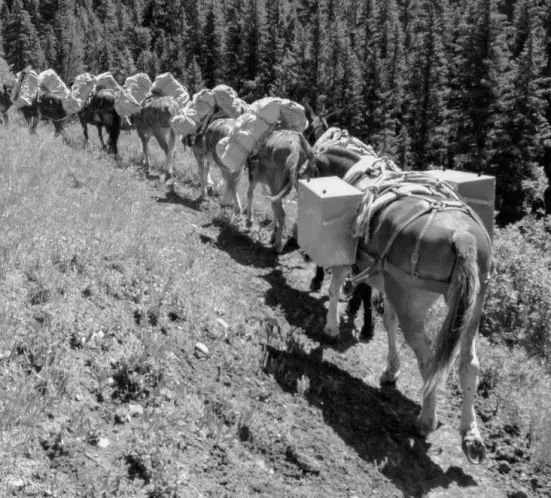
The morning of the departure arrived, and a special service was held so that the whole town could send them off. It was a tedious procession. Jonathan led with his staff in hand, at the head of a string of six burros. Three of his devotees followed on each side, helping guide the beasts, along with the smaller animals in tow. Beast and man were loaded down, and they reached the edge of town already tired, from so much waving farewell.
Even so, it had been obvious a few days earlier that they couldn’t carry all the supplies they’d need in one trip. So they decided to send back two of the young men with the pack animals some ten days hence. From these two loads they would have enough to build a cabin and start a farm and begin the shrine that was to be the talk of all the world.
They set out on the same north-east course that Jonathan had followed before. He kept the two lads he intended for the return trip close to his side and marked every few hundred yards of their course with three stones piled one on another, so that they couldn’t possibly get lost.
They seemed like pleasant lads as they chatted and walked. They were probably in their late teens. Jonathan remarked to himself with surprise how full he was of things to teach. Pretty soon he called his followers to his side and asked them what names they went by, among their friends.
The tallest of the boys, a skinny lad, said that he went by the name of "Sprint."
Then his shorter companion, who had a wrestler's build, reluctantly offered in that he was sometimes called "Nose."
"What sorts of names are these?" asked Jonathan.
"All we have," said Nose.
"What are your parents' names," continued Jonathan, "the old ones, that also belong to you?"
Sprint said that he called his father, "father" and knew of no other name. But Nose teasingly added that Sprint's father went by the name of "Gruff" in his neighborhood.
"Well, we can fix this matter right now," said Jonathan. "My own name is Jonathan, and you may call me that at all times. You, Nose, shall from now on shall be called 'Paul,' and Sprint, you shall be 'Peter.' Remember it."
Then he called upon the rest of his group, and after hearing "Cherry" and "Feather" desisted in even asking.
He named his first-chosen girl "Mary" and the other two "Sarah" and "Eve." To the remaining young man, the scribe, he gave the name "Simon." They continued on their march.






