
Towards noon Jonathan called his troop to a halt, to eat lunch at the top of a hill. From this height they could see the land rolling away in all directions, out of sight of the sea. When Jonathan noticed his wards all gawking at the vistas around them, he realized that they’d never been two miles outside their own town limits before. Now the whole world was in view. When he sat down to eat they insisted on bringing him his food and drink and then seated themselves around him, like so many mute disciples, waiting for him to speak.
It would be hard for anyone not to be secretly pleased by such attention. But Jonathan was no friend to formality. The Church had too much of it. "From now on you must eat as I do," he said. "I will be your teacher, but in all else we must be equal."
Simon was about to speak but stopped himself. Jonathan felt a strong urge to change the subject.
"Consider this," he went on. "Someday this little path we tread through these hills might be a busy highway, crowded with pilgrims. If that happens you’ll remember that you were the first to travel it. Or you might, like me, go to the ends of the earth on some great mission, to enlighten mankind. I’ll teach you all I know, if you’ll listen, and you’ll have no regrets that you followed me."
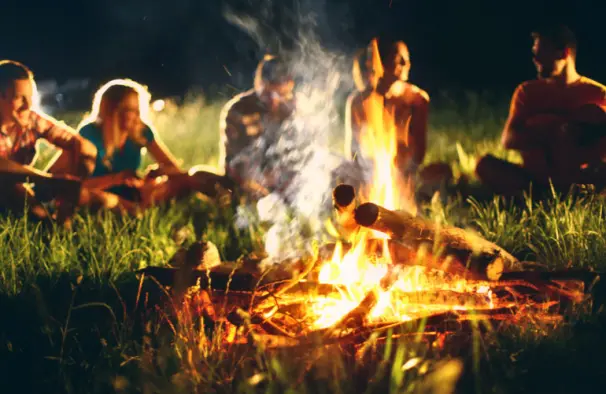
They proceeded the rest of that afternoon all silent, either full of thought or weary of the walk. That evening they reached a valley with a meager pasture for the animals. They pitched three tents while Jonathan built a fire. After the meal Jonathan reclined against a bundle of supplies and told them stories of his travels, while they sat and stared at the dancing flames.
After he sent them to bed he lay there awhile longer, thinking of the days to come and how he might employ these innocents. He knew he could keep them busy. A solid shelter would have to be constructed and a farm laid out. This would take time, so he decided he would arrange a schedule so that he had a few hours each morning to work on his book. And in order to do this without disturbance he resolved to keep his own cabin off limits to the others. It would take time to gain their trust, and minds, and introduce them to his own real purposes and history.
The next morning they rose cheerfully and broke camp as quickly as Jonathan could have done it alone. Just as they were about to set out Simon asked Jonathan if he had forgotten the morning service. Jonathan excused himself for this slip and led them in one long prayer and a song.
"When we’re traveling," he said, "this is all we need to do. But each of you can pray along the way as much as you see fit. After we build our village and our shrine you can have a daily service. I’ll help you in this, but you must remember, good work is good prayer."
They started off again, marking the path and making good time. Jonathan knew the countryside from the time before and guessed that if they pushed on they could reach the place by nightfall. He wanted to arrive there in the dark, so that he could park his troop in the valley and then sneak off to his cabin, to clean up the exterior of the place enough to make it presentable to them the next day.
He’d already stacked most of his books back in the cellar before he left, to protect them from rain. But there were probably a few stray ones and other odd things, lying right inside the door. He wanted to make sure his papers were out of sight, along with the other items on his desk. He could hide everything downstairs and then cover the hatch with a mat and put some cloth over his windows. This would insure his privacy when he wanted it.
All this came to pass just as he’d planned. They reached the hidden valley just after the sun had set and while they unloaded the animals and set up their camp, Jonathan took leave and found his home just as he’d left it. In a half-hour he was done cleaning up. As he was about to head back down the hill he decided to take two cans of beans with him, tearing off the faded red and yellow labels so as not to shock anyone. When he returned he set the shiny cans on a flat rock right next to the fire and then went about unpacking a few things. He was curious to see who’d be the first to question him about the strange objects.
When they sat down around the campfire to eat, Peter was the one to speak up, but not until after a minute of obvious staring.
"May I look at this," he asked.
Jonathan leaned forward and tossed him one of the cans. Then he took up his knife and began to cut open the other can, explaining, "this is a can of beans, which we’ll cook and eat." Then, after a thought, he added, "brown beans."
When they showed no signs of being shocked he realized that they didn’t know what he’d said. He passed the can around for all to see, opened both and placed them near the flames. His followers still didn’t seem the least bit shocked, only curious, and Jonathan took this as a very good omen. Any Churchman who had lived the revolution would have condemned these beans to immediate destruction.
Only Simon, with his more formal education, dared to ask, "but are we not told that anything not completely white must never pass our lips?"
"There was a time," replied Jonathan, "when that law didn’t exist, and these beans come from that era. But they are still good, as you shall see. To satisfy the law we’ll add a little white paint. It’ll help cool them. And remember, they were found at this holy place and may impart a holiness to us."
When the hot beans were superficially whitened and then dished up in equal portions, Jonathan helped himself to the first hearty spoonful, with evident delight. After the first timid tastes his disciples all agreed that the strange food was very good, no doubt for its unfamiliar sweetness. Jonathan was pleased with this agreement, as if he’d just won a battle.
He had, indeed, made one important discovery. Up to now he had no idea of how the young were indoctrinated by the Church. He feared they might be strongly prejudiced against everything old. But it seemed that Church educators had opted for the far easier course of never mentioning the things outside their system, thinking that total ignorance of the old world was as good as it’s destruction. But here they made a gross miscalculation, he thought, as he watched these youths eagerly scooping the beans into their mouths.
"Those old fools could burn and bury an entire civilization and erase the map and paint it white and deny it was ever there. But give these kids a taste of sugar, and we'll see who'll be burning things next, for a crime."
These reflections put Jonathan into a cheerful and expansive mood. He watched Peter holding up one empty can to the firelight and admiring its ridges.
"These cans," Jonathan broke in, "used to be very common, as our forefathers knew the art of preserving foods for many years, if need be."
"Why don't we practice such arts?" asked Peter.
"Because there’s no need," Jonathan replied. "Food is grown more wisely than it was before. There used to be many more people and the food had to be carried in large ships and vehicles from one end of the earth to the other."
"Yes," Mary chimed in, "and then the people sickened and the world began anew."
This, Jonathan surmised, was probably the full encyclopedia of the girl's historical knowledge. Then he added with a sigh, "Yes, they made mistakes and paid a heavy price for it in death. I’ll tell you their long story from time to time so that you and your own children don't fall into the same errors as they did."
These young people were happy to hear this. They’d been brought up in a strange limbo, and told how things were, but never told why. Even the simplest of them would sometimes ask a question that would anger the elders, only to receive the blunt reply that all such thoughts were unholy and dangerous. But they were secretly disturbed by such responses and made up many fantastic tales which they whispered into each other's ears, about a mysterious era that had to exist.
Now they were amazed to find in front of them an old man, apparently ready and willing to answer all their questions, to bridge the gap that puzzled them. It was as if an island which they had long marvelled at in the distance was now accessible, the water between covered over one cold morning with a dazzling ice. It was, no doubt, a thing to approach carefully, to probe and to tempt many times before venturing on, but the bridge was there.
They made small talk for another hour or so, while Jonathan laid back and stared into space, devising plans for the following days. He sat up abruptly from this revery and told them they’d better get some rest, with much to do the next day. They joined in a brief prayer and then crept off to their tents, while Jonathan fell asleep where he was, by the fire, after the long day of walking.






