
Lickers
I woke up to the sensation of Ben shaking my shoulder. My head was aching. It was the second hour of morning and the family were just preparing to go to the church service and on to work. They each bid me ‘good luck’ and thanked me for my visit. Then they opened the door and quickly slipped out into the empty street. I thought they must be late and in a hurry.
I picked up my satchel and bicycle and blundered out into the morning air. To my surprise a small stream of people were coming along the way and looking oddly at me as I stood in front of the open door. I quickly closed it and stepped into the street, not wanting to draw attention to the house. Then I began walking and pushing the bicycle along with them, in the direction of the central square, hoping to blend in. My plan was to turn onto the first side street I came to and then sneak away along empty lanes.
But at the next intersection there was an even greater flow of people and I was caught in a tide of souls, all heading in the one direction I wished to avoid.
I was not yet awake enough to perceive my plight. I was strolling along dreamily, trying to imagine the size of the square that could contain such rivers of people. I was now hemmed in on every side and my bike was becoming an impediment, often knocking others or being rudely bumped.
I realized that I had better get out of here fast, and so I tried to push my way over to a wall where I could stop while the masses flowed by. I would feign some delay until they passed, then sneak away when the road was clear.
But getting to that wall was not easy. I knocked and jostled several people, tripped up a child and held up more traffic while helping the boy back to his feet. His mother was angry with me and complained loudly. Then, what was worse, I caught up with a large fellow from behind with my front tire. He turned and smacked me hard in the arm and called me a ‘foul dog’. Nor did the commotion go unnoticed.
Finally, I made it to the doorway of a large building and crouched, pretending to examine my pedals. Just as the crowd began thinning two officials with silver insignia flapping on their chests came up and hemmed me in, asking to see my card.
Panic gripped me. I nervously showed them the card from the messenger I’d bludgeoned. The shorter one grabbed it, pulling my neck forwards and staring at its embossed symbols. Then he let it go. But they both noticed the bloodstains on my shoulder as it happened. The larger one clapped my arm in his and told me they had a complaint I must answer for. The other took my bicycle and they led me along the back streets, now empty, to a lone door in a long and windowless two-story structure that stretched the whole block, no doubt some sort of police bureau.
But we went straight through the building and came out at one corner of the square. We stood at attention like the thousands in front of us. Even though it had been three years since my last service, it was all too familiar, the bullhorn lecture packed with empty slogans and schoolboy jingles chanted back on cue. We stood with the cheering crowd for a long half-hour, until it finished off with a prayer for the whiteness and brightness of the world.
All the time my mind was intensely active, trying to grasp the implications of this sorry end. For I was fully resigned to the certainty of my death. I knew I’d be tortured but was so lacking in any believable explanation that I didn't waste my few remaining moments trying to invent one.
When the ceremony was over my guards led me back into the building along a dim corridor and up a dark flight of stairs. The next hallway was lined with office doors, much like the old bureau I worked out of as a messenger. "At least I’m not in the torture chamber yet," I thought.
We entered a small conference room. It contained a table and six chairs. The walls were featureless except for one high window, too high to use, and a framed, white sheet of paper below it, like some false window. The room was empty. One guard left, the tall one still holding my arm and sitting me down next to him on the side of the table facing the light. We sat in gloomy silence.
After a few minutes had passed I noticed him staring at me quizzically. The expression on his face looked positively pained. He was probably wondering what I’d been doing in the crowds with my bicycle, and perhaps was worried that I had some perfectly logical explanation which would put his arrest in a bad light.
At this point a roundish, balding, middle-aged man stepped in and sat across from us. He was clearly my captor's superior, as the giant stood up and bowed to him and then elbowed me in the ribs to do the same.
The official wasted no time, obviously a busy man:
"Well what were you doing obstructing traffic this morning?" he said in a high-pitched, complaining voice.
I could think of nothing to say and looked at him sheepishly. The near prospect of death seemed to be making me bold.
"What's your station?" he roared. "Empty the mailbag."
The guard did this for me. His hands were shaking. The balding official shuffled through the packages impatiently then leaned over the table and ripped the identification card from my neck.
"So you’re from White Seat, eh, and getting here just in time for the morning service," he went on in a sarcastic tone.
"Either your night vision is extraordinary or you've found some warm bed in our hospitable town in which to refresh yourself before proceeding to duty."
I broke in at this point and told him I had a fall, pointing at the bloodstains and my head-wound. "I spent the night at the side of the highway, not far from town, and walked my bike in this morning. It was all I could do."
I could see by his changed look that he didn’t like my explanation. There was a hint of truth in it that foiled his nasty opinion. Now there appeared a gleam in his eye.
"If you spent the night outdoors your clothes would still be damp."
"I slept under a tree," I replied.
"You know we have ways of finding out the truth" he said, growing impatient with me. "Tell us who she is and it may go lightly for you."
A fear now came over me. They would use torture until they found out my story. I considered myself a dead man but wanted at all costs to protect my new friends. I realized I had better change my tune and not anger the people about to tear into me. So I covered my face with my hands as if full of grief and said in a pathetic, sobbing voice, "I have sinned, master, many times, against many women. Now I am caught, with crimes upon my head."
I buried my head in my arms and started sobbing, in hopes of bringing the interview to an end. The official let me go on like this, silently pondering my case. Then, standing up, he said in disgust, "take him to the basement." By this I knew he meant the torture room.
As the guard led me into the hall the official called out: "wait a minute." We looked back. He was peering at me intently, as if trying to see through me. "Have the messenger lists brought to my office," he said, "and report back to me with his confession, and don't kill him. We'll throw him to the dogs for his bad habits."
Even though I still pretended to sob it was hardly pretended grief that now troubled my mind. Many thoughts raced through it as we went down the hall and a dark staircase. My first concern was for Hiram, waiting for me in the woods in vain, and the real messenger tied to that tree, now doomed to a slow death by my very humanity, with food and water enough to stretch out his existence for days, and no way to get loose.
I thought of Ben again. Biting my lip I resolved not to succumb to the torture and reveal him. But here, I thought, I had the advantage over my captors. Since the abolition of personal names it was hard to refer to anybody in particular, even when one wanted to. There were job titles and generic titles and looks, but the symbols of the identity card were unspoken. I couldn’t single him out or his house in a hundred words if wanted to, and this thought comforted me.
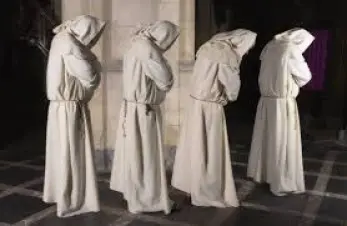
I was led into a small, torch-lit room and chained, arms and legs against a damp, stone wall. My guard then left me. A few moments later two hooded priests came in. The first carried a pan of glowing coals swinging from chains. He also carried an iron poker which he began heating. The other, who had a gaunt and stern appearance, stripped me to the waist, all the while mumbling some prayer.
This scary one then took up the iron and seared me twice on each arm, as if to see whether it was hot enough. The other asked questions, starting out in a general way, such as: "what is your profession, your residence, your work record?"
The questions had no point and so I lied readily, except that the grim priest had a bad habit of searing me after each reply, almost like a punctuation mark, whether the answer was satisfactory or not. He was now applying the burning metal to my chest and I almost fainted with pain at each branding.
When they got around to my crimes I started making up longer answers, putting off the burn that would inevitably come when I paused. But the pain got the better of me. By the seventh or eighth wound I was rattling off a long, half-delirious list of paramours, all the women's names I could think of, old style. Then the iron touched my cheek. I passed out. A searing wave of white light swept over me, and then nothing.
I woke up in the dark, alone, in feverish pain and thirst. I was still chained to the wall. Finally the door opened and two hooded men let me loose. Each took an arm to lift me and slowly walked me out of the building and into the streets.
The day was just dawning and a cool mist revived me just enough to open my eyes. The streets were deserted. I could see in the faint light that these men were in rags and guessed that they must be ‘lickers’. Then it struck me that they were the ones referred to by the official the day before when he mentioned ‘dogs’. I’d never heard the word applied to them before but it fitted them perfectly. They cowered along the fringes of the street even as they hurried and looked like beggars.
We made our way to a row of wooden bunkers near the harbor. These buildings had no windows. I was taken into the furthest of these barracks. The door opened and I saw before me a long table and at least forty more of these strange men all sitting at it, eating from crude, wooden bowls and licking their spoons, giving me only a cursory glance as I was carried in. I was taken along the line to an empty seat, and a bowl of some kind of porridge was set before me. As no spoon was brought with it, and everyone else silently minding their own business, I began eating the gruel with my fingers.
Now I was sure that this was a company of lickers. Such a grim and rough-looking bunch of shaggy-bearded men could be nothing else. I remembered from years earlier that they were never to be spoken to, as they had all taken vows of silence and wanted their ears left alone. Their tongues now had no more business with words.
They lived in a self-imposed poverty, on the cheapest of foods. Their clothes were as white as their faces but often in rags from so much washing. They each owned a bowl, a spoon, a bell which they kept tied to their belt, and a canister for paint, which hung all day about their necks, like the albatross of the ancient mariner, though it was their one useful tool. They had no identity cards. Their persons and their comfort had been sacrificed to the service of the Church.
After breakfast I was given my bell, a spoon and a canister, and a bunk was pointed out to me as my own. There was a single blanket folded at the foot of it. It was a bed of planks. An empty bucket was stored beneath it.
Besides the two rows of bunks along the walls, and the central table, there was nothing, except for some washbasins at the far end of the room. As I looked around I could see why the state had no need for prisons. This was penal servitude in its most perfected form and its walls were adamantine, rooted deep within each prisoner's mind.
The strange thing was that I remembered the lickers, in their early days, as the true pride, the glory, the storm-troopers of the Church-militant. There was no task too big, too tedious, too dangerous for them. At a single command they would set to work and swiftly and silently carry out each assignment to its end. Their number was legion. They contained all the best and most fiery blood of the young recruits.
I remember how thousands of them, in two summer weeks, with only their belts and buckets and tongues, licked the whole Bay Bridge white, from its underbelly to its highest spanners. They worked day and night, and hundreds fell to their deaths in the attempt. Yet the job was done, and rewarded with only the report, and the respect.
They accomplished many such grand feats in the early years and people stepped aside and waved to their ranks as they jogged on by in the streets.
But the first, high enthusiasm waned, as I suppose it must, even before I left the cities. Their complexion was already changing into the one I could now plainly see. The big projects ran out or were performed by more professional workers. The lickers slowly turned into a beggarly order, wandering in small groups like stray dogs, mostly through the debris of construction sites, looking for any refuse or corner they could whiten. They were often given unsavory tasks and so they came to be associated with foulness and trash. And being silent and given to obedience, how could they complain?
The company I now sat with looked as if they’d been carrying out this sad drudgery for an eternity. They must have been in their late twenties or early thirties, but they looked like old men, disheveled, stooped, grim and prematurely toothless from years of spitting paint and mouthing all sorts of foul objects for the purpose of coating them. I wasn't feeling too chipper myself and I supposed I fit right in, which was a good thing, as I’d had enough of being singled out in this society.






