
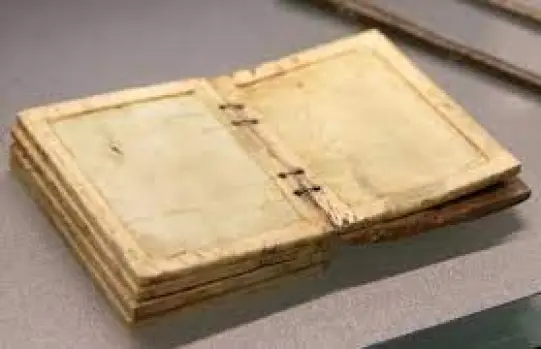
Wax tablet, twitter.com
That first morning I could barely walk. I was led with the rest to the nearby wharves. The leader of our squad was the man who had pointed out my bunk. He was as sad and as taciturn as the rest and his only distinction, as far as I could tell, was a staff and a pointed beard that was longer than anyone else.
We spent the whole, long day standing in cold water, from ankle to waist deep, spitting up paint against the under structure of the docks. We were directed in our labor by the goads and prodding of our leader's stick, and sometimes by blows when we moved too slowly. Our canisters were filled every half-hour by two lickers standing nearby with a drum in a wheelbarrow. Not a word was heard all day and we retired exhausted at nightfall to another bowl of the same gruel and then to our bunks. We were exempted from attending services, either because we were so holy as to need no encouragement, or because we were so smelly and ragged.
That winter was the darkest and worst of my whole life, which was never sunny. I spent my waking hours crawling and groping and spitting with this abject crew, usually in the harbor district. Each morning we trudged off in single file to our project, sometimes the rusty hold of a ship, sometimes the high rafters of a workhouse, but most often the dumps around worksites or behind factories, ringing our bells whenever pollution was found, gathering around it like children finding an old shoe, then coating it as if we were removing one more bit of evil from the eye of the universe.
Although I didn’t realize it at the time, the profound shock of my capture and torture and hard labor had deadened my mind. I lived as if sentenced to a slow death from which there was no possible escape, killing all hope and self-concern. I stumbled out of my bunk each morning to a wordless, rainy day, and back each night exhausted, to a dreamless sleep.
My health deteriorated. My wounds had left painful sores that wouldn’t heal. A rheumatism invaded my bones and a constant cold infected my lungs. Even though I didn’t think of escape, I doubt if I had the strength to run away. I had barely enough energy to shuffle through another day, like an old man. Besides this, I was always surrounded by my fellow laborers, while our captain kept a close watch over us, stick in hand.
Since the days of winter were short we were often led indoors in the evenings and set to work by lamplight, whitening up the workplaces after everyone else had gone home. We were sent to a cafeteria sometimes and I remember eating all the scraps I could find. We put things in our mouths so often no one noticed. The others, I believe, were too far gone to think of improving their meager diets. Life for them had come to assume a stranger meaning.
It was with this occasional food and the warmer days of spring that my mind, as it were, thawed and showed fresh signs of life. I had dreams again and often thought of Ben, Hiram and my lost tribe. I made vague plans to get away, as soon as my health improved, to travel through the forests to my people and even come back afterwards and rescue Ben and his children, setting up stations of supplies along the way to make their journey comfortable.
The rest of my existence that spring was bleak beyond description. I realized one day that my hopes for escape were only daydreams, played out like movies to mask my wretched lot. My health was not improving and I had no solid plans for a getaway. I was in the center of the city, under constant surveillance and my clothes marked me as one always supposed to be with my group. I thought of a night escape or else swimming the bay or even stealing a boat. But by now I had just enough life in me to want to preserve it, and with my present strength such an attempt seemed impossible.
So my thoughts turned grim, matching my fate. "A plague upon us," I thought, "Why couldn't we use brushes, like the rest of the world, and finish our work in half the time? Why couldn't we talk, at least to receive and acknowledge directions, like the public workers around us? We make ourselves contemptible for no reason!" I was disgusted with my group and often near other people, and loved hearing, even listening to their chit-chat and joking.
I looked up to carpenters and masons as blessed beings. They seemed to talk constantly, I guess because they worked without blueprints, or rather whiteprints. Foremen were constantly explaining things in loud voices or drawing figures in the dirt when they were at a loss for words. Not so for us. The bell and the stick completed our world. On occasion a word would escape me inadvertently, but a sharp blow to my back would recall me to my fate.
Then again, ours was a religious task, not a public one. And our religion was not cheerful. Only its color was white. Its spirit was dark, as with all shifts born out of desperate and tragic times. Its theme was death, a reintegration with the universe, a worship of the great, white flash that was supposed to start and end it all. Our lives were meant to represent a steady march towards this end, an ‘enwhitenment’ of ourselves and everything around us, a preparation for death, and a death in life.
Those black marks that one day began appearing on people’s skin, the first symptom of the plague, took a far greater toll on those they spared than on those they killed. They blackened our minds and left us crazed victims of some divine punishment, trying to wipe away all stains with frenzied thoroughness.
When I look back on it now, it must have been during this dark winter that the first inklings of these realizations began dawning in my mind. The following year was one long preoccupation with such thoughts, and a slow and systematic organization of them. I’ve come to believe that the early inceptions and growths of our ideas lie far anterior to the time when they first show above ground, so to speak, like the shoot of a plant, in our conscious mind.
I remember it was during one of those long, dreary evenings, sitting on a cold stone floor with buckets of nails in front of me, scraping the rust off each one with my teeth and licking it white, that an idea started in my head that was to radically alter me. If I could understand the underlying psychology which directed this religion, and the sick, upside-down logic it employed to manipulate its people, then I’d have a handle and become something a little better than either a victim or an escapee.
I became quite a philosopher when I was made to shut up for several years. But this change saved my life, gave me purpose and rendered me whatever I am today.
I was still without hope and continually sickly but survived the first year and on through the following winter and spring. Not a few of my sullen comrades died during that period. There was no such thing as a sick leave for us, or even a doctor, and we crept to work whatever our condition, supported by our fellows if we were too weak to walk. We died at our posts while our fellows rang their pathetic bells to signalize it.
It was apparent to me that our order was fast dying out. There were never any replacements or new recruits. Almost all of us suffered from stomach disorders and malnutrition. The paint that I was constantly swallowing was slowly poisoning my own system. I could feel it in my bones. It was supposed to be non-toxic but my joints began to ache and I sometimes fainted, like all my companions.
The only good thing that came out of their deaths was my own promotion; first, after a year of hard service, to canister-filler, then, after the unlucky fall of our group leader from a ceiling beam to staff-wielder.
There was one general supervisor who managed all the squads, and whose job it was to inform the group leaders of their assignments. He sometimes watched us when we worked and so I made it a point to look smart when he was nearby. When our leader fell to his death I was chosen to succeed. The others resented this at first, as I was in a way the youngest of the group.
But I quickly changed their opinion of me by never using my staff, except in a sort of showy way when the supervisor was nearby. He also grew to like me as I was quick to understand his meaning and prove it by my gestures and nods. He was short-tempered, probably from dealing with mutes all of the time and was glad to have one underling who could faithfully and quickly carry out his orders.
Even though I gained no privileges from this promotion and continued to share the same poor diet with my men, my health slowly improved. I was now free from drinking paint and could stand and watch while others worked. I again began thinking of escape, but I put it off. It was still winter and I was waiting for spring, when the forests would brim with edible life, which I knew very well how to pluck.
But other things conspired to alter these plans. As spring came my alacrity gained me yet another advancement. It happened one day that my friendly supervisor was reading to me a list of the places we were to purify that week. One of the symbols on his wax tablet had smeared and he paused over it a minute. But he noticed that I bent over the wax to see if I could unriddle it. He looked at me in amazement and then handed me the tablet and I silently read it, moving my lips. Then he handed me his stylus and bid me write on the opposing leaf two simple sentences which he spoke. I did this and showed him my knowledge of a language I had long ago deciphered.
The language was a simple one. It was another one of those strange compromises which the new order was forced to make when its leaders condemned all old style print. But I must admit that their shifts were sometimes ingenious.
Besides burning all the books they could lay their hands on, they wanted to destroy the alphabet and all possibility of reading it. As they only worked in white they adopted the old Roman practice of writing and keeping records on wax tablets. These were thick films of wax which were spread on two wooden boards which could be closed and protected like a book and used and erased many times.
For their meaning they employed a series of symbols, somewhat like Egyptian hieroglyphs, pictographs that stood in place of our own syllables and phonemes. From my own identity card I was able to decipher three of these symbols and I was often handed letters with the addresses distinctly placed, the names of which told me what the other fifty symbols meant.
Numbers were even more simply coded by different patterns of dots. Our identity cards held several of these configurations, denoting the districts and streets to which we were assigned for work and sleep, along with our meal tickets. All this information was encoded by numbers which officials could check in the streets with a quick feel. For the dots were embossed on our white, plastic cards so that a blind man could read them, so great was the state's fear of even the appearance of reading.
From these identification cards and tablets came a whole, huge bureaucracy, with its agencies and departments, trying to keep track of its people and wares and works, a thing inconceivable without written records. And ancillary to these developments came the messenger service to which I once belonged.
We couriers were never taught the codes but being in daily possession of so many examples of it and given my philological background, my voracious appetite for reading, and the total lack of any other material, it wasn’t long before I was an adept in this language and an avid reader. The letters they handed me were never sealed because they thought their code was secret enough.
The code of this city, White Van, was the same as the one I remembered and it gave me no pause. All the cities must have made a concerted effort to standardize their records long ago, or perhaps the whole idea originated and spread from a single source. When my superior realized that I knew it, he was baffled and amazed. But I continued writing on the tablet, since I dare not speak, that I had once been a special envoy for the city of White Oak and entrusted with these secrets.
The next day I was taken away for a few hours from my troop to the temple and shown to several priests as if I were a spectacle and drilled again in my knowledge of the language. I passed the test but nothing seemed to come of it, since I was sent back to my post and continued in my daily routine for the next few weeks.
Then one late afternoon I was called aside by my supervisor and handed a blank tablet. He said he had need of a scribe and would borrow me for the next few hours. My lickers could manage well enough on their own.
I took down a letter about a clique of priests in the temple who somehow intercepted and meddled with my boss’ correspondence. He directed me to the office of a certain priest in the temple and told me to wait there and make sure the message was not only read but erased, and then to bring back any reply.
From that day on I was borrowed many times and began to be used not only by my superior but by two other managers and the priests in frequent correspondence with them. I still ate and lodged with my fellows but spent hours each day on errands.
Apparently there was a rift between some city officials and a set of priests in the temple. The priests pulled the strings of government and it was forbidden for working managers, like my own, to have direct communications with them. They had to go through channels and offices, where all sorts of chicanery sprouted up.
My own status was too low to ever be questioned at the temple gates. I became a sort of secret liaison between one set of managers and priests, and because I was mute, they thought me trustworthy.
Most of their letters were complaints against their enemies. But one of the notes informed me of a rumor just arrived, of a big project brewing, soon to be announced, and sure to spell the promotion and fortunes of a lucky few.






