
Though I’d never seen the city in its former state it was obvious that most of it had been razed to the ground. The hills on every side were barren, denuded of trees and structures for miles around. When we reached the border of these hills we had a better view. We could see with our glasses the specks of people and carts moving along the streets. On the waterfront we saw factories with smokestacks smoking. Behind them, on another hill, there were reservoirs like those once used to store oil. On the furthest hill, to the south, were rows of shiny glasshouses, no doubt the food supply of this community.
What amazed us most was the dazzling whiteness of the place. Everything was so bright it almost hurt our eyes to gaze upon. It was not like the dull, greyish-white cities I remembered, full of the dust of demolition and reconstruction. This was obviously the perfected result of such toil and zeal, and countless coatings of paint.
Around the edge of the city, forming a margin or belt about a quarter mile wide, stretched an extremely smooth and white cut of land that appeared to stand in some symbolic way for a wall. We were intrigued and wanted to get a closer look. So we hid our canoe and circled around to the east.
We crossed the first naked hills hastily, as there was no one in sight, wanting to get a look at the place before the light failed. I noticed now in the low weeds and grass I was treading over that there was a great deal of rubble, pieces of concrete and charred wood and the outlines of streets. This must have been an old suburb of the city, destroyed by fire, and now crudely razed.
Soon we came to the top of another mound at the edge of the trimmed hillside. It must have taken immense labor to smooth and plant this lawn. Before us lay thick and close-cropped acres of the whitest grass. On the opposite hillside we spotted a small flock of unattended sheep, which probably accounted for the trimness of the grass. It felt strange to walk upon, almost slippery beneath our leather boots.
We went another little ways to another crest from which we could spy. Only a small portion of the city was visible, most of it obscured by another height, but we dared go no further because the dark color of our fur clothing would stand out against this backdrop. Indeed, this was the only purpose I could imagine for the lawns themselves, to give a visual warning of someone's approach. But the labor of this defence must have far exceeded any other work imaginable, and I guessed right that it was just one more of the sick aberrations that had infected the thinking of the Church.
One thing we could see was a road painted white and in good repair, coming east towards us and then turning south through a valley before disappearing in the distance. Then we saw someone on a bicycle travelling on it towards the city, probably a messenger just as I had been. So this meant the presence of another city to the south. From what I remembered it would probably be White Seat, the capital of the Northwest.
In the fading light we caught a glimpse of another scene that bothered us. Across the bay to the north of the city we spotted a landing and a road that wove into the hills, in the direction of our own camp. At the water's edge there was a dock and a ferry boat, and it was now being loaded with what looked like a platoon of men, coming home from some kind of work. They were standing in a square formation and wearing the same uniforms of long, white robes. We were at a loss as to what their business might be, but knew we had to discover it for the threat it posed to our own people.
It was dark now and we retreated to the woods to camp for the night. By our small campfire deep in the forest we debated the possibility of another city to the north. But this seemed impossible, unless it was further north than our own camp, and the highway to it broken or just being built. We had scoured the coast all the way down and found nothing. But perhaps roads were being built further inland and from both directions, as they usually were, and about to converge somewhere dangerously close to our own camp. The situation seemed critical. We had to get more information before we returned, which spying through binoculars was unlikely to yield.
So I conceived a plan that night for a daring mission, the outcome of which I was to ponder and rue for many years to come.
By our campfire we decided that there were three questions we had to answer; where this highway to the north led, what the squads of men were doing on it, and what cities or towns lay further up the coast, threatening our own group.
We decided to split up. Hiram would travel north through the woods and spy upon any crews there and trace out the road to see just how close it came to our camp, warning the others if there was danger. I would circle south and choose some spot along that highway and waylay a bike messenger. I would steal his uniform, take his bike and enter the suburbs of the city. There weren’t likely to be officials in those parts and I could question some pedestrians about a city to the north, as messengers commonly did, and make my way back out of the place before suspicions were aroused.
Plans often seem neat and sensible in the conceiving. The only hitch to ours was that we couldn’t tell how long it would take to accomplish our ends. We spent hours discussing where we’d meet up again, as if the rest of our plan was a "fait accompli". We finally decided to make our canoe the rendezvous point. If Hiram chose to head further north he would come back and leave a note to that effect before setting off. Otherwise I would find him there or wait until the fourth day from now, before heading out on my own. I had to assure him again and again that I could find the tribe.
After a few hours of sleep we rose at dawn and with a warm handshake parted for what would turn out to be forever. I don't want to appear superstitious, but I can’t help noticing that every time I’ve given someone a warm handshake something important has gone seriously wrong a short time later on. A few days afterwards I made a mental note of this but forgot it again until it happened again.
I travelled alone that morning to the south and to the west, intersecting the empty, white highway about five miles south of the city. Then I walked along it until I discovered a suitable spot for an ambush.
The construction of the highway was curious. The rubble of the old highway had been broken up into pebbles to make the wide shoulders for one newly painted lane, about ten feet wide. I found a spot where a large boulder was left close to its edge. I could hide there and jump any passing bicyclist within seconds. I had my pistol in my belt and a hatchet to encourage me.
The road was deserted and I sat there into the afternoon. Finally I spotted a lone bike-messenger heading towards me, up a long incline and probably weary of the toil. Just as he passed I rushed out, almost too late, as he nearly escaped me. But the shock of looking back and seeing a man in furs, hatchet in hand, and chasing him like an Indian, undid him. As he looked back he veered into the gravel and lost his balance. I caught up and knocked him a blow to the head. He fell to the ground unconscious. Blood wetted his hair.
He was a young man, clean shaven, as tall as me and probably stronger, considering his pace up the hill. I was glad the first blow had stunned him.
The bike was undamaged. I hid it in the brush and then dragged him into the woods, far enough from the road that his cries couldn’t be heard. It took me awhile to switch his uniform with my furs and tie him to a tree. But he didn’t come around. I shaved myself quickly and applied the white ointment he carried in his satchel to my face and hands. I left his arms free and my food and water within reach, hoping he’d wake up soon and live until I returned. Then I cleaned his wound and splashed water in his face, but to no avail. The last thing I did was to wrap up and bury my weapons nearby, hopeful I would be back in a few hours to free him and go on my way.
I picked up the bicycle and mailbag and gave myself one last visual inspection before setting out. The only flaw in the outfit was the stain of a few drops of blood on my shoulder. But the hood concealed that when it was down. It was the custom in the cities never to show oneself in public unless immaculately clean. But I could explain, if need be, that I had fallen on the road and hadn’t had the means to repair the damage.
I started off and slowly pedaled my way toward the city, to all appearances the same as when I rode out of another city some two-and-a-half years earlier. It was late afternoon. A shiver of fear came over me as I approached the marginal zone.
I could see stray sheep here and there, and, as I came over a crest, at least two dozen hooded people ahead, mostly women and children, wandering about on this lawn, some quite near the road. They were all looking down and bent over. Some were even on their hands and knees, crawling about, much like the sheep, lowering their heads at intervals, apparently spitting at things or else looking for small objects, as if on an Easter egg hunt.
As I came closer I could see that they all had the familiar canteens of white paint at their sides, from which they were filling their mouths every few minutes. It was then that their pathetic business dawned on me. A young child looked up and waved as I rode by. I waved back, but then lifted my hood over my head to see only the road ahead and be as inconspicuous as possible.
It was terrible to think what sort of life these people were living, chasing after sheep droppings. But the particulars of religious fanaticism always sickened me. I had to remind myself to concentrate on my immediate task, to find out what projects the city had in hand to the north and get back with the information as quickly as possible to Hiram.
I was now entering on the first rows of houses. I wouldn’t call them houses, though they were used as such. They looked like barracks, since they were all uniform and joined together, each with one door and one window. The structure stretched a block in length and followed exactly the curve or straightness of the street. There were no yards or plants of any sort, only brick walls, and every one of them as white as could be.
The wider streets, avenues, all radiated out, straight from the temple and its large, open square, which I could already see ahead of me. Smaller streets intersected these and they were curved, like the ripples from a rock thrown in a pond. I turned on to one of them when I saw where I was heading and passed many of doors, each one exactly like the next. Then I looped back to remain in this strange suburb.
This was a far cry from the cities I remembered. The place was as symmetrical as a spiderweb. The towns I knew were filled with all sorts of miscellaneous dwellings, assigned in blocks to people of the same job classification, since families were almost nonexistent. At least in its external aspects this civilization seemed to have reached a perfected state.
While I was wrapped up in curious speculations I realized with a start that I had been riding back and forth in the camp of the enemy. I had no plan and had to keep pedaling for fear of breaking a law. I rode another half hour trying to avoid the same streets and any attention.
But the danger of my plight began to dawn upon me. Perhaps inner-city communications had changed so much that my presence in these parts was already suspect. I passed people who starred as I went by, making me all the more nervous. Already the saner part of me was urging that I turn the bike around and hurry away as fast as possible.
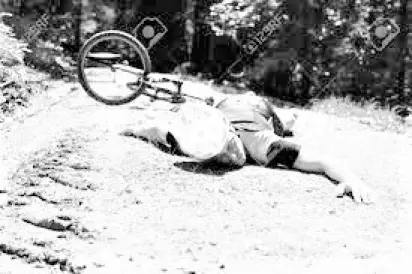
With growing fear and confusion I settled upon one attempt before heading out. I rode until I found a street that was deserted except for a single person standing before a doorway. Coming up from behind, I would pretend to fall as a pretext to ask a few questions. It was a woman. I could tell this from the gasp that I heard as I spun the front tire and flew headlong into the cobblestones.
Unfortunately the landing was a little too hard. I raised both arms but my head still hit stone. I woke up seeing stars, disoriented and in a state of shock.






