
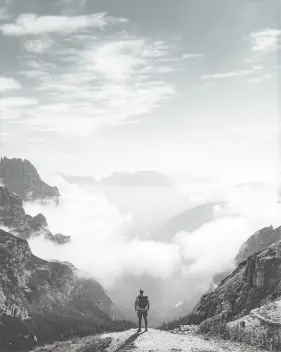
Our trek, ge.com
“As soon as the first warm days of spring arrived, we prepared for our next move. We had a fair supply of food and about sixty able members left to carry it. But even in leaving we had some bitter choices to make. First, we decided to burn the camp that somehow harbored the plague. But along with this went the greater portion of our baggage. What weighed our group down most in these desperate times was its own humanity. The year before we had exhausted ourselves by dragging heavy bundles of clothes and pictures and knickknacks and tools and even chairs and bicycles, along with heavy litters for the sick across the mountains.
By now we realized our folly. The four pack horses we had then were dead, eaten along the way. But in the fire that we made of this extra baggage we recognized the loss of a part of ourselves, in the pictures and books and the pieces of technology that burned. It was as if cruel nature were winning the battle and degenerating us despite our efforts, turning us into the savages we were trying to flee.
All those relics had been preserved in the hopes of a better life over the mountains. We set out this year over more mountains with many of our hopes lost in that black column of smoke, though we were better fitted out for our journey than ever before. We still had one working computer and its precious disks and a few other remnants to remind us in our rags of what we once were.
The sick were a more complicated matter. Each litter required two strong men and reduced by a hundred pounds the food we might otherwise bring. After some debate we settled on three litters, which was far more sane than the eight we dragged the year before. No one was left behind, and the few who needed it most took turns being carried. For those who died along the way there was a brief pause and a decent burial.
We had maps but no precise destination this year. We followed waterways, mostly dry riverbeds across the deserts of Nevada, to the east and north. We ended up, by early summer, in the white, tree-covered hills of Idaho, full of game and rivers.
We travelled cautiously, in a tight little column like the year before, sending a team of scouts ahead to warn us of everything in our way. We skirted every town and roadway for fear of rovers. But we encountered no one, nor any sign of people, until almost summer.
It happened as we were approaching the crest of a bald hill. I was near the head of our column. Our scouts were nowhere to be seen. A group of Indians in a column longer than our own suddenly appeared, marching straight towards us on the same dirt path that we were following. We had not a minute to react. We met them in mute astonishment.
But more astonishing, after a moment's hesitation, they proceeded to file right past us in perfect silence, as if we were no more than pedestrians passing on a street. As soon as they walked by I dropped my load and ran back with two others to confront their leaders. They stopped, out of kindness I suppose and spoke between themselves in their native tongue, completely foreign to us. They were wearing their ancient dress and had women and children and even a few babies with them and seemed to be well.
After a few minutes one of them told us to be on our way. I begged him for any information he might have of other white men like us. He said we were all spirits now, paying the price for our folly and returning the land to them. "We will not harm you" he continued, "because we see you are passing away by yourselves. But we will have nothing to do with you, because everything you touch has the contagion, so go and meet your destiny."
While I pleaded on for some information, they spoke a few more sentences between themselves in their strange tongue and then bowed to us as a sign that our interview was over. We were powerless to do anything but walk away.
In one respect, as I thought on it afterwards, I was secretly glad at the appearance of these people. It meant that an alternative model of human life showed some prospect of surviving, and that the religious intolerance so spiteful towards any form of diversity would be foiled in its mad schemes, for a long time to come.
A few weeks after this encounter we descended into a valley which seemed rich enough to support a winter camp. There was a small river here and another lake, and such steep hills on every side that we seemed to be hidden from the rest of the world. There was an abundance of fish and small game which we hunted poorly with our crude bows and arrows.
We again built a longhouse and a palisade. We planted crops, picked berries, and enjoyed a slightly more comfortable winter than the year before. We now numbered sixty three. Only seven were lost during the journey, five from disease and two scouts, mysteriously. It was a cold winter, but we had enough food and wood, and we enjoyed social hours as pleasant as any in the years before. We felt comfortable and secure. Only two of our members fell ill.
Our number might even have enjoyed one small addition that winter, had the baby, which I fathered, survived. But that was not to be, and probably best for the world that we live in. The mother died soon after, and along with her all the parental ambitions I have ever known. The plague had touched her a few years earlier. That it never touched me I have often found reason to curse.
Spring came and we began to spend our days and nights debating our next move. One set urged that we stay here, as a permanent camp, and send out scouts to contact others instead of jeopardizing the whole tribe in aimless wandering. The other group, with which I sided, voted that we all go on in a body. There were bound to be better camps than this in such an expanse of deserted territory. Then there was the incident of the two scouts the year before. How many more might we lose by sending them out in all directions. The rule was that there was safety in numbers. We agreed on one point; our best chance of a decent future depended on our joining up with another group. We no longer had the numbers to continue on our own. In the end we left together.
This spring we left the structures of our camp standing. We even hid a few tools and supplies in case we did return. When we set out we carried hardly any provisions with us. We didn’t have many left and yet we were more confident than ever.
There were streams and rivers throughout this region and the fish abounded. It didn't take long, after the disappearance of man for them to regain their former plenty. A few of us became adept at catching them. Our diet and our health improved. We ate fish every day. Nature seemed to be shaping us into her own mold which we gladly accepted as our one chance of survival.
A few days travel to the north lay the deep gorges of the Snake river which we descended and started following at a leisurely pace towards its source.
One morning, as we were breaking camp at the river's edge, there came out of nowhere a young man dressed in furs, wearing a fur cap and carrying a rifle on each shoulder. He asked if he could join us. We gathered round him and asked who he was. He called himself a trapper and had been living in these regions all alone for the last seven years. He said he knew the area well and could help us out in the matter of survival. Besides this he informed us that he’d been watching us since we’d set up winter camp and wished to join us now because he knew we were decent people, not like some others he had spied on. After a minute of deliberation we gladly agreed that he join us.
On his advice we made another camp on a more elevated bank a few miles upriver. While we were setting up our tents he went off in the afternoon and returned a few hours later with a fresh-killed buck on his back, proving he was worth any five of us in getting food. The whole tribe feasted on its good fortune that night.
After dinner we sat by the fire and asked the newcomer about the people he’d seen in these parts. The news was a little disappointing. There were no communities anywhere near, just a few scattered bands of Indians who would have nothing to do with us.
There had been one group several years earlier, wandering with no purpose. But they were less adapted to the wilds, more sickly, and suffered in the end from internal dissension. In the middle of a cold winter they split into two factions of about twenty each and parted to die miserably of starvation over the next few months. He said he’d watched the whole, sad drama unfold through his binoculars. He even regretted not aiding them, especially towards the end. But he said both groups had bad leaders. The last survivors even took to cannibalism in one camp, but they all died of cold and hunger, in two wretched hovels, less than ten miles apart.
Besides these, he told us, there were a few others, always in groups of two or three or four, but no women. These men were to be avoided, he said, because they robbed and killed. The especially violent ones the Indians themselves killed, as he came across the remains of those slaughtered. All these men depended upon their dwindling supplies of ammunition, and their days were as numbered as their bullets.
His name was Hiram and he was a remarkable fellow. He’d grown up in the mountains with his father in a cabin. As a boy he’d learned all the skills so valuable now. When the plague broke out he’d just been sent off to school. He quickly made his way back to the wilderness and his father, to escape the contagion.
Realizing that their stay in the wilds might be a long one, they set up a string of caches full of supplies and ammunition. This took over a year but it was enough to last them a lifetime. Then his father fell sick after buying the last of their stockpile. His final words to his son was to avoid humans at all costs and he took this advice to heart and spent the next three years in the deepest recesses of the Rockies.
But loneliness and a lack of purpose finally led him down the mountains, and he developed a habit of spying on others and shadowing them, for some shadow of company.
He was surprised once by several Indians. But he discovered by the gift of a rifle and some ammunition that he was welcome to trade and coexist with them, an honor they extended to no one else.
He told us that in his opinion we should go west, for milder winters and better game. He was heading in that direction before he spotted us. If we were to find any others like us it would be there. The mountains were barren of people.
It didn't take much debate on our part to agree. We told him our own stories of 'rovers' and our policy to stay well away from any towns wherever we went.
So we followed the advice, almost the leadership, of our newcomer and organized ourselves along more military lines. Our first order of business was to collect some of the supplies he’d hidden in the mountains. We built a small stockade for our group, while I and four others left with him for two weeks to help carry back his treasures. He left behind the two rifles, since he also carried a pistol which he never parted with. The six of us set out straight into the mountains.
It was on this very first trip that he began teaching us about survival. He showed us how to make and set traps, track game, find our way, and what plants and roots were edible. From my eagerness to learn and from some similarities in our characters it didn't take long before he and I became close friends.
We travelled high into the mountains and after visiting two of his stockpiles, descended loaded with twelve more rifles, scopes, thousands of rounds of ammunition, metal traps, fishing gear, binoculars, maps, compasses, knives and four more pistols with holsters.
From now on we felt like a little army and for the first time, the masters and not the slaves of our environment. We still took every precaution though and sent out armed scouts whenever we moved. The first and last members of our column were also armed, while the baggage carriers and weak ones filled the center in comparative safety.
We kept to the valleys and forests, avoiding roads and open spaces and the charred remains of towns. I was often a scout and soon learned to hunt with a rifle. Hiram and I would often be ten or fifteen miles ahead of the others marking a trail, roughing out camps and stocking them with supplies of fresh meat for the others to enjoy at their day's end.
With all my questions about every detail of the woods and his endless questions about my past life in the city, before and after the plague, our conversations were almost continuous, from dawn till late into the night. I suppose he was catching up for all the years of solitude. But I couldn't tire him with questions or answers, no matter how long or detailed they were. For every fine lecture he gave me about the properties of plants or the habits of animals, he expected one back, on history or government or anything else that I knew.
By late summer, without a single accident or encounter, we reached the Pacific coast at a spot that we calculated to be about eighty miles north of the old city of Vancouver. There were islands off the coast and good fishing, but no sign of man. We made canoes and searched the region and built a solid winter camp five miles inland along a rushing river. It would have been dangerous to settle on the coast, where any passing ship might surprise us.
After our fort was built it was decided that before winter set in Hiram and I should journey south along the coast and see what had become of the city there. We travelled slowly, on foot and carrying a canoe, as there were inlets to cross.
On the fifth day, after rounding a point in our canoe, we saw across a wide bay a white fortress commanding a small port, with concentric circles of streets and rows of houses covering the uneven terrain of small hills behind it.
We could also see a long, white tanker at one end of the port and smaller boats that looked like fishing trawlers, lining a row of wharves. We paddled our canoe to shore in case there were other vessels nearby. We could tell the city was bustling with activity and could even hear the sound of hammers banging upon metal and travelling across the still waters on that quiet afternoon.






