
Dash has been steadily and heavily increasing its market share and visibility in Latin America. Venezuela in particular has been a heavy focus – among other countries with volatile and insecure currencies.
But where can they go next? What market should the Dash Core Group (Ryan Taylor please accept my LinkedIn Invite) focus on next?
Countries with weak or highly inflated currencies are a clear target. Dash postures itself as “Digital Cash” and seeks to compete with other companies in the digital payment space. So this leads me to think, that multi currency countries should be the next logical focus.
For countries and territories that operate in 3+ currencies – a push for a unified method of digital payment, and, an easily convertible digital alternative for various currencies may drive adoption rates – especially as tourism and international trade hopefully begin to pick up after Corona Virus.
The Caribbean case for adoption
There are currently at least thirteen different currencies in circulation among a population of roughly 43 million people. Often times island to island currencies and rates can vary. And, while most islands will accept some mix of Dollars and Euros, most will give back change in the local currency -thus rendering money for tourists or business people effectively worthless - unless they plan to withdraw more local money.
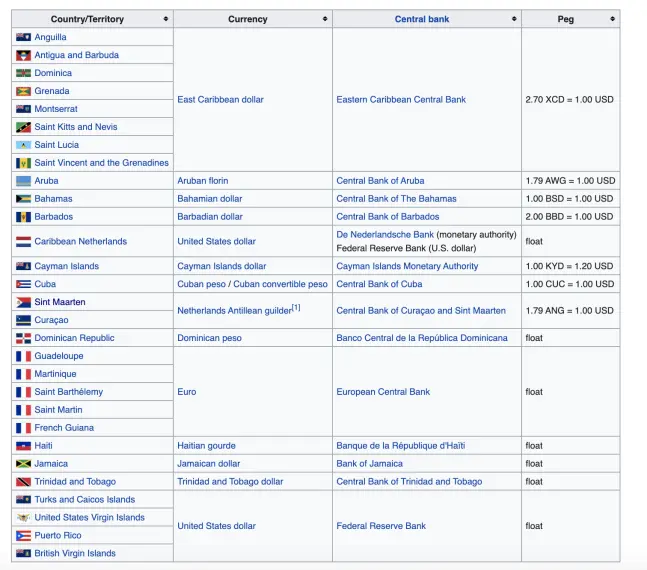
Source: Wikipedia
I can attest to this first-hand after spending a number of weeks on a particular island. I paid in dollars for some groceries and received back euros, dollars and the local currency. With the current weakness of the dollar a 1 for 1 exchange rate on the island would have meant I’d have effectively lost money if I’d paid in Euros.
For tourists, this poses an issue – pay by card and expose yourself to high conversion fees offered by the generally less than helpful banks. Withdraw money in the local currency and accept that anything left unused at the end of the trip is useless to you. Or, receive back a strange mixes of currencies which may or may not all be worthless to you.
The issue for merchants
Due to the complicated currency setup in the Caribbean, and limited scope of the central banks for each nation – many payment processing companies view the Caribbean as high risk. Thus, integrated and online payment options are low and fees high.
In this article from mastercardbiz.com – the author explains that, in order to receive lower transaction fees and merchant processing fees, many companies in the Caribbean must weigh the cost of becoming a US corporation, in order to have access to more processing companies with better rates.
And, while the author states that larger corporations like Paypal may help merchants, rules and requirements vary by country – making it difficult to carry funds internationally and withdraw into the correct currency.
In addition – many merchants are restricted from opening accounts with their current banks in currencies other than their own for electronic payment processing, either due to low transaction volumes, or the high risk of a volatile tourism based market. The Finextra blog states:
“While in the Cayman Islands most merchants have both a KYD as well as a USD merchant account, in the Bahamas and Barbados there seem to be some restrictions in place. In Bahamas, merchants need to have an annual card volume of less than US$100K to open an account in USD, which is in sharp contrast to Barbados, where only a few very large merchants have been granted permission by the central bank to open an account in a foreign currency.“
The barriers to digital transactions then force merchants to transact in cash, that can easily be converted (though for a fee). However, this then poses the risk of alienating tourist business, when change can only be given, or partially given in unusable currencies.
The Solution is Dash
The solution I believe lies with the adoption of Dash. With near instant settlement speeds and ultra-low transaction fees (fractions of cents) – this provides merchants a decentralized and autonomous way to collect payment and pay customers with a decentralized “tourism focused currency”. The pending release of the ability to create usernames within the Dash application -and ultimately the Dash Core Group’s mission to be come a competitive payments and digital cash application make the Caribbean a prime location for adoption.
In addition, the decentralized nature of Dash means there is a very low barrier of entry for merchants to transact or even set up payment terminals. Without the need to verify transaction volumes, or certify which currency they accept, merchants can easily begin to accept payments from islanders and tourists without the need to haggle over physical cash and exchange rates.
Tourists can then shop confidently, knowing that the exchange rate of 1 dash to 1 dash remains constant – and, when they are done with their trip, any remaining Dash can be converted back into their own currency, should they desire. Or, they can leave it in app, to use on other trips.
A universal, easily accessible and secure blockchain network may be the solution in general to currency exchange woes – while simultaneously providing a daily solution for merchants in a sizable demographic area. What remains to be seen is how Dash can expand its ease of use to the tourism sector – helping even those tourists who are relatively technology adverse or uneducated use this universal solution to a multi-currency system.






