
Introduction
Previously I wrote about what I learned in a Dave Ramsey course in financial literacy and how I ended up agreeing with his preference for the snowball method of debt repayment over the avalanche method despite it not making as much sense, mathematically, because of the psychological benefits gained from reducing debtors.
Dave also weighed in on another financial matter, once again snubbing the mathematical side for the psychological one: cash vs. credit card. Dave opposed the use of credit cards—acknowledging the ostensible appeal of their cash-back rewards programs but arguing that using them results in increased spending as opposed to cash, which, according to Dave, has a stronger deterrent effect since you actually witness the money leaving your hand.
On this issue, I disagree with Dave. I acknowledge the risks of credit cards—mainly, the slippery slope that arises in the appeal of only making minimum payments and then being subjected to exorbitantly high interest rates. In that sense, credit cards aren’t for everyone. But, if you have enough discipline to pay off your credit card statements in full (and to use them for legitimate expenses, rather than as an excuse to spend beyond your means, as Dave fears), you’d be leaving a serious amount of money on the table by not using them—not just because of the cash-back rewards they offer but also because, if you use them properly, they essentially enable you to give yourself a never-ending, interest-free loan of at least 4 to 8 weeks.
Credit Cards and Cash Back
The average American household has approximately $5,000 in monthly expenses. Let’s say $3,000 of that could be placed on credit cards. That’s $36,000 per year that you could be earning a percentage back on. Many credit cards offer up to 5% cash back on rotating categories over time, with anywhere from 1% to 1.5% cash back on every other purchase. Let’s take 1.5% as a conservative average, resulting in an estimated $540 back in cash, every year, just for paying with your credit card instead of cash or debit.

That’s $540, every year, you wouldn’t have if you had paid for those expenses using cash or debit cars. That $540 invested in Bitcoin a year ago would now be worth $3,367 today, an increase of 524%. (New to crypto investing? Consider my Coinbase referral link and earn $10 in free BTC). Want to feel really depressed? Here’s what that $540 looks like over the past 5 years if you had used it to buy Bitcoin:
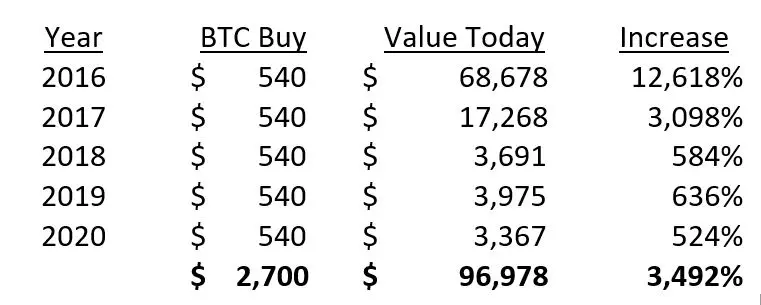
As long as you’re paying off your credit card statement in full every month and keep your spending focused (remember, money not spent on unnecessary things will greatly exceed the 1.5% cash back you’ll get on it), not using a credit card to buy things you’re already going to buy anyway is leaving a lot of money on the table.
Credit Cards as Free Personal Loans
The cash back alone would be enough for me to recommend credit cards over cash, but there is another major benefit: monthly statements. Unlike debit cards, which initiates a withdrawal from your linked checking account separately and daily for every purchase, credit cards work in monthly cycles, where everything you purchase during that cycle is aggregated together and billed to you at the end of the cycle. Even better is that you do not have to pay off that balance until the next month.
That is, if your credit card cycle ends on the 1st of every month, that means that everything you buy this month from May 2nd through June 1st isn’t due for payment until July 1st, and if you pay it all, in full, on that date, it literally costs you nothing extra. If you don’t pay off the balance in full, though, you’ll get hit with some pretty rough interest rates, so never use a credit card to buy something unless you know you can pay it off.
This gap between date of purchase and actual date of payment is therefore a significant opportunity to lend yourself money for free. This is especially appealing for major purchases, particularly if you time the purchase to occur at the start of a new cycle. For example, if you needed to buy an expensive item that cost $2,000, using that same example cycle of the 1st of every month, if you were to buy it on May 2nd, you’d essentially be getting, in addition to the item itself, an interest-free loan of $2,000 for almost two extra months, as that payment wouldn’t be due until July 1st. Even if you purchased it at the end of the cycle on June 1st, you’d still get to keep your $2,000 for an extra month compared to buying with cash or a debit card.
If you have more than one credit card with staggered cycle dates—say, in addition to the one with the cycle ending on the 1st of every month (Card A), you had a second credit card whose cycle ended on the 15th of every month (Card B)—you can essentially gift yourself at least a 6-week free loan on all of your regular monthly expenses just by switching your usage to the card with the newer cycle. For instance, if you buy gasoline and groceries daily, you would use the first credit card (Card A) from the 2nd of the month through the 15th and then switch to the second credit card (Card B) from the 16th through the 1st of the next month. Thus, if that example $3,000 of monthly expenses were spread out evenly throughout the month, this means $1,500 would go on Card A and would not be due until 6 weeks later and $1,500 would go on Card B and also not be due until 6 weeks later. Until then, though, you can put it to use making you more money.
Consider investing it in a cryptocurrency lending platform. (New to crypto lending? Consider my BlockFi referral link and earn $10 in free BTC). BlockFi offers free deposits of fiat into stablecoins (meaning, you don’t have to worry about volatility, as what you put in will be what you take out) and also a free monthly withdrawal back into fiat, using ACH transfers with your bank. Estimating a one-week processing time on either end, this means that 6-week free loan to yourself of $3,000 can be invested in 4-week increments into stablecoin lending. BlockFi has rates of 8.6% APY (which is 8.28% APR), meaning that a rolling $3,000 investment, compounded monthly, would net you $258 per year:
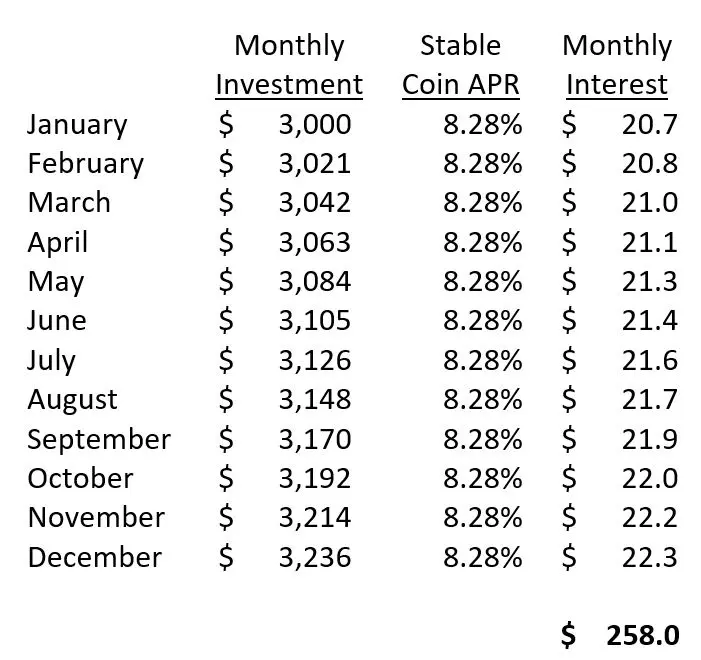
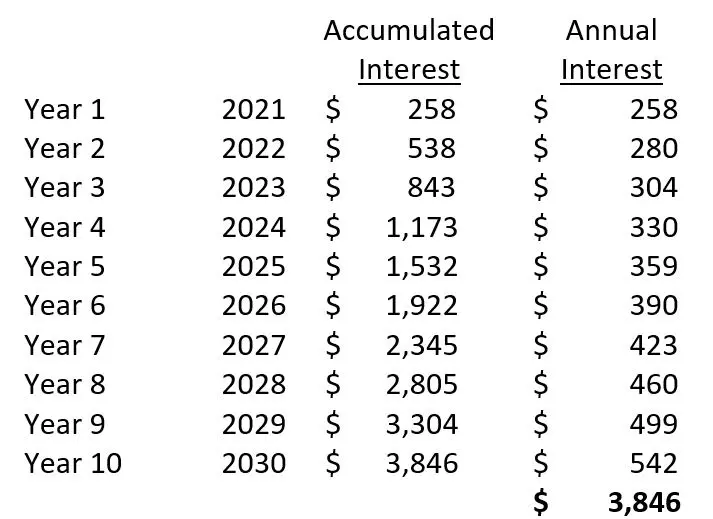
If you kept doing that, you’d have $1,532 after 5 years and $3,846 after 10 years. (Of course, rates may change, but, actually, BlockFi currently has a promotion of stablecoins from 8.6% APY to 10% APY, so that change could be for the better as well).
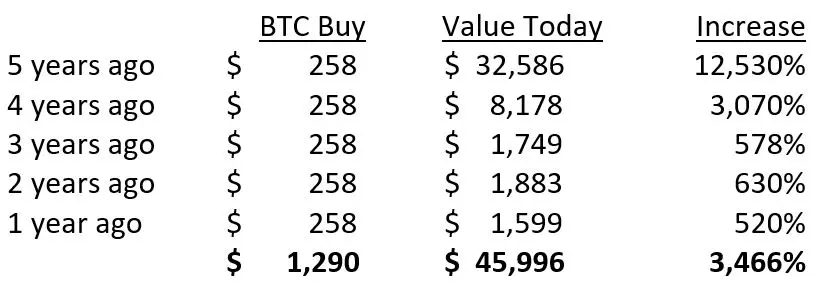
Or, if you want to feel bad again, here’s what it would’ve looked like if you had swapped out that $258 for Bitcoin annually each of the past five Mays:
In fact, BlockFi’s flex interest option enables you to automatically have your interest earned from stablecoins converted to cryptocurrencies like BTC or ETH. Again, this is money you’re creating for yourself just by using credit cards strategically to buy things you’re already buying, instead of using cash or debit.
Conclusion
If you play the game right by always paying off your credit card statements in full, using cards that give you cash back, and staggering your credit card usage to maximize the time you get to hang on to your own money, you can potentially earn a significant amount of money every year, not just from the cash back but also from earning interest on the money you’re temporarily holding onto longer thanks to the monthly cycles of credit cards. And that’s without even factoring in what gains you’d potentially see if you use that extra money to invest in other assets, such as stocks or cryptocurrencies.
I have been using credit cards for most of my expenses for over two decades and I have never paid a penny in interest because I always pay my statements off, in full, on their due date. Instead, I’ve enjoyed cash back rewards on these purchases regularly these past two decades, and now, in addition to that, I am earning interest on my own expenses by using credit cards’ monthly cycles to delay payment and therefore loan that money to myself and investing it in the interregnum.
(Photo by RODNAE Productions from Pexels)






