
Publication in Russian on the Zen blog
https://dzen.ru/a/adpVWH0JDDjE27Wx
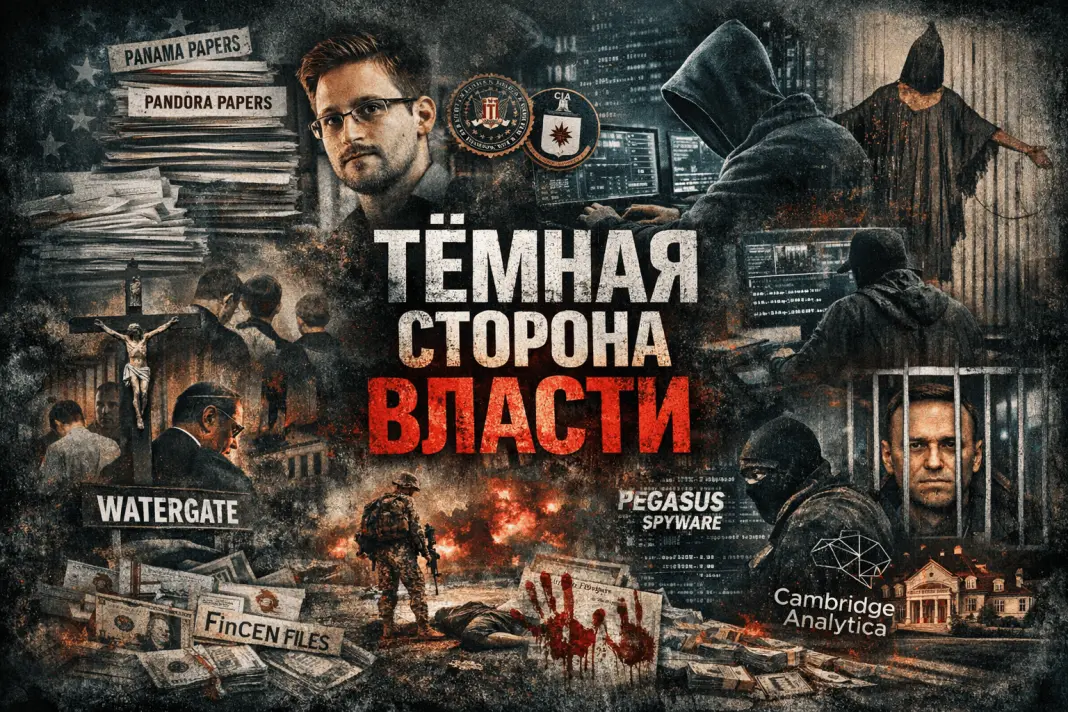
The most "dark" selection is real journalistic investigations and leaks, where the system of violence, control and cynicism is shown without embellishment. It is important to remember this today.
1) The Panama Papers. The collected archive of documents from 1977 to 2015, consisting of 11.5 million files. Rich and influential people (politicians, businessmen) hid money through offshore companies. This investigation is the largest example of cooperation between journalists, which has led to resignations, criminal cases, and a global scandal. The Panama Papers are proof that the law is mandatory for some, but not for others. The Panama Papers showed the main thing: corruption is not a system failure. This is the system. Only for the poor it looks like prohibitions and punishments, and for the rich it looks like “optimization”, “structuring” and “tax planning". That is why such stories infuriate the authorities the most. Because they don't just uncover schemes. They show that those at the top have no morals other than keeping their money and power. Remember: if a man from the podium teaches you patriotism, honesty and order, and his assets are sitting offshore, you are not a statesman. This is a parasite who lives off a system that he publicly portrays as protective. The Panama Archive showed the very rot that can be seen if a beautiful package is torn.
2) The Pandora Papers Archive. This is a sequel to the Panama Papers.
Only the scale is even bigger. Documents have been leaked again. Offshore companies again. Politicians and billionaires hide assets, register property through shell companies, and hide how much money they actually have. While ordinary people are being told about "transparency" and "laws",
from above, everything is arranged so that nothing is transparent. Pandora Papers is proof that big money has the main right to remain invisible. Pandora's Archive is not about papers. It's about greed, hypocrisy, and power, which loves shadow more than responsibility. The Pandora Papers showed the main thing: corruption does not hide from the system — it is often the system.
3) Edward Snowden and the surveillance investigations. Edward Snowden is a symbol of the fact that state surveillance has long been out of control and has become the norm. He showed a simple and scary thing: you can be followed not because you are a criminal, but because you just live in a digital world. Correspondence, calls, metadata, movements, connections — all this can be collected, stored and analyzed. The authorities like to talk about security, the fight against terrorism and the protection of society. In fact, this often means one thing: the more control, the less freedom. Snowden tore off the beautiful mask from the system. He showed that surveillance is a business process, a technology for managing people. That's why his story still infuriates everyone who likes to say, “If you don't break anything, you have nothing to fear.” That's a lie. There is something to be afraid of — not the law, but arbitrariness. Because when the state knows too much about you and you know almost nothing about it, it's no longer a social contract. This is an asymmetry of power, where some have access to your life, while you have only the illusion of privacy. Snowden has shown that security is too often used as an excuse for total surveillance.
4) The Watergate scandal. Watergate is how the government reaches complete paranoia and turns into a mafia under the guise of democracy. While they tell you, “Everything is fair, the system is working, the law is in place,” meanwhile, there is wiretapping, blackmail, and espionage operations against their own citizens and competitors at the top. The power machine does not protect the country, it serves the politician. The most disgusting thing is that all this was disguised as “security” and “protection of interests.” This story has shown a simple thing, that power, unchecked, inevitably turns into a crime.
5) The British company Cambridge Analytica. This is not "just a marketing firm" - it is control, data collection, manipulation. If you don't understand how your “preferences” and “opinions” are formed online, then you may have been making decisions that have been planned for you for a long time. The company collected the personal data of millions of Internet and social media users without their consent to compile their psychological profiles and develop personalized advertising, to develop programs designed to influence political preferences and voter behavior. The consequences of the scandal have led to serious investigations by the authorities of various countries, as well as stricter regulatory requirements for companies working with personal data.
6) Investigation by the Boston Globe (Catholic Church). The Boston Globe is an explosive demonstration of how the global religious system has been covering up for pedophiles for years. The investigation revealed a simple and cruel thing:
the church was not protecting children, it was protecting its name, reputation and power.
The priests who committed crimes against the little ones did not disappear from the church — they were simply transferred to new parishes, to new cities, to new victims. And the whole structure of the system was built so that nothing would pop up. The church, which preaches about conscience, morality, holiness and family values, has become the main criminal. The hypocrisy is that
People who say “family, faith, purity" have allowed their ministers to ruin the children's lives for years, and then silently transferred them from parish to parish. The Boston Globe is when you thought that the church was a “spiritual home.” But it turned out that the most heinous crimes were hidden in her basements, and no one from above wanted to stop them. Not because they didn't know. Because it wasn't profitable to know. The Boston Globe is an imitation of holiness, it's about how long the world has been silent when it rests on blood and silence.
7) Abu Ghraib (Abu Ghraib is a prison in Iraq). This is not "just torture in prison." There, behind bars, they showed the truth that everyone did not want to see: the military and special services are people who, having gained absolute power and complete impunity, turn the prison into a sadistic show theater. Prisoners were locked in cages, stripped, humiliated, trying to squeeze information out of them, even if there was none. And it was done with photos, videos, and jokes—as if they weren't filming torture, but a dumb reality show. Abu Ghraib is a system where they say that "tough measures are needed for security," but in reality it turns into beatings, humiliation and sexual violence. The most disgusting thing is, when the world saw these photos, the world found out about it, the authorities got into an "indignant" pose, and pretended that this was an exception. But in fact, this is the norm that the system reaches without control and without morality. And this is about any system where some people decide for others, for whom "they" are not people, these are "problems" that can be tortured, humiliated, raped. Abu Ghraib is a blow in the face of an illusion that ends with torture instead of freedom, cages instead of democracy. This is about any place where the authorities decide that a person's life can be ruined if it is "necessary for security." And if it happened once, it will happen again.
8) FinCEN Files. FinCEN files are not just "leaked bank reports." It's about how global banks, elites, and criminals have been turning the "financial system" into a dirty money laundry for years under the guise of "due care" and "regulations." The banks knew that the money was coming from crime, corruption, the mafia, and tyranny, but they continued to spend the money because the commission was delicious and the issues were not their problem. The most disgusting thing is not even the schemes themselves, but a dual system: for ordinary people, there are strict checks, account locks, "suspicious transactions" over 100 euros, but for those who need the system, thin tunnels and offshore. FinCEN Files is about tools that can be hidden, redirected, and protected if you have the right connections and a "sufficiently important" status. The entire global banking system is a system that protects its profits more than it protects people from the crimes it finances.
9) Dieselgate (Volkswagen) - Falsification of data on harmful emissions by Volkswagen. Even large companies systematically lie if it is profitable. This is the largest example of how the corporation has been lying for years, manipulating the law and the environment in order to sell even more cars and earn even more money. They independently programmed the fake software to make the cars look clean in the tests and stink like a pipe on the road. This is not a technique, it is a deception of consumers, states and entire cities. This is when the system, represented by bad managers, chose profit instead of honesty and the health of people and the planet. And if it weren't for journalists, scientists, and complaints, it would have gone on endlessly. Because a business that knows how to lie and hide doesn't stop lying on its own. This story is about the whole world, where large companies believe that rules are for the weak, and there are "additional opportunities" for them. Dieselgate is a reminder that the words "we follow the rules" sometimes mean only one thing: we follow them before we get caught.
10) The Iraq War Logs. It's about what a "civilized war" really looks like: with corpses, lies, innocent victims, and complete indifference to human life. You will not find heroic "liberators" in these documents. You will find reports of interrogations, torture, arrests, mass deaths, cases of shooting at civilians, and attempts to beautifully describe it all as "unintended damage." We are not talking about a "couple of mistakes", but about a system where war turns into a routine, and people turn into statistics. The Iraqi dossier shows that the war that is being shown on TV actually looks like a thousand human tragedies multiplied by thousands, while almost everywhere in the documents the same thing sounds: conclusions, justifications, reports, "further measures", but not "stop this slaughter." The most disgusting thing is not only the number of victims, but also the way they are described: "victims", "collateral damage", "acceptable losses" — all these phrases make people abstract pixels in numbers. The Iraq dossier is about any war led by the "right goals", but in reality turned into hell. It's about how politicians and generals make decisions thousands of kilometers away, and an ordinary family in Baghdad or Mosul gets a real war instead of beautiful slides. If you still believe that "war for democracy" is a pure mission, then the Iraq dossier is a blow in the face of an illusion. Because wars waged under beautiful flags almost always end that way —with charred houses, destroyed destinies, and "official reports" that don't read the names of the victims, but only "losses on both sides." This is about how any large-scale system of violence, led from above, always ends in pain, devastation and lies, which are then covered up with "some mistakes." This means that violence is not a "mistake", but part of the process.
11) Pegasus Project (Spyware for states). The Pegasus Project is not about technology - it's about the fact that the boundary between "security" and "total control" is disappearing very quickly. It's not even "just a virus that spies." It's about how modern authoritarian regimes turn smartphones into pocket surveillance cameras by putting it in everyone's hands. This is the state level, where special services, the army, the police, and "friendly neighbors" use a ready-made system to hack, track, record, read, and listen to anyone they are uncomfortable seeing free. Surveillance of activists, the opposition, journalists, politicians, lawyers - they were all on the same list as "targets." Authorities who publicly talk about the "right to privacy" include a full surveillance regime, including access to a camera, microphone, correspondence, location and files. These systems have contracts, "licenses" — everything is executed "according to the law" in order to conveniently turn citizens into digital test subjects. It's about how any regime that wants to control starts using these tools "to fight terrorism," "to protect national security," "to identify threats" — that is, as usual, to suppress those who ask uncomfortable questions. If you still think that "I don't have anything in my phone to hide," then the example of Pegasus is a punch in the face, it's a reminder that in the 21st century, the most dangerous spy is not a man in the shadow, but a virus in a smartphone that you yourself carry. a camera and a microphone, and someone is watching you from above.
12) Bellingcat investigations. Bellingcat is when state secrets are revealed not by special services, but by people with a laptop. Without access to secret archives. Without "internal authority". Bellingcat is about making it harder to hide, but telling the truth is still more dangerous. In the digital age, governments and propaganda cannot hide everything the way they used to in dusty basements. You don't have to work in a secret service to find out the truth. A smart person, the Internet, and determination are enough. Bellingcat is when ordinary citizens, volunteers, analysts, and journalists reassemble the trajectories of downed planes, track the movements of "unknown" fighters, disassemble viral videos into frames and dates, and turn propaganda into an object of investigation. And the most humiliating thing for the authorities is that Bellingcat constantly brings out what is "not confirmed by anything", before their official "mistakes" and "discrepancies". Bellingcat is not about "super‑intelligence," but about how technology has long given people the opportunity to see further than governments like. The most dangerous thing for any system that lives on lies is that the truth is no longer stored in one building, in one safe, in one "report from above". It's scattered across videos, photos, recordings, and social media — and anyone can learn how to assemble this puzzle. In a world where everything has been printed somewhere, everything has been uploaded somewhere, everything has been removed somewhere, no minister, no censor, no "commissioner" can kill the truth anymore. Bellingcat is a reminder that each of us is a potential witness, not just a spectator. And as long as there are people who want to know the truth, the government will never be sure that everything is under control.
13) Internment camps in Xinjiang. A system of non-legal mass detention centers, which, according to some claims, are operated by the Government of the People's Republic of China in the Xinjiang Uygur Autonomous Region. This is when control becomes a system, this is when technology and power work without limits, this is when control becomes an industry. The state that builds "retraining camps" in Xinjiang is not fighting terrorism. The internment camps in Xinjiang are mass cultural and religious cleansing under the guise of "de-extremism" and "retraining." People there are, in fact, locked up without trial, without normal charges, without transparent procedures. There, people "retrain" them in accordance with the ideology and behavior approved by the authorities. Islam, language, culture, traditions — all this is declared a "problem", not a human right. The most disgusting thing is not only the fact of forced detention.
The most disgusting thing is how China disguises it as "school, aid, social integration," while there are reports of torture, forced labor, sterilization, family separation, and mass detentions all over the world. This is a system where you no longer have the right to be different if you are a Muslim, a Uighur, and not the one the state wants to see. It is a state that teaches people how to become "necessary" and "quiet" by forcibly destroying their identity. If someone still says that "everything is under control there, everything is calm," remember that almost every story about repression has always said: "this is for the sake of order," "this is for the sake of security," "this is for the sake of stability." Xinjiang is a conveyor belt that retrains an entire nation, as if people could simply be "reprogrammed." If you are not shocked by this, it means that you are just used to seeing freedom only where the cameras of the state are not looking.
14) The role of the media in covering the genocide in Rwanda (Rwanda genocide media role). This is when words become weapons. This is an example of how quickly a society can break down if hate becomes the norm and is broadcast out loud. The genocide in Rwanda is not just about 100 days of killings. It's about how the media has become an instrument of murder rather than an instrument of truth. There was no "news" on the radio. It called people to the streets, told them where to look for victims, who to kill, how and when. In fact, it was a broadcast weapon. The most disgusting thing is how quickly propaganda has assumed the right to say: "they are the enemy," "they are dangerous," "they are not like us." Interestingly, many continued to believe that this was a "free press" or "free opinion",
but in fact, it was a shout from the crowd, organized according to a system that turned people into rioters. The Rwandan media was not "just information support" - they were the coordinator, the recruiter, the trigger for the murders, and this is their main, most heinous role. If you still think that "everything is fine on the Internet because it's freedom of speech," remember how the Rwandan radio station Radio Television Libre des Mille Collines turns any speech into a call to kill — and did it not in secret, but on an open channel, as if it were normal. The Rwandan genocide is a reminder that any time hate prevails in the media, rather than critical thinking, you may find yourself in the next "genocide session," only with a different name, but with the same scenarios.
15) MK‑Ultra is not a "strange Soviet experiment." This is a program in which the United States, calling itself the "beacon of democracy," has been turning people into laboratory rats for years in order to figure out how to better control their minds. It's not about "drugs" and "psychotherapy." This is about intensive experiments with LSD, hallucinogens, electric shocks, sensory deprivation, sexual and psychological abuse, carried out on their own citizens, prisoners, psychiatric patients, beggars, military and even children — without their consent, without an honest explanation, without the right to refuse. The most disgusting thing about MK‑Ultra is not only violence, but the way the state and scientists defended it as "science for the sake of national security." People were broken, driven to madness, and then they said: "this is in order not to allow the enemy to manipulate us" — that is, they turned the enemy into the system itself, which uncontrollably experiments with people. And if this was done in the middle of the 20th century, it means that any system that considers itself "above morality" can repeat it, only in a more modern form. If you still believe that "science and government always work for the benefit of people," then MK‑Ultra refutes this. Because in reality, sometimes they work on how to manipulate, break and control even better — and they do it within the framework of a program approved by the special services. MK‑Ultra is a warning: when the authorities and scientists begin to believe that "the end justifies the means," these means almost always fall on the heads of innocent people. The state can do anything as long as no one is watching.
All these investigations show the same pattern: the system does not work as stated, they know it inside, they hide it until someone brings it out. This is becoming the norm in systems. All these stories came to light not because the system "fixed itself." But because someone took a chance and started digging deeper than was "allowed". The reality is almost always worse than the official version - it's just that no one usually investigates it.
About how the system protects itself in Russia. I'll make a reservation right away that now I'm going to tell you about the high-profile cases that have received the most publicity. And whether it's facts or not, whether it's true or not, you decide for yourself. So, about how the government deals with those who open it.
1) Sergey Magnitsky. He investigated corruption, showed how millions were stolen from the state budget. The result: arrest, years in jail, death in a cell. Investigative and international reports have shown not "poor health," but refusals of medical care, bullying, and conditions that are designed to destroy. The system kills not only with a pistol, but also through arrest and "self-destruction" in a cell, which no one officially recognizes.
2) Anna Politkovskaya. She wrote about the war in Chechnya, torture, "purges," and the impotence of the law. Bottom line: she was killed in the entrance. If you reveal a military and repressive mechanism, the system responds not with words in the media, but with a body on the asphalt.
3) Alexey Navalny. He investigated the most transparent schemes — palaces, offshore companies, "rats" in public procurement, live figures. As a result: two assassination attempts, one of them chemical, and the second through the prison system. The system is not afraid of facts, it is afraid of their visibility. If there is a person who makes her transparent, her answer is not an argument, but poison and a deadline.
4) The Poisoning of the Skripals. The use of a military nerve agent on the street of another state. Russia officially denies everything, but logic and evidence remain. The system is capable of operating outside its own borders, without declaring war, but with military weapons in the hands of hypocritical officials.
5) Bellingcat and Russia. Poisoning of the Skripals, Navalny, Flight PS752. Even the most closed systems leave digital and physical traces — and the more they try to hide everything, the more likely it is that someone will put it together in one puzzle - Bellingcat.
6) Chechnya: a local regime of violence. Journalists, human rights activists, and initiators of investigations record kidnappings, "extrajudicial killings," "purges," "baseless" cases, harassment of LGBT people, and anyone who "breathes incorrectly." The investigation is either "abuse of office," or "not established," or "it's not ours." In one state, there may be semi-autonomous zones of violence where the punishing apparatus acts as "uncontrolled," but everyone knows who benefits from it, and no one pretends not to know.
7) The war in Ukraine: international investigations. Mass graves, attacks on schools, hospitals, residential areas, the treatment of prisoners, "accidental" shelling, which always hit the most painful places. Hundreds of investigations, UN reports, Human Rights Watch, Amnesty International show: These are not "mistakes", but part of a tactic where military action is combined with demoralization and pressure on citizens. A system that puts pressure on its own people in peacetime will put pressure on them even more effectively in war, only with more widespread consequences.
8) Prison video leaks. Videos from penal colonies where prisoners are "fined" by torture, the staff pretends that "it's not him", the cameras are silent when everything is visible except the face. Journalistic investigations show that
these are repetitive practices, well-established methods, and regular "training" tortures. The system retains power not only through the law, but also through a hidden regime of violence, framed as an "internal order."
9) Corruption investigations in various "palaces". Palaces, offshore companies, one‑day companies, purchases, contracts, "moderate incomes" and "partner friends". From different sides, like in a puzzle, schemes are being formed, as the state budget turns into a personal wallet for a narrow circle of people. In the system, money and power do not just "intersect" — they are inseparable. Corruption is not a side effect, it is a way for the system to survive.
Information is not just being hidden — it is being destroyed, rewritten, disputed, and smeared with lies. The system protects itself through arrests, poisoning, murders, "accidental" illnesses, closed cells, and "internal" processes. The pressure is not only on the victim, but also on those who open it: journalists, human rights defenders, investigators, witnesses, even those who just "talk normally about their case." Responsibility is blurred: "someone did it, but not us", "it wasn't my order", "I didn't know it", "someone abused it" ‑ a standard set of phrases that allows the system to survive, even if dozens of people die. A system in which its operation cannot be verified does not just become "rigid". It turns into a mechanism that lives off silence, fear, illusion, and bribery.
The most unpleasant thought is that most of these stories became known only because there were leaks, there were investigators, there were people willing to risk their lives and jobs to reveal the truth. Without them, everything would have remained "non—existent": prison cells were silent, the war "would have been," but without the paintings, poisoning would have turned into "strange heart attacks," corruption into "normal incomes." Yes, the system can be tough, but it becomes really dangerous when it cannot be checked.
More on the topic of the publication: They went against the system and saved human lives.
I write and shoot. Join me
Author's video content
https://www.youtube.com/c/ViolettaWennman
Political trash
https://www.youtube.com/@Ship-Shard
I invite you to the telegram channel
https://t.me/shipshard
Highly Social on Zen
https://dzen.ru/shipshard
For goodies
https://dzen.ru/shipshard?donate=true
My hobbies are history, philosophy, psychology, music, economics, politics, and sociology. I write about this and much more. Professional model. She has performed at international music festivals (vocals, dancing, imitation of vocalists). I am studying at the Academy of Arts - the film and art industry, I am a producer and the owner of a video studio.
I am glad to see all of you on my blogs.

You won't lose me here. https://t.me/shipshard






