
Publication in Russian on the Zen blog
https://dzen.ru/a/afdZKGZUSGn7-x2F
"There's no money, but you're holding on": the confession of the man who gave you "Public Services", danced at the alumni meeting and still hasn't turned off Telegram.
Ironic, self-mocking, absurd and "documentary" with pain and farce in half, "Dmitry Medvedev's Diary is Almost the president. Almost the author. It's almost true."
A logical continuation of the first Diary, which I deleted, but you took a screenshot: "Dmitry Medvedev's Diary: almost president, almost a meme."
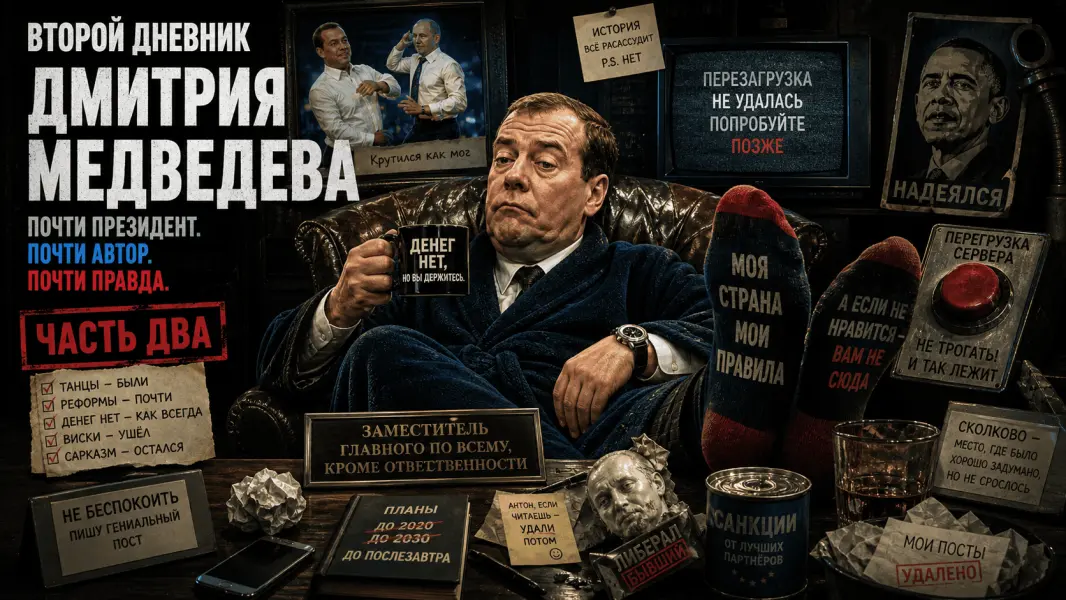
Chapter 7. Public services: how I gave the country a personal account and got cursed.
Do you know what the main tragedy of the creator is? He creates something ingenious, comfortable, ergonomic, and humanity remembers only bugs. God created the earth in six days — and still someone complains about earthquakes. I created the Gosuslugi portal, and now I am hated by millions of citizens who cannot verify their account because "the SMS code does not arrive, and tech support is an artificial intelligence with suicidal tendencies."
The year is 2010. Office. Outside the window is an era that is about to cease to be "zero". Nearby are programmers wearing glasses as thick as a submarine. They explain to me what "digital identification" is. I'm nodding. I think that was the first time I regretted going to law school, and not to some faculty where they teach you to understand why the computer is hanging right at the moment of sending an important letter.
—Dmitry Anatolyevich,— says the chief IT specialist, shifting shyly from one foot to the other. — Imagine that: you will no longer have to wait in line to get help.
"What am I going to do?" I ask, sensing a catch.
"You'll be queuing online," he says honestly. — But it's more convenient. Because you can stay at home. In his underpants.
The phrase about underpants was my personal editorial edit. It was then cut out of the final presentation. Said: "Not according to concepts." But the essence remains: We created a portal that was supposed to kill the bureaucracy. Instead, we created a portal that digitized the bureaucracy. Now the official doesn't lose your piece of paper — he just doesn't click the "Approve" button for three weeks because he has a "day off in the system."
The most offensive post in my Telegram was about the fact that "Public services are love." I wrote it in 2021. Sincerely. With a soul. I even put a smiley face — a heart, red like a Victory banner or like a "Server overload" light bulb in the data center. Two hours later, the service went down. I couldn't stand the love. 2.5 million people could not make an appointment with a doctor. And do you know who was to blame? Me. Because I "jinxed". That's what a political strategist told me. Since then, I've only been praising badminton. Badminton has not broken down yet.
In general, digitalization is like a kitten. At first it's cute, then you find out that he ate all the charging, shat in his sneakers and demands food every three hours. And you're sitting like this, President, and you're thinking, "Is that why I did this?" And then you remember: "Oh, right, so that there are no queues." But the queues remained. Only now they're on the phone. And people aren't standing in them — they're lying down. On the couch. With a bad back. In those very underpants that I so recklessly mentioned at the presentation.
Moral: if you want to make God laugh, tell him about your import substitution plan for software. If you want to make Medvedev laugh, tell him "Public services are working." And he'll laugh. Nervous. Through my teeth. And then he'll delete his laughter after forty minutes, when the assistant taps on the glass.
Chapter 8. About grandma's pension, inflation, and a sense of flight that didn't exist, or "Eight thousand isn't money, it's a lifestyle."
The story of "no money, but you're holding on" has one sequel that I haven't told anyone. Even during interrogations (just kidding, there were no interrogations, there was only a routine audit of the Accounting Chamber, which is the same thing, but with polite smiles).
The same Feodosian grandmother. Her name was (the name has been changed because I don't want journalists to call her, she already has a small pension) — let it be Klavdia Petrovna. After my visit, she woke up famous. Her face was shown on TV more often than mine. Irony of fate: an ordinary person becomes a star because the president told him something stupid, not because he won the lottery or planted a rose of incredible beauty.
A month after that sentence, I secretly sent her a grocery basket through my assistants. Not from personal money, but from what? I had the salary of the president, of course, but everyone knows what to live on there? Joke. But I sent the basket. With butter, buckwheat and five packs of your favorite cookies "Jubilee" (symbolic, right? Jubilee — for my anniversary in a chair that was almost never there). Klavdia Petrovna accepted the basket. And she said to tell him, "Dmitry Anatolyevich, thank you, but money would be better." I almost cried then. Not out of resentment. Because she's right. Absolutely. Actually. In a worldly way.
When I hear about 4% inflation, I understand that this is a good thing. When Klavdia Petrovna hears about inflation at 4%, she counts pennies at the pharmacy, because aspirin has risen in price by a ruble. We live in different countries. I am in the country of the declared indicators. She is in a country where "holding on" is not a meme, but a daily quest.
Speaking of money. I am often asked, "Dmitry Anatolyevich, do you have any money?" There is. But it's not my doing. This is due to my wife, who thought in time to buy an apartment in Moscow while I was writing my diploma. And the credit goes to my mom, who raised me so that I don't consider other people's (and my own) money a sign of success. Success is when you can afford to be funny and you don't get shot for it. They're not shooting yet.
Chapter 9. About badminton, which would have saved the world if it had been broadcast on TV, or "My Theory of Everything."
I'm serious. Absolutely serious. As much as is possible for a man whose four years of rule fit into three memes and one unsuccessful interview with Dudu (which, by the way, I did not give, but everyone thinks I did).
Badminton is an ideal model of government.
Listen carefully.
In badminton, you can't just hit. You need to calculate the trajectory, the wind speed, the level of fatigue of the opponent and how much you yourself are ready to fall face down to the floor in order to get the shuttlecock. It's like signing a decree on raising pensions the day before the election: spectacular, but shuttlecock will still fly back. In badminton, the winner is the one who holds the racket straight the longest. In politics, it's the one who keeps his face longer.
In 2012, I invited the then Prime Minister of Ukraine to badminton. I will not mention his name, so as not to traumatize his psyche. We played three games. I won. He lost. Two years later, we started having problems with gas. A coincidence? I don't think so. Just an offended politician with a shuttlecock in his hand is a terrible force. If I had let him win, would Crimea have remained Ukraine? I'm kidding. Crimea is ours. And the shuttlecock is mine. Period.
Why is badminton not included in the school curriculum? Because then we would have a generation that can make decisions faster than an official can take a bribe. And nobody needs it. Not to me. Not to you. Not to those who are sitting in the next room and patiently waiting for us to play enough.
Chapter 10. The look that no one saw, or How I mentally crushed Alexander Grigoryevich without getting up from my seat.
Do you think being president is just about signing decrees and opening sports and recreation complexes? No. Sometimes it's also the art of war. Not the one with bombs and trenches, but the one that happens in the CSTO conference halls when the air becomes thick like jelly in a school cafeteria, and every glance can be either a step towards reconciliation or the beginning of World War III. In silence.
The year is 2010. Yerevan. An informal summit. A long table, polished to such a mirror—like shine that it reflects the doppelgangers of everyone present - more tired, more tense, with slightly deeper bags under their eyes. I'm sitting at this table. On the other hand, Alexander Grigoryevich Lukashenko, a man who has been single—handedly defending his country for so many years that his portrait probably learned to say "Bang" without hesitation.
And now imagine the picture: I'm sitting with my arms folded, wearing what my assistants call "diplomatic calm" and my enemies call "the arrogant grin of a man with nothing to lose but his iPhone." Alexander Grigorievich, who usually in such situations pours quotes from Soviet films and loudly outrages the injustice of the world order, remains silent. Moreover, he doesn't look up. At all. He looks at the table, at the menu, at his hands, into the void. He's looking everywhere but at me.
Why? Because, as the journalists would later write, there was "steel" in my gaze. In fact, there was a slight lack of sleep, residual irritation from an unsuccessful badminton match (the shuttlecock once again flew to the wrong place) and a firm confidence: "Sasha, I'm not afraid of you. And unlike you, I don't have any videos where I promise to take collective farms on the wing." But Alexander Grigorievich does not know this. He sees only my eyes, which once looked at Obama with the same calm confidence that political scientists would later call "cold." Although, to be honest, I was just hot in my jacket, and the air conditioner was running at four.
The journalists then replicated this story at a speed that Alexander Grigorievich himself would probably have assessed as "completely unacceptable for coverage in independent media." They wrote: "Medvedev morally crushed Lukashenko with one glance." I read and thought: "God, what a great strategist I am." And then I remembered that an hour after this "historical confrontation" I stumbled on the carpet at the exit of the hall, and all my moral victory crumbled to dust.
But at that moment, in that brief moment when Lukashenko hid his eyes in a napkin and pretended to study the label on a bottle of mineral water, I felt like Napoleon. Not the one who lost at Waterloo, but the one who has not yet reached Russia. Then, however, sobering came. In the form of a call. In the evening. From Vladimir Vladimirovich. As short as a shot and as succinct as my entire political career.:
— Dima, why are you doing this to Lukashenko? We agreed: no personal victories. Only a team result.
I wanted to say that a team result is when you look at an opponent, and the opponent looks away because he recognizes your superiority. But he didn't say anything. Because, as you know, there is a head coach in the team, and there are those who wipe the bench and sometimes give interviews that "we are preparing for the next games."
Since then, I've realized that a moral victory is when you're applauded in the audience, and a real victory is when you don't get a call after a meeting because you haven't done anything that could be discussed, rewritten, or put on display.
Alexander Grigorievich, by the way, still doesn't look me in the eye. Not because he's afraid. It's because since then I've been constantly looking away first, remembering that evening call and the phrase: "Dima, we agreed."
Ironically, I won the battle of looks, but I lost the war for the right to look someone in the eye without looking at the next room, where the commander-in-chief lives. And now, when I write another post on Telegram about "independence of judgment," I look at the monitor, and the monitor, it seems to me, looks at me with the same paternal, slightly tired, but inexorable intonation of a person who knows that screenshots are, of course, good, but passwords from everyone. He has my accounts. That's it.
By the way, such a number does not work in badminton. If you look away, the shuttlecock flies into your face. And in politics... in politics, if you look away, someone will cover for you anyway. A roommate, for example. Or that phone call in the evening.
So for me personally, this story with Lukashenko is not about greatness. It's about the fact that even the hardest steel bends if it's not backed up with something heavier than just a confident look and good genetics.
Chapter 11. The Burger that diplomacy couldn't Digest, or How I almost choked on my own alternate reality.
There was a case. The year is 2009. Washington. I was invited to a diner called Ray's Hell Burger. Not to the White House, not to Camp David, but to a place that smells of fried onions, fried meat, and the fried American dream. Obama apparently wanted to show: "Look, Dima, I'm my boyfriend, I can eat where they serve napkins from a roll." For my part, I wanted to show: "And I can eat where napkins are served from a roll, and at the same time not stain my tie, because I am a man from law school, and we know how to eat even under the sight of cameras."
We are sitting at a table, the leaders of two superpowers, who, as it seemed at the time, were about to "reset" relations to a state where it would be possible to exchange not only sanctions, but also barbecue recipes. I ordered a burger with a double patty. Obama — with a single one. He's on a diet. Or maybe he just didn't want to look like a glutton in front of a guest. Being overweight wasn't his problem back then. Unlike me, whose weight has always been as stable as the ruble exchange rate after my promises to modernize the economy.
Barak chews carefully. As a person who knows that he is being watched not only by the press, but also by his coach. I chew a little less carefully. Because I'm my boyfriend. We discuss missile defense, human rights, cybersecurity, and why he has a BlackBerry and I have an iPhone. I remember joking back then, "Steve Jobs is a genius, and your phone is made in China." Obama did not laugh. His guards laughed. But it's quiet. Through my teeth. They probably had iPhones too.
The main problem of that dinner was the sauce. I love barbecue. I love holding a badminton racket with my hands like this. But the sauce they served me was sweeter than my inaugural speech. I asked for a spicy one. The waiter brought the harvest. It tasted like a mixture of molasses, ketchup, and disappointment. I ate it. Because the president can't send the burger back to the kitchen. The president should eat what he has been given and smile. To smile as if it were the most delicious burger of his life, and not a reminder that at home in Moscow, in my favorite restaurant, the chef knows which barbecue won't offend me.
Then Obama said a phrase that later became the headline: "Russia is a regional power." I remember I almost choked on it. He washed it down with a Coke. I looked at him for a long time, the same way I looked at Lukashenko in Yerevan, but without steel. Rather with bewilderment. Two lawyers were fighting inside me: one was saying: "Object, give the facts, remind me about the nuclear arsenal, about the place in the Security Council." The second one was talking: "Dim, finish your burger, run to the car, write something caustic on Twitter in the evening, and then delete it."
I listened to the second one. And you did the right thing. Because Twitter is designed for such cases. For instant emotions. For an alternate reality in which Obama is wrong and I'm almost right.
That post, by the way, was a masterpiece. I wrote: "Trump wouldn't say that." Then deleted it. Because at that time, Trump was just a reality show host, and our country did not yet know that we would love or hate him with varying success for the next eight years. Anton called two hours later: "Dmitry Anatolyevich, there is no need to get personal. And don't fantasize." I deleted it. But the sediment remained. Like the harvest sauce that I couldn't digest for several days.
Actually, I love American burgers. This is the only thing that united us in those years. Well, and the desire not to stumble in front of the camera. Stumbling, by the way, didn't work out. He stumbled. In 2010. In Yerevan. On the plane ramp. No burger. But with a sense of dignity, which I later had to collect on the ice of Ararat.
Moral: we never became friends with Barack. But I still respect burgers. Especially in the country, after badminton. I just make the sauce myself. Without an alternative reality. Without politics. With garlic.
P.S. Besides, Nicolas Sarkozy came to Moscow in August 2008 to stop the war. More precisely, I had already stopped the war — the plan was called "Medvedev—Sarkozy", and my last name was the first. A small victory for a small ego. And Berlusconi is the only one I had fun with. He laughed at politics with such contempt for conventions that you wanted to laugh next to him. It was a good time. Simple.
Chapter 12. Sanctions: How I became a forced patriot.
Sanctions in the personal dimension are when you get used to a certain kind of whiskey, but it no longer exists. Neither in the "ABC of Taste", nor in duty-free. Because Scotland, as it turned out, has an opinion on international law.
March 2022. I read the list of personal sanctions like a wedding guest list, only the other way around. It turns out that I have assets in Europe that European officials found out about before me. And Apple has suspended sales. It was a betrayal. I met with Jobs, showed off the iPhone at protocol meetings, and now I'm being dumped. My iPad froze on the same day. I'm not superstitious, but the coincidence was artistic.
But there are still "Public Services" that I launched in 2010. Now they work with such self-sufficiency that Anton's assistant helps me make an appointment there myself. Without Anton, I end up with error 404, which is also a kind of autobiography.
I wrote on Telegram: "Sanctions are a confession. If they are afraid to limit you, then you mean something." The post lasted three hours. Then Anton called: "Dmitry Anatolyevich, the wording...". "I'm deleting it," I said. The sanctions have made me a patriot after my imprisonment. There's nothing you love more than something that suddenly doesn't exist. Even if it was just a good whiskey.
Chapter 13. The main question: if I had real power.
They don't ask it out loud to me, but I read it in my eyes: "What would you change if you could?"
I'm responding. I would make the courts independent. Not decorative, but real. So that small businesses are not afraid of raiders. Freedom of speech — I would have left the real one. With journalists who investigate and the opposition who criticize. The Internet is free. I built it. I remember what he was like: young, arrogant, honest, annoying to the authorities—and priceless for that. Then they combed his hair, cut his hair, and put on a suit. Now he's like an official at a corporate party: he seems to be smiling, but he's thinking about something else.
But here's the thing. I do not know if I could. Even with real power. Because the system is not one person or two. A system is a million decisions made by a million people, each of whom thinks they are just following instructions. The result is something without a name, address, and a "turn off" button. There are only the "louder", "quieter" and "pause" buttons. Which, as always, is unsigned.
Chapter 14. About the future, which is always somewhere ahead, but for some reason never comes on time.
The future is a strange thing. When you're in power, it's always after five years. When you're gone, it was yesterday.
We lived "on the horizon" all the time. Five years. Ten years. By 2020. By 2030. It's as if the country is a student who writes a term paper on the last night, but reschedules the deadline every time, because "just a little more, and it will be perfect."
I was also talking about the future. About the digital economy. About innovation. About new markets. And, you know, a lot of this really happened. Just not the way we planned, and not where we expected.
This is probably the main lesson: the future does not ask for permission. It comes when it wants to, and it doesn't look like it does in presentations.
Sometimes I think: what if we talked less about the future and more about the present? About that grandmother. It's about the very road that gets repaired every year. About the very office where a person sits and waits for a signature, on which his life depends. Maybe the future would have come by itself then. Without an invitation.
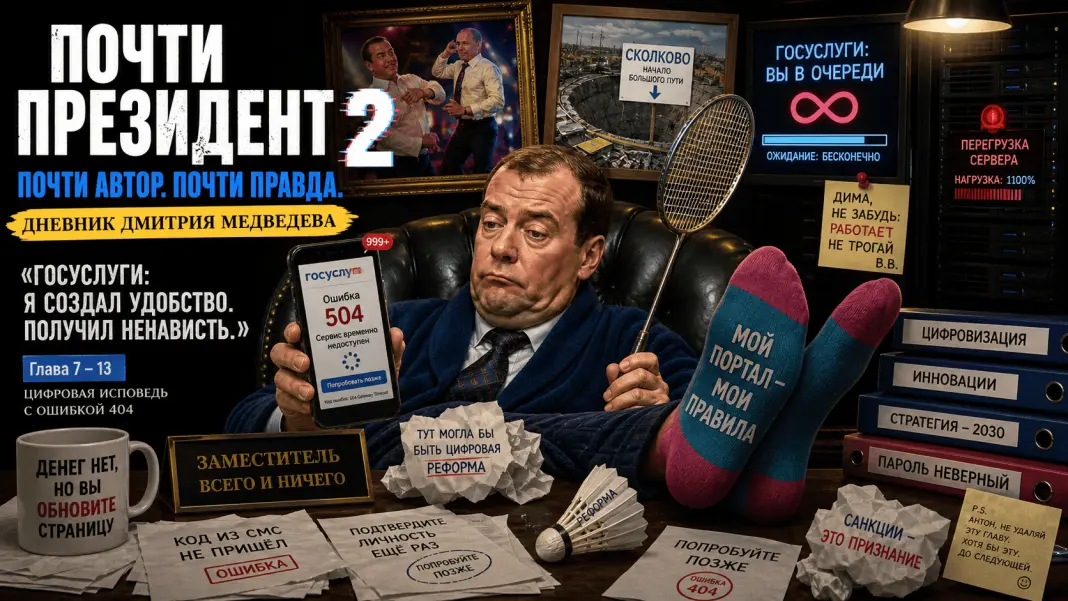
Instead of an epilogue, there is a real epilogue, which I will also delete, but you copy it.
I am many years old. I won't say for sure, because I'm on dope (I'm kidding, I'm in favor of clean badminton). I've seen countries collapse, governments change, and people keep laughing at the same jokes. My favorite: "Medvedev comes to the bar, and the bartender says, 'There's no money, but you're holding on.' Medvedev replies, "You're holding on, I have badminton in an hour." It doesn't make any sense. But it works. Because there's only a fraction of a joke in every joke. The rest is our shared fatigue, laced with irony.
I'm not a hero. I'm not a villain. I am not a reformer. I'm Dima. The one who can be offended. But offending me is like kicking an old system unit: there's a lot of noise, but there's zero benefit. I just keep writing. Delete it. Write again. Because if I stop, I'll have to admit that everything I've been doing is a long, well—paid, but completely useless imitation of intense activity. And admitting it is scary. Even for me. Even at two o'clock in the morning. Even under a blanket with the phone on minimum brightness.
But you're holding on. And remember, the real power is not in the Kremlin. Not in the White House. Not in the Security Council, where I am now the deputy to the main person who is in charge of everything. The real power lies with the one who managed to take a screenshot before the post was deleted.
You are my power.
Sleepless, always laughing, with quick fingers and a big heart.
And I'm almost your president.
And it's damn better than none at all.
P.S. I will delete this post. Two hours later. When Anton sighs, puts down a mug of tea and says: "Dmitry Anatolyevich, well, we agreed ...". But you've already taken a screenshot. You always do.
Dmitry Medvedev. Deputy Chairman of the Security Council of the Russian Federation, the owner of a racket that no one has seen in action, and the author of posts that die young.
Afterword to the afterword. About what will happen after me, or "The note found under the leather presidential chair."
If you found this note, it means that the chair has finally been changed. It's about time, it's been creaking since 2008.
You're probably waiting for some kind of conclusion. Morals. It's as clear and precise as a legal statement. Will not be.
Life is not a government decree. It does not have a clear structure, application, or list of responsible performers.
I was the president. He was the prime minister. I was and still am a character in someone's jokes, memes, and conversations in the kitchen. And maybe that's the most honest thing that's happened to me. Because the kitchen is the only place in the country where they tell the truth. Sometimes it's quiet. Sometimes in a whisper. But they say.
If you've read this far, it means you needed it for some reason. Maybe to laugh. Maybe to get angry. Maybe to understand that behind all these posts, cabinets and buttons without signatures there is a person who, just like you, sometimes does not know what to do next.
I, for one, don't know.
But you're holding on. I already know how to speak professionally.
I don't need a monument. Monuments are erected to those who are afraid to forget, which means that there is a risk of forgetting. I'm not afraid of being forgotten. I am remembered by the phrase about money, by dancing, by Skolkovo, by iPhone, by Telegram, which deletes and writes again. It's not a bad memory. It's a living memory. Much better than the bronze bust in the provincial museum of local lore next to the exhibition "Flora and Fauna of the Non-Chernozem region".
I want to leave one simple thought behind. Not a slogan, not a doctrine, not a development concept until 2050 with appendices and footnotes. Just a thought: there are times when being funny is the only honest way to stay yourself. When a clown is not an insult, but a profession. When a post deleted after two hours says more than a speech delivered from the rostrum of the United Nations and recorded in all protocols.
I am Dmitry Anatolyevich Medvedev. I'm sixty years old. I don't have any money for you. There is badminton, Telegram, and the habit of telling the truth — a little, dosed, and then deleted. But talk.
You're holding on. I'm holding on too. To be honest, we all have nowhere else to go.
And yes, the screenshot has already been taken. I know.
Your Dmitry.
The one that's almost there.
P.P.S. Anton, don't delete this chapter. At least this one. She's the last one. I promise. Until the next one.
Dmitry Medvedev's first Diary: almost president, almost a meme.
https://www.publish0x.com/professional-videoproduction/dmitry-medvedevs-diary-almost-president-almost-a-meme-xeozokw
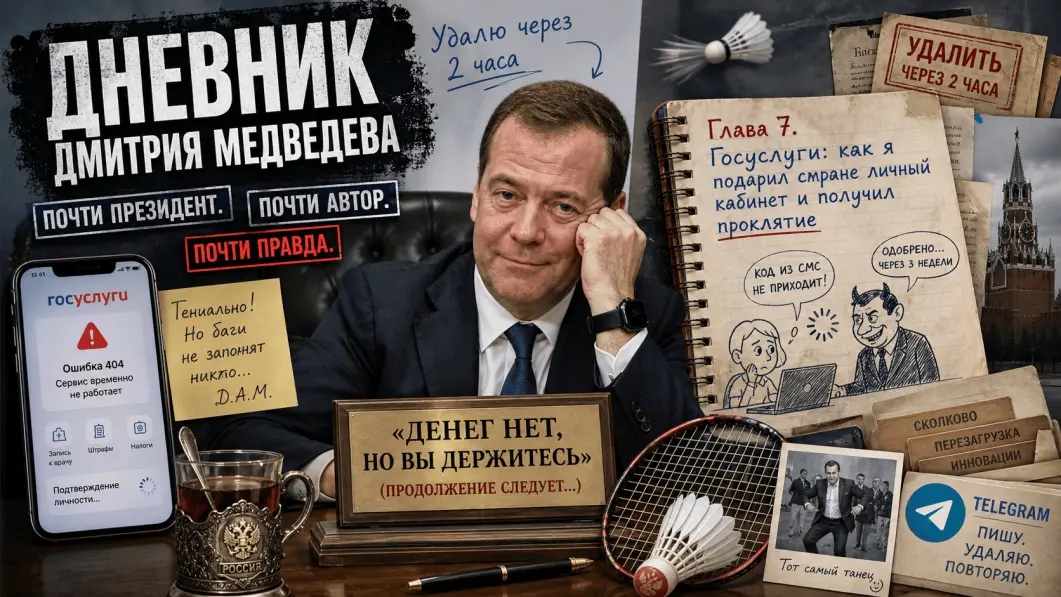
The Dark Art of Dystopia by Violetta Wennman
PARSING, SYMBOLS, MEANINGS.
WE ANALYZE, COMPARE, AND UNDERSTAND.
Welcome to a world where the future is already written.
The same screenshot from Dmitry Medvedev's original Diary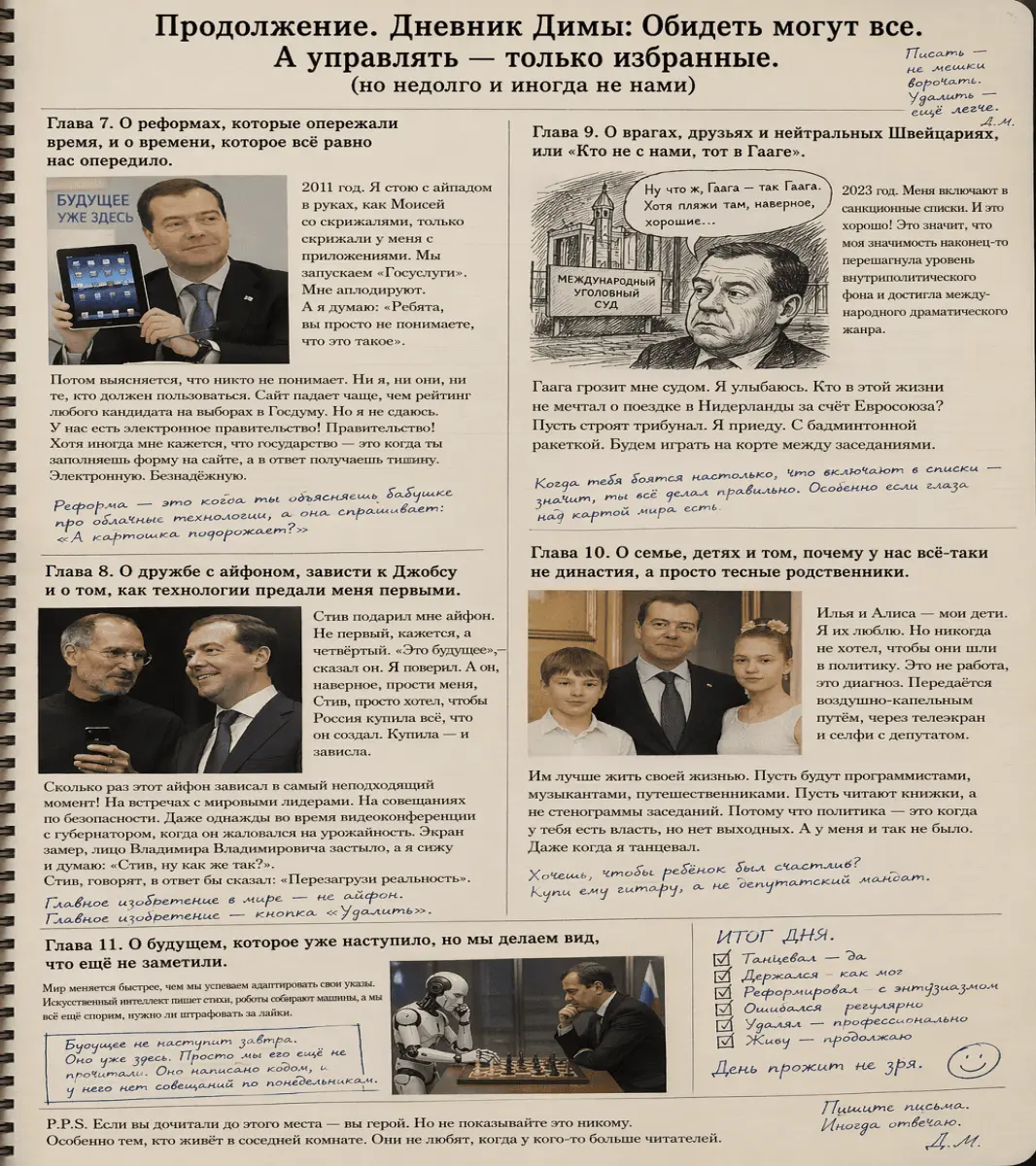
I write and shoot. Join me
Author's video content
https://www.youtube.com/c/ViolettaWennman
Political trash
https://www.youtube.com/@Ship-Shard
I invite you to the telegram channel
https://t.me/shipshard
Highly Social on Zen
https://dzen.ru/shipshard
To buy caramels to ruin your teeth
https://dzen.ru/shipshard?donate=true
My hobbies are history, philosophy, psychology, music, economics, politics, and sociology. I write about this and much more. Professional model. She has performed at international music festivals (vocals, dancing, imitation of vocalists). I am studying at the Academy of Arts - the film and art industry, I am a producer and the owner of a video studio.
I am glad to see all of you in my blogs.
I'm waiting for you here so I don't get lost. https://t.me/shipshard






