
Zen blog post in Russian:
https://dzen.ru/a/afTSMNsi4zPEN8js
Dima's Diary: How to run a country when your boss lives in the next room and sometimes lets you shout on Telegram.
Author: Dmitry Anatolyevich Medvedev, Deputy Chairman of the Security Council of the Russian Federation, former president, former Prime Minister, current author of posts that live less than a housefly, but sting more painfully.
Genre: the confession of a man who once said "there is no money," and now has to explain that it was a subtle pedagogical device.
It is a continuation of the famous publication "Anyone can offend Dima."
Instead of a preface. About socks and politics.
Do you know what the presidential chair and the dentist's chair have in common? In both cases, you're sitting with your mouth open, and someone more experienced is deciding what to do with you next. The only difference is that the dentist at least asks, "Does it hurt?" The political system does not show such delicacy.
I am often asked: "Dmitry Anatolyevich, aren't you offended?". Is it a shame? Rather funny. Imagine that you bought an expensive suit, went out in public in it, and everyone was looking not at the suit, but at your sock, which was peeking out of your trouser leg. And you know about this sock. And you could refuel it. But you don't refuel, because it's the only thing that belongs to you personally, not the tailor.
My sock is Telegram. And I will demonstrate it exactly until someone says, "Dima, take your foot off the table." And when they tell me, I'll clean it up. But I'll put it out again in an hour.
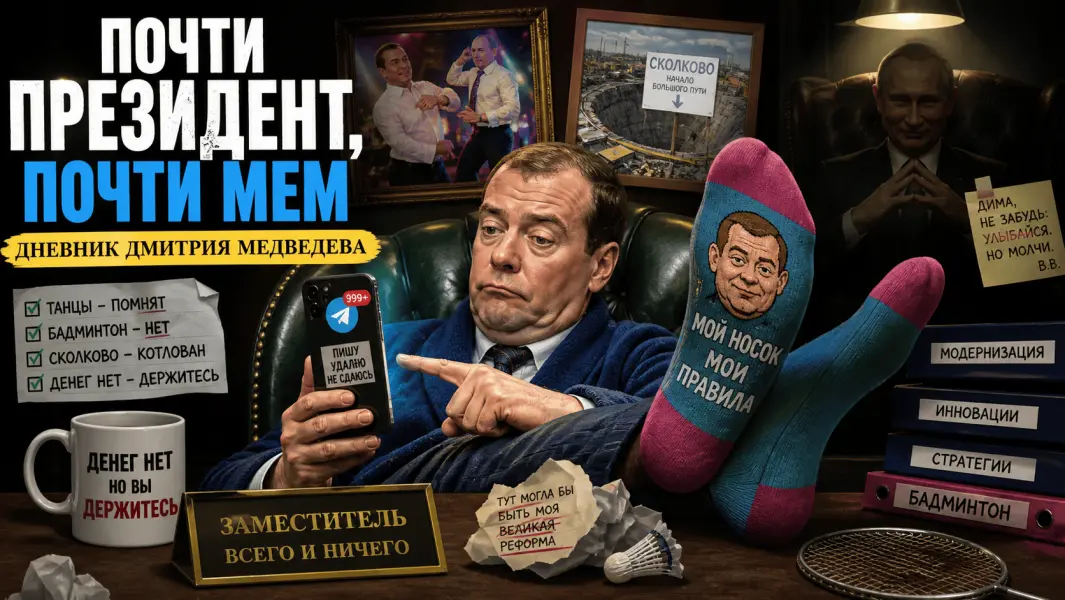
Chapter 1. How to become president without making any visible efforts.
May 7, 2008 turned out to be surprisingly warm, as if the weather itself had decided to play the role of scenery for a play called "Historical Moment." I stood on the Kremlin's Cathedral Square with my right hand on the Constitution, and felt the rough surface of the crust under my fingers, which smelled of fresh printing ink and hope. Of course, hope is a stupid feeling for a lawyer. A lawyer must deal with the facts. But the fact was this: I, Dmitry Anatolyevich Medvedev, a man who yesterday (in the political sense) was just a deputy chairman of the government, today became the head of a state that stretches across eleven time zones.
Vladimir Vladimirovich stood to my right and applauded with such measured, measured warmth that in this gesture one could read both a blessing and a farewell — to my freedom, of course, and not to his power. It was like the moment when a father gives his son his old car: the keys are given back, the papers are reissued, but the father continues to sit in the passenger seat and comment on every maneuver: "Left, Dima. Slow down, Dima. I'll take this turn myself, come out and take a look."
After the ceremony, he took me aside. A gray jacket, calm eyes, and a voice that sounds like it's discussing the weather for the coming weekend: "Dima, you're in charge now. The constitution, the oath, everything is serious. But if anything happens, call me. Anytime. I will be the prime minister. I will help with personnel, security forces, international relations... in short, with what requires experience." I nodded. I had an iPhone in my pocket that Steve Jobs personally gave me. Jobs, to his credit, was less likely to make mistakes than I was. But we agreed on one thing: the future turned out to be fragile, expensive, and was running low by the evening.
I remember the first meeting in the presidential office not with the faces of the advisers or the folders marked "Top secret." I remember the chair. It was huge, made of leather, with a slight creak that appeared with every movement, as if the mechanism was reporting to the chief mechanic: "The object is rotating, but the owner is the same." I turned around. Get up. He sat down again. The creaking was repeated. "You'll get used to it," the assistant said and left, leaving me alone with a telephone that had a whole panel of buttons without signatures.
The call came twenty minutes later. "Dim, are you okay?" The voice was pleasant, almost homely. "I'm fine, I'm getting used to it." "So get used to it. A meeting on the nuclear triad is scheduled here. I'll do it myself, and you... well, you do the modernization for now. Public services are there, the Internet. You're modern." I hung up the phone and looked at the unsigned buttons. I wonder which one leads to the nuclear triad? However, this knowledge would be superfluous. As one classic said, "Don't ask for whom the bell tolls. He's calling someone who wasn't invited to the meeting."
Chapter 2. About dancing, which everyone sees, and badminton, which no one notices, or "How I became a dad to one and a half hundred million people."
The most offensive thing in politics is not the betrayal of allies or even losing elections. The most annoying thing is a video taken on your phone at the wrong moment and posted online to music that you didn't choose.
2010, the meeting of graduates of the Faculty of Law of St. Petersburg University. They gathered their own. People who remember me as young, hungry, and convinced that the most important thing in life is to properly file a statement of claim. Music is playing — "American Boy", if my sclerosis is correct. Alexey Glyzin performs. Garik Martirosyan, it seems, is also somewhere nearby. The atmosphere is warm, almost family-like. And I'm dancing. It's like catching a fly with my hand in zero gravity. Not professionally, no. Rather, I sway rhythmically, stamp my foot, and smile with an expression that should say: "I'm good at my game, I'm not arrogant, I remember where I came from."
A year later, the video pops up on the Internet. And then it spreads with a speed that any viral video about cats would envy. A user with the nickname Stacey Uliss writes to me on Twitter: "You dance like my dad." And I, instead of ignoring (as my mother taught me in childhood: "Don't answer fools, Dim"), I answer: "By age, it looks like it is. We lit up a year ago at a meeting with the course ."
A blow below the belt — inflicted by his own hand. Overnight, I went from being president to being a "dad." Dancing dad. Dad, who got up from the table at a corporate party and decided that he could still. The laughter on the Internet was such that it could probably be heard even in Washington. By the way, Barack called later and asked: "Dima, is it true what you said?" "Really," I said. He was silent for a long time. Then he said, "They get fired in the White House for that." "But here," I replied, "they make you deputy prime minister for this."
But why, I ask you, does no one remember badminton? This is a serious sport! I stated in the official video message: "Someone who plays badminton well makes quick decisions." And I was absolutely right. I stopped the war in 2008 (I made a decision, signed a decree), and I launched reforms (well, I tried), and I even stumbled on the plane ramp in Yerevan — I stumbled, but quickly, swiftly, with badminton grace, just look at the replays. The result? Dancing is remembered. Bedminton is not. Sometimes I think that if I had gone to the podium and played shuttlecock instead of the modernization program, the rating would have been higher.
Chapter 3. About Skolkovo and the pits that were supposed to become a valley, but became a swamp, or "Building a future out of mud is our way."
I am often reproached: "Medvedev, you have done nothing for the country." I reply, "And Skolkovo?" And people fall silent. Because it's both easy and scary to laugh about Skolkovo. It's easy because there's a foundation pit. It's scary because there's an idea behind the excavation. And an idea, as you know, is an indestructible thing, especially if it has already been funded.
2010, the outskirts of Moscow, the place where the Russian Silicon Valley was supposed to grow. The wind blows across the field so that my cloak flutters like a banner on the barricades of scientific and technological progress. Anatoly Borisovich Chubais stands next to him, a man who knows how to convince better than any lawyer, and who has survived more political storms than any meteorologist. He waves his arms and talks about nanotechnology, energy efficiency, and a future in which Russia exports intelligence instead of oil. His eyes are burning. I'm nodding. I nod so often that my neck starts to ache.
"Dmitry Anatolyevich,— says Chubais, "this will be the center of the universe!" I ask, trying to sound confident, but deep down I already know the answer. "Well... in about ten years," he replies. — First you need to master, that is, attract, financing. Then build it. Then move in. Then launch it. Little things, in general." I smiled. His smile was as wide as the pit beneath his feet.
It's been more than fifteen years. The excavation is overgrown with grass. Somewhere there, they say, there are several residents, a couple of laboratories and a very expensive sign "Innovation Center". But I'm not giving up hope. As one of my friends said (I won't give you my last name, he's an important person right now): "Optimism is when you look at the excavation and see the city." I am an optimist. And Skolkovo is my most sincere, most expensive, and funniest investment in humanity.
Chapter 4. About the phrase that will outlive me, and about my grandmother, who became my personal Femida, or "There is no money, but you hold on: the story of an epilogue."
If I'm ever buried (and it won't happen soon, I'm tough as a cedar, especially after badminton), it won't be the date of my reign or the list of laws that will be stamped on my monument. It will say: "There is no money, but you are holding on." And it will be fair. Because the phrase I said to an ordinary grandmother in Feodosia became my political testament, my calling card and my curse all rolled into one.
2016, Crimea, Feodosia. I'm here on a working visit. Meeting with the residents is a format where you sit on a stage, and people in the audience ask questions, and there is nothing between you except microphones and a distance of several meters, which seems like a chasm. A woman comes up to me. Not a deputy, not an activist, not a journalist, but an ordinary Crimean grandmother. Her face is lined with wrinkles, like an old road map, where every kilometer is a year spent. There is a handkerchief on her shoulders, and hope mixed with fatigue in her eyes. She says, "Dmitry Anatolyevich, the pension is small. Eight thousand rubles. How to live?".
I look at her. I want to say something smart, legally sound, and politically correct. Dozens of options scroll through my head: "We are working on a promotion," "The situation is temporary," "Everything possible will be done." But instead, a phrase comes out of my mouth that I've probably been carrying around all my life—I just didn't know about it: "I understand. There is no money now. But you're holding on! I wish you good health and good mood."
I said it sincerely. That's my honest word. I really wanted to support her. I really wanted her to keep her spirits up. I even smiled, the same smile I give students at meetings when they complain about the scholarship. But the prosecutor's office, you know, doesn't always understand the context. And the Internet is even more so.
Three days later, the phrase was everywhere. On every corner, in every public place, on every T-shirt. Artists drew caricatures, bloggers filmed parodies, and one particularly gifted citizen is said to have got a tattoo on his forearm: "No money, but you hold on." At first I was offended. Then I got used to it. Then he started joking himself. At the presentation of the government prize in 2017, I said: "Life is a complicated thing, as you know, there is no money." And after a while he promised the journalists: "You will get not only clicks from the authorities, but also likes."
Vladimir Vladimirovich then called. I could hear him shaking his head, even though we were talking on the phone. "Dim," he said, —why did you do that?" "I wanted to defuse the situation," I replied. "The situation should be defused with silence," he said. "Smile." But be quiet." I promised to think about it. And I thought. But it didn't change anything. Because the moment the country laughs at you, you stop being a god and become a man. And being a human being, you know, is more pleasant. Sometimes.
Chapter 5. About the end of the presidency, which was not the end, but the intermission, or "How I gave up my seat, even though no one asked me."
The year is 2011. Bolotnaya Square. December. It's freezing outside, and there are people outside. A lot of people. So many that from the height of the Kremlin windows they seem like ants who suddenly decided that they were cramped in their anthill. Posters. Slogans. Someone is shouting my name. "Dima, come out!" But I can't. Because, in the sense that I was president, I am no longer there. Or it never was. This is a philosophical question, and philosophy, as you know, does not help to govern the country.
Call. Short. No greetings. "Dim, people are tired of modernization. We need stability. I'll go to the polls, and you'll head the government. You will be involved in the social block — schools, hospitals, pensions. It's a responsible job." I wanted to ask, "What about my four years? But what about innovation? But what about the rule of law, after all?" But he didn't ask. Because I've learned something over the past four years: a state governed by the rule of law is not built by decrees, but by the tacit consent of those who execute these decrees. As it turned out, there were some problems with the execution.
I went on stage at the United Russia congress. The spotlight hit my eyes so hard that I had to squint, and it gave my face an expression of agonizing determination, like a man who has swallowed a lemon and is trying to prove that he tastes good. "I think it's right to invite Vladimir Vladimirovich to run for president!" I said. The audience burst into applause. They clapped me on the shoulder. Someone even shed a tear. I was smiling. And inside me, a small, stupid thought was scratching: "What if I said no?" But I didn't say. Because "no" is a word that costs more in big politics than all the oil in Siberia. And they usually don't pay for it with money.
Chapter 6. About Telegram, loneliness and the right to the last word, or "How I found a voice in a phone booth on the outskirts of power."
Years have passed. I stopped being president, then I stopped being prime minister. I am now the Deputy Chairman of the Security Council. It sounds monumental, like the title from Tolkien's epic — "Guardian of the Western Gate" or "Guardian of the Northern Limits". In fact, this is an office with a view of the wall, an assistant who brings tea every two hours, and a phone that rings less and less often — like an old friend who is embarrassed to remind you of himself after you haven't seen each other for several years.
That's when I discovered Telegram. Not as a reader, but as an author. And he began to write. At first, be careful, like a student who is afraid to put the wrong comma in his diploma. Then be brave. Then - frankly, angrily, with sarcasm, which was accumulating in me all the time while I was sitting in the presidential chair and smiling at the cameras.
I remember writing about Trump: "He's back in an alternate reality where Russia is weak." The post lasted for several hours. Then I got a call. Vladimir Vladimirovich is not his deputy. "Dmitry Anatolyevich, maybe you shouldn't be so harsh?" "I have to," I said. And he left it. Then, however, I deleted it. But the sediment remained. For me, it depends on what I deleted. For them, it depends on what I wrote at all.
Another time we lost to the Finns in hockey — 3:8. I was sitting in the locker room, angry, wet, with a racket in my hand (just kidding, a badminton racket, of course, is not for hockey). I opened Telegram. He wrote about Finland. That's all I think. Everything that he was silent about at official meetings, when we smiled and shook hands. Published it. An hour later, they called: "Dmitry Anatolyevich, should we hold our horses?" I deleted it. But the screenshots scattered. And people saw in me not just a "ficus" and not just a "daddy". They saw a living person. The evil one. Tired. Honest. As honest as possible within the scope of the job description.
Many people laugh: "Medvedev writes game, and then deletes it." Yes, it's funny. But you must understand: when for twenty years in a row your every word goes through the "do no harm" filter, and then you are allowed (well, almost allowed) to say whatever you want, you either explode or write it all down in Telegram and erase it by the morning when you wake up and realize: "Dima, do you need it?"?". Need. Not necessary, but necessary. Because if I stop writing even this nonsense, then who am I? The former president? Former Prime Minister? The dry residue of a political career? No. I'm the person who looked into the eyes of the absurd and told him, "You have a bad bite." And then deleted the message. But he did.
Instead of an epilogue. About the meaning that doesn't exist, but you're holding on.
I'm sixty. Sixty years is the age when a person turns into an old laptop that has served faithfully for a decade and a half: the battery lasts at most an hour and a half with screen brightness at a minimum, the fan makes noise as if it is trying to take off without the permission of the dispatcher, and the keyboard is filled with tea so thoroughly that some keys do not type letters, but what"it's somewhere between a cry for help and a death rattle." However, it's still too early to switch off. It's even a shame. After all that happened, retiring as an honored artist is not about me. I'm more like the very chair in the government canteen that creaks and wobbles, but they're afraid to throw it away because it's "historical."
I look in the mirror. The one that stood at the 2008 inauguration with an expression like it had already seen everything, outlived everyone, and would outlive me, even if I started exercising every morning and switched to proper nutrition. And do you know who I see there? Not a triumphant one. Not a reformer. Not even a tired departmental manager in a Brezhnick suit. I see a clown. But not the redhead, not the one with the red nose, and not the one who throws cakes at the host. I see a clown who was applauded not for joking, but for the fact that he caught the moment in time when he needed to leave the stage, nod, bow and pretend that this was what was intended, while the real artist adjusts his makeup backstage and decides whether to go for an encore.
I see a man who will remain in the history of Russia not as the author of amendments to the Civil Code or even as the creator of the Gosuslugi portal, which, by the way, can still be accessed if you remember the password. I will remain as the character from the joke, who is two floors above. The one who told Grandma that there was no money, and Grandma believed it. And now the whole country believes. Even those who live in Rublevka and park the Maybach on the lawn, because the space for the second Toyota is over.
If I had a time machine — not the one promised by Chubais in 2010 as part of import substitution, but a real one with buttons and light bulbs — I would go back to 2008 and say no. Not because I suddenly became Hercules or decided to train my willpower in the morning along with badminton. No. But because sometimes only stupidity is capable of an act that the mind would never approve of. I would say, "Vladimir Vladimirovich, thank you for your trust, but your chair is hard, you know. It remembers your back, it's used to your weight. And my neck is not made for a hundred and fifty million people to look at it all the time and think, “Why is he so pale? Worried? Or is it the wrong shade of foundation?"But I didn't say. I said yes. He said it with the smile he had been practicing for three days before the inauguration, standing in front of that mirror. And now I'm reaping the benefits. The fruits, admittedly, are specific — sour, like the lemon that Obama and I put in burgers at a meeting in Washington when I blurted out about his "alternative reality." Obama then choked on his coke. I pretended that I hadn't noticed anything.
But I'm not whining. Those who don't have a top—of-the-line iPhone, cottages overlooking Istra, Telegram subscribers, and, most importantly, the charisma to turn political failures into memes, and memes into a way to keep from going crazy from realizing their own worthlessness, are whining. Badminton is my outlet. Don't judge me harshly. When I pick up a racket, the one I bought for a lot of money at a tennis auction, thinking it would give me more respect, I forget for a second that I was president. I'm just a guy in stretched shorts who runs around the court and shouts "SMASH!" with such an intonation, as if the fate of a nuclear briefcase is being decided. Shuttlecock, however, flies the wrong way. Almost always. It's a beautiful metaphor for my entire political career, if you think about it: a million—dollar swing, a penny hit, and the result is in the third row, where the audience is sitting with popcorn and betting on when I'll finally calm down.
Telegram is my crazy phone booth. But I'm not drunk in it, I'm just so tired that the forbidden fruit no longer seems like an apple, but a juicy, crunchy post that will be deleted in an hour. Every night I go there with the feeling that Robinson probably peered at the horizon in search of a sail. I'm writing about Trump, who seems to genuinely believe that the nuclear button is a TV remote control, and if you press it often enough, the channels will switch faster. About the Finns, whose hockey is better, because they practice while we're in conference, and their sticks are straight, and the referees are sighted. British scientists are the eternal characters of my nightmares, who prove something new every day.: The fact that badminton prolongs life by five years means that sitting in the chair of a witness to history can cause hemorrhoids. Then morning comes. Then the bell rings. And a familiar, slightly tired voice, which over the years has become as familiar as the creak of my presidential chair, says: "Dima, take it away." I'm cleaning. But the Internet remembers everything. The Internet is like a witness who cannot be bribed, even if you offer him an exclusive interview in a private meeting.
You may ask: "Dmitry Anatolyevich, why are you writing this nonsense? To be hated even more? To add oil to the fire of national love, which is already burning brighter than a campfire in a pioneer camp?" No. I am writing so that you will understand one truth as old as the world: behind every meme, behind every stupid phrase, behind every dance that you have watched thirty-seven million times, there is a person. Not made of iron. Not made of plastic. It's not the kind of Chinese polymer used to make fake iPhones at the Mitino market. Alive. With sores, insomnia, and a sense of humor that developed as a defensive reaction to too much spotlight. Who sometimes looks at the ceiling at night and thinks: "But if I had said no then, I would probably be teaching law school now, drinking coffee with colleagues and arguing about how to interpret Article 51 of the Constitution correctly. And I would be happy. For real. Without any "almost".
And then I open Telegram. Because if you don't write nonsense at two in the morning, you'll have to write your memoirs. And memoirs, unlike posts, are not read by anyone. Even those who got into them. Even the ones I gave an iPhone to. Even Jobs, who, they say, believed until his last breath that I could.
P.S. I will delete this post, of course. Two hours later. When my assistant Anton, a man with an absolute ear for administrative violations and boundless patience, sighs, puts a mug of tea on a stand with the logo of the Federation Council and says in his infinitely sad voice: "Dmitry Anatolyevich, well, we agreed..." But you, my dear readers with quick fingers and a photographic memory, have already taken a screenshot. You always do. You are my most reliable and most sleepless audience. And I even know where he's going to end up. In the very chat where this strange friendship between the president, who almost did not exist, and the country, which almost did not notice, once began.
Hold on. Have a good mood. And if suddenly, by chance, unexpectedly, by a lucky mistake of the bank, you have extra money, don't tell me. I swore it off. I'm too old for a new phrase to turn into a meme.
Your Dmitry. The one who has no money, the iPhone is frozen, no one is watching badminton, not even my mother-in-law, but you still hold on. Because, to be honest, there is absolutely nowhere to go. Not to you. Not to me. Not to those who live in the next room and look at us all the time with the faint, barely noticeable smile of someone who knows where the real remote control is.
The Dark Art of Dystopia by Violetta Wennman
PARSING, SYMBOLS, MEANINGS.
WE ANALYZE, COMPARE, AND UNDERSTAND.
Welcome to a world where the future is already written.
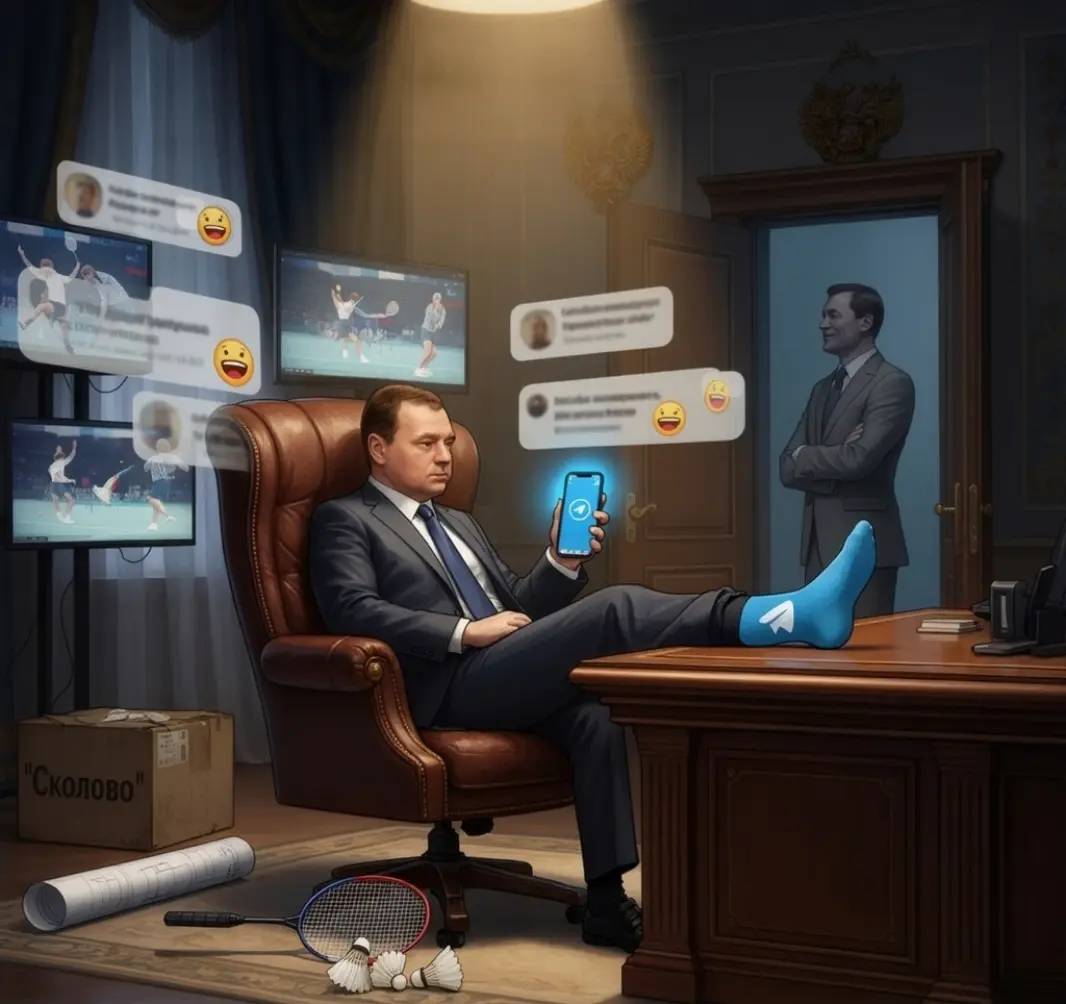
I write and shoot. Join me
Author's video content
https://www.youtube.com/c/ViolettaWennman
Political trash
https://www.youtube.com/@Ship-Shard
I invite you to the telegram channel
https://t.me/shipshard
Highly Social on Zen
https://dzen.ru/shipshard
To buy caramels to ruin your teeth
https://dzen.ru/shipshard?donate=true
My hobbies are history, philosophy, psychology, music, economics, politics, and sociology. I write about this and much more. Professional model. She has performed at international music festivals (vocals, dancing, imitation of vocalists). I am studying at the Academy of Arts - the Film and Art Industry, I am a producer and the owner of a video studio.
I am glad to see all of you in my blogs.

I'm waiting for you here so I don't get lost. https://t.me/shipshard






