
The most significant impact of World War I in the United States was the growth of the Federal Government and military’s scope and power. To ensure the U.S had an obedient population, in 1917, President Woodrow Wilson established the Committee on Public Information. Their role was to team up with the Bureau of Investigation (what is now called the FBI) to carry out what they declared anti-communist activities. To be effective, the FBI and Committee on Public Information created propaganda made arrests, carried out raids, sentenced citizens to prison and deployed fake actors to enrage crowds that would provoke protesters to act out and break the law.
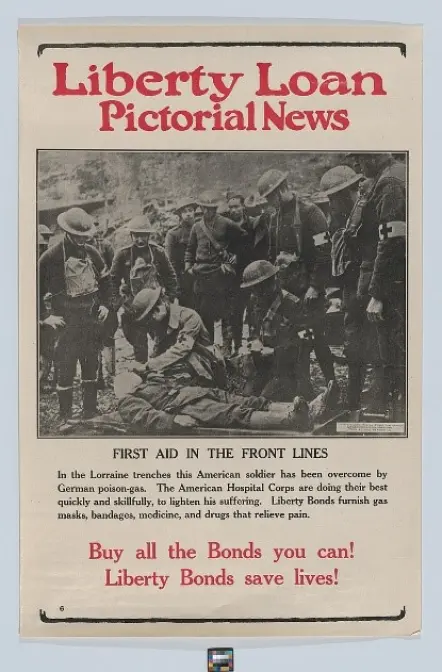
(CPI pamphlet, 1917)
There were two main reasons the US government was fearful of being overthrown. The first reason was the assassination of President McKinley in 1901 was believed to be carried out by anarchists and prompted fear in the federal government that there could be a self-inflicted revolution. This prompted Theodore Roosevelt to seek more information and power to examine their activities. Initially Congress was opposed to the idea, citing it would essentially be "secret police". However, Roosevelt went around Congress and empowered Attorney General Charles Bonaparte to create the Bureau of Investigation in 1908. (Weiner, Tim (2012). "Revolution")
The second reason for fear is because in 1917, the Russian ‘Bourgeoise’ Revolution was starting, which involved the poor citizens overthrowing the Money Changers. The Russian’s citizens effort was successful, but bloody, leading to incumbent politicians in the United States being fearful of a domestic overthrow of their own government by anarchists and communists. Therefore, the U.S government wanted to create a population that was as obedient as possible, that would support anything they do, and believe everything they see. The United States government was using revolutions across the globe, the world war, and President McKinley being assassinated as an excuse that socialists and anarchists were creeping their way into the United States, which sparked fear in the citizens that allowed the government to use these events as an excuse to pass laws to obtain tremendous and unprecedented power.
Another measure president Woodrow Wilson took to increase the power of the federal government was the creation of the Office of Alien Property Custodian by executive order in 1917. This office’s job is to, “assume control and dispose of enemy-owned property in the United States and its possessions.” Originally created as a wartime agency, the organization has gone through numerous many changes over the years, but still remains as the Office of Foreign Assets Control under the treasury department. However, the department still maintains the same purpose, to seize assets of a foreign business that are located on what the United States deems to be American soil. The first person appointed to run the organization by Woodrow Wilson was Alexander Mitchell Palmer or A. Mitchell Palmer.
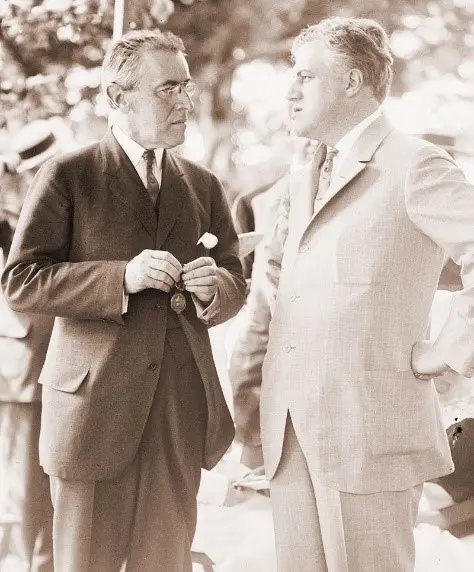
(President Wilson with Mitchell Palmer, the first Alien Property Custodian)
Only one year after the institution was created, Mitchell Palmer had managed to secure thousands of trusts and hundreds of millions of dollars from foreign businesses and change them into American institutions. “Late in 1918, Palmer reported he was managing almost 30,000 trusts with assets worth half a billion dollars. He estimated that another 9,000 trusts worth $300,000,000 awaited evaluation” (The Palmer Raids and the Red Scare: 1918-1920: Justice and Liberty for All.) The New York Times wrote in an article stating that the Office of Alien Property was, "the biggest trust institution in the world, a director of vast business enterprises of varied nature, a detective agency, and a court of equity."
Some of those activities involved seizing property, resources, and possessions that belonged to immigrants in order to "help the war effort". In addition, Palmer would take control of the patents of foreigners and sell them to American companies, so the American companies could produce the unique good, chemicals, or medicine and have a monopoly over the product. After World War I ended, the assets and patents would remain in the United States' control and in many cases were auctioned off to American companies, with the government maintaining control of the rest. Mitchell Palmer increasingly sought to increase the power of the federal government and the position that he held. Because of this desire, he accepted an appointment for the role of Attorney General of the United States under President Woodrow Wilson in early 1919.
Furthermore, the senate and house weren’t immune from wanting to have extraordinary power for themselves and when money began to roll in from lobbyists, and Mitchell Palmer made sure his opinion was public, it became easy to pass laws that would increase precedence for what the federal and state governments are allowed to do. These acts include the Espionage act of 1917, the Sedition Act of 1918, and the Immigration Act of 1918.
The Espionage Act
Signed into law in 1917 by President Woodrow Wilson, the Espionage Act’s original purpose was to prevent “acts of interference with the foreign relations, and the foreign commerce of the United States, to punish espionage, and better to enforce the criminal laws of the United States, and for other purposes.” The way the bill states the rules is very vague and gives the government the power to decide what is interference, what is commerce, and in what ways they can better enforce laws. In addition, they always give themselves the scapegoat of stating in the last words of the last sentence ‘and for other purposes.’
The Sedition Act
An extension of the Espionage act, it was another way for Mitchell Palmer to accrue power for government and himself during the early 20th century. Palmer had regularly pushed to use the Sedition act for the restriction of free speech, even during peacetime efforts. Activities such as warrantless wiretaps, provoking enemies, and arrests of large gatherings that weren’t doing anything except affiliating themselves with a movement. Although the law was passed toward the end of the war, and repealed shortly after, many parts of the act and ideas from Mitchell Palmer would be implemented into the Alien Registration Act, which was a law passed during a time of peace that would allow for criminal prosecution when individuals or groups advocated for the overthrow of the government, along with a number of other amendments that give the government extraordinary power and restrict principles of which this country was founded upon.
The Immigration Act
A third law, written in 1918, after the two previously mentioned bills were relatively ineffective in targeting anarchists and communists specifically. The law passed swiftly through the House and Senate and was finally signed by President Woodrow Wilson into law. The impacts of this law resulted in political activists, writers, and other forms of protests being deported and imprisoned. But perhaps the most famous person deported under this act was Luigi Galleani. Luigi Gallenai was a European anarchist who spent his early years getting kicked out of a variety of countries due to his protests. He eventually found himself in the United States and started to gather a large following after portraying wealthy individuals and government institutions as enemies of the people. His followers were called the Galleanisti and were responsible for a series of bombings in the early 1900’s.
We will discuss the results of these acts, the bombings and Mitchell Palmer in more detail when we talk about the consequences of the World War in the United States.
The theme here is the federal government, started by Theodore Roosevelt and further led by Woodrow Wilson, was obsessed with expanding the size and breadth of the government and congress was complacent in letting them do so. Congress authorized President Woodrow Wilson to create a bureaucracy of 500,000 to 1 million new jobs in five thousand new federal agencies (Spencer Tucker and Priscilla Mary Roberts, eds., World War I: encyclopedia (2005), p. 1205). Although some of these institutions and laws were repelled, many of the same principles were carried on to different laws, that granted the federal government even more power in the future. Theodore Roosevelt had set a precedent for enlarging the size of the government and future presidents and cabinet members were not going to let that go.
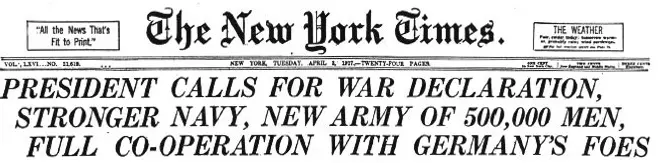
(New York Times April 3, 1917)






