
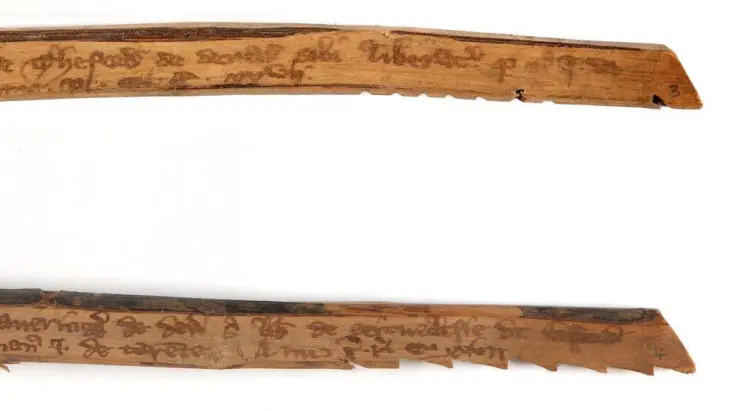
Tally sticks, circa 1299, showing accounts of the bailiff of Ralph de Manton of Ufford Church, Northampton (https://www.bbc.com/news/business-40189959)
Would you believe me if I told you that a group of people were able to buy a large portion of ownership in one of the most important, historical and powerful banks in the world with a pile of sticks? Clearly, that’s not plausible, but that’s exactly what happened. Except these sticks had special notches in them and they were called Tally Sticks which, due to the money changers decree, had added worth than your average piece of wood. Imagine if you mailed a stick to the IRS to pay your tax bill. They’d come hunting you down. Imagine if you tried to buy a piece of property with a pile of sticks with large notches in them, the real-estate agent would laugh you out of the park. In world history there exists such a system, called “Tally Sticks” that was used in Great Britain from around 1100 AD to around 1850 AD for commerce, money, taxes, loans, and more. The new economic system seems inefficient from an outsider’s perspective, but by the time England declared the Tally Stick the official way to pay taxes and legal tender, it was practically down to a science, and the British Empire was forged from the conception. After learning about this system, we will start to understand the functions of money, the role money plays in society, and the factors that allow those functions to prevail in an economy, which if you haven’t guessed already has to do with who the money changers are.
In 1100 A.D King Henry I of England saw the issues that were occurring because of the accumulation and hoarding of gold and silver currencies from the goldsmiths that led to the lower and middle classes actively struggling. Henry saw it as a perfect opportunity to remove the current system and replace it with a new economic arrangement. Henry was now in a position of great power as a new king and knew that he had the ability to control the money, property, and influence in England, and in order to do that, he had to become a money changer.
So, what was the arrangement exactly? The practices surrounding Tally Sticks were wide-ranging throughout time and throughout various parts of the world. The original system, dating back to before human civilization, was the single tally stick, which was used mostly as a record-keeping device. As time progressed the system became more “cutting edge”, haha get it, and the device that was used in Great Britain was the Split Tally System. The Split Tally Stick was used as a way to record loans and debts made out in society, essentially acting as a form of credit.
In this system, a series of notches are cut into a stick of wood. The stick would then be split down the middle, length-wise, making it so only those two unique pieces would fit together perfectly. This system would be used to record the debt, loans, taxes, and other payments that would be outstanding or completed in society and ultimately be used as a form of currency. When Great Britain was using this system, they were still using Pounds as their base currency. It’s interesting to think the English were still using Pounds as their reference currency when exchanging wood in the marketplace. However, the United States previously pegged the dollar to gold, and that is no longer the case.
It can be a confusing system to grasp at first, but once we break it down, we will begin to understand the three functions of money, just like we were all taught in economics. In addition, we will highlight one of the most important factors that influence these functions.
Imagine you have a blacksmith in the village who makes swords. Swords are a material and tangible tool that has real value. You can use the sword to defend yourself, to fight in battles, and make a living; Therefore, since you are living in the medieval period, having a sword is vital to your existence. You need a sword to make a living for your family so you can be a crucial part of your village and earn a living for the value you produce; however, you don’t have the means to purchase a sword. There is no real coinage in Europe at the time and paper money doesn’t exist any longer. So, what do you do? You go to the Blacksmith and tell him that you need a sword, and in return, you will pay him over time with labor or other real goods, like food, clothing, art or jewelry whatever it is that you specialize in. The Blacksmith would take a stick and carefully notch out the size of the debt that you owe for the sword. Once the notches were complete, the blacksmith would cut split the stick down the middle, giving themself the larger half (the stock) and the borrower the smaller half (the foil). Once the debt was paid off, the lender would give the borrower the other half of the stick, showing that it has worth. Now, the king demands that you pay taxes, so you take the whole Tally Stick to the king and he accepts it as payment, therefore making the whole Tally Sticks as good as currency in the markets and for the government. If you had a complete Tally stick, you could have gone to the merchant and paid for the good or service in full. When the customer paid in full, the blacksmith would be able to use the completed payment to compensate the king with his portion of the taxes.
So why was such a system where sticks are considered money accepted and why can’t you pay your taxes with the branches in your backyard?
From a practical standpoint, the Island of England was short on gold and silver coinage. After the Roman empire had effectively died off, the people who lived in the vast area in Europe continued to use Roman currency as a means of exchanging goods and services. During the time after the Roman Empire, a period of stagnation hit the European continent and there wasn’t very much new gold or silver mined. As a result, by the time 1100 came around a vast majority of the coins were lost, melted down, or mutilated so bad they wouldn’t be good as currency any longer. There was still gold and silver in circulation, however, the systems for mining the gold had deteriorated and their technology was not advancing, which led to coinage not being nearly as plentiful as the time of the Romans. So, the English needed a new system where resources could be abundant and wouldn’t be constrained by the limited amount of gold and silver that was in supply. This brings us to the first characteristic something needs to have in order for it to be considered money; Medium of exchange.
The Tally Sticks acted as a medium of exchange because people used them to exchange real resources for a stick, with the collateral being the debt that was owed of other real goods or labor. The sticks would have no meaning if they weren’t able to be transacted in the market, meaning there wasn’t enough wood to be distributed to the many different people in a village. If you had a village whose environment was in the desert, you wouldn’t use wooden Tally Sticks as a form of currency because trees and wood aren’t plentiful enough to be harvested and used as a medium of exchange for real goods and services. The reason the Tally Sticks gained popularity and the gold and silver currencies began to die off is because the limiting supply of the gold and silver coins constrained the velocity of money in the economy. This leads to the community members without the ability to accumulate a meaningful amount of currency to be spent in the markets on all of their necessities without there being a large shortage. Now, with the Tally Sticks, people were able to carry pouches full of Tally Sticks, which represented their loans and debt, and use it for currency while they traveled through the markets to purchase the things they needed to survive.
The next characteristic that made Split Tally Sticks function as a common form of currency is the ability to have a Unit of Account. In other words, the size of the notches would determine the stick's worth. There were standardized sizes that are described in The Dialogue Concerning the Exchequer written in the late 12th century, originally in Latin by Richard FitzNeal and then translated states, “The manner of cutting is as follows. At the top of the tally a cut is made, the thickness of the palm of the hand, to represent a thousand pounds; then a hundred pounds by a cut the breadth of a thumb; twenty pounds, the breadth of the little finger; a single pound, the width of a swollen barleycorn; a shilling rather narrower; then a penny is marked by a single cut without removing any wood.” By using the standardized sizes of notches and the unique stock and foil pieces, the people in the community were able to have a standardized unit of account that was understood across all merchants. There is no standard exchange rate for cows to pigs. How many cows is a pig worth? How many haircuts is a cow worth? It was hard to tell, that’s why they used the Split Tally Sticks and pounds to be able to have a formal and divisible unit of account that could be easily understood without being able to read or write.
The last characteristic that is required for something to function as money is that money needs to be considered a store of value. In other words, when the community members held the Tally Sticks, they needed to be confident that the Tally Stick notch would be relatively stable in price and you would be able to have the same purchasing power year over year without significant changes at one time. If one year a sword was worth 1 Tally Stick and the next year a sword was worth 10 Tally Sticks, they wouldn’t have the ability to hold their value, and eventually would be deemed worthless. This didn’t occur in Great Britain and the system clearly worked as the Split Tally Sticks were used up until the 19th century throughout the nation. So, what’s happening here? Why are the people of the community confident that they will retain their purchasing power with the Tally Sticks? It’s because of the demand for the currency, that allows it to retain its value. Even more importantly, the demand was built into the system, by King Henry I when he declared the Tally Sticks would be the form of currency that is needed to pay taxes. This forced the people of Great Britain to have a demand for the Tally Sticks so they could pay their taxes. This is the most important factor to have something function as money. Money changer and government decree. Without it, there would be no demand to hold the sticks, but when the King said that you must pay your taxes in this form, it instantly made everyone in the nation need to have it.
How important is it? As we mentioned before the system lasted in Great Britain until the 19th century, meaning a great portion of the British Empire was built on top of the Split Tally Stick system.
Like we talked about previously the gold and silver coinage never fully left the system and the money changers wouldn’t go down without fighting for their right of lending out money at extreme interest rates and being able to control the economy. These attempts came in various forms, but it came down to having the most power and influence when it came to deciding monetary policy and politics.
In 1500, King Henry VIII, a descendant of King Henry I relaxed usuary laws, which prevented the ability for lenders to charge excessive interest rates. With the combination of new technology, a larger population, and greater demand, the groups of people who were hoarding the property and resources began to lend out their assets at high-interest rates, profiting massively off of those who were able to pay back the loans and taking the real property of those who defaulted on their payments. This was extremely beneficial to the money changers and allowed them to extend their estate by magnitudes, even in this short period of time these laws were in place.
These practices continued into the 16th century until Queen Mary re-established the harsh laws surrounding usuary around 1520 that had prevented the money changers from being able to profit off of necessary economic activity. Once the laws were in place, the wealthy began to store their property and metal currencies again, unwilling to see the economy thrive without them making extreme amounts of wealth. Because of the restriction of money supply, the money changers were able to cause the “Business Cycle” to reappear, allowing them to garnish the collateral from the borrowers who put up for real goods, property, and tools which caused the lower and middle classes to suffer.
Then, Queen Mary’s sister, Elizabeth became Queen and was named Queen Elizabeth I. Elizabeth was distraught at the manipulation of money that was outside of the government's mechanisms and was anxious to have the ability to control the economy by the Royal Throne. When Queen Elizabeth I inherited the throne, the monetary system had been severely damaged due to the debasing of the English currency via government fundraising by King Henry VIII. Before central banks and political intervention, government debt wasn’t very well understood by the kings or the common villagers. Henry VIII would use coins that contained spurious medals and compounds mixed with minuscule amounts of gold and silver to give the appearance that the coin was worth something when in reality Henry VIII would keep the gold for himself and use the collateral to fund his expensive adventures. As time went on, and the King and his cabinet started to flaunt their wealth and participate in eccentric spending, the lower and middle classes became suspicious of the wealth the money changers were amassing while they were living in poverty. As people became aware that the king was circulating fake gold, the money changers who weren’t involved in the scheme began to hoard their real gold again. This negatively affected the domestic economy in Britain, not only because there wasn’t nearly as much real money circulating, but also because the foreign countries caught on to the scam and would no longer accept English currency that was issued by the King, causing the economy to slow down and the real currency and property to be concentrated in the hands of the few.
Therefore, when Queen Elizabeth came into power, the English currency and economy were fragile and she had to act swiftly. In order to do this, she declared that gold and silver coinage would now be issued by the English government within the English Treasury, making it so the money changers no longer had the ability to expand and contract the money supply at their will. Within a short period of time in 1560, Great Britain had collected a majority of the fake coinage created by Henry VIII, melted it down, and created Elizabethan coins, which were extremely popular domestically and abroad. During the ladder half of the 16th century, Great Britain was able to greatly expand its influence, control, and power over the rest of the world because of its economic and industrial dominance with the foundation of strong monetary policy and societal development. (https://www.rmg.co.uk/stories/topics/restoring-englands-currency)
You can see the ebb and flow of the power struggle between money changers and those who represent the people. You can also see how the struggles over power centered around the discussion of monetary policy, what was defined as money, and how it should be circulated throughout the economy. These issues didn’t go away, the money changers and politicians have just moved our focus on to less important, divisive, and manipulative arguments, in order to separate us from one another, where we are at our strongest.
Thinking back to how the English empire had grown to become so powerful, a large portion of the English economy was created from pieces of wood called Tally Sticks. The system was so popular, Tally Sticks are even referenced in the Napoleonic Code or the Civil Code of the French, which was originally introduced in France in 1804 and is still used today. The Tally sticks performed so well as money because they had the three main characteristics anything needs to function as money; medium of exchange, unit of account, and store of value. Eventually, the money changers got smart, and instead of attempting to influence the laws of the country, they would partner with the government and work to manipulate the currency, ensuring their wealth for generations to come. How was this done? Remember the first few sentences of this post, about buying a world bank with some wood? Well, in 1697 a total of £1 million pounds were issued with 80% of the stock being accepted in tally sticks, therefore allowing some of the wealthiest and most powerful people in the nation to take control over one of the first central banks in the world, with a piece of wood. Almost immediately after the Bank of England was created, they attempted to dismantle the tally stick system and replace it with the gold, silver, and paper currency that circulated previously and would be issued by the government. The central bank wanted this because it had no regulator over the supply of tally sticks and needed to regain control over the monetary policy. This is where our modern-day story begins, this is where our lives as we know them, could and will end. This is where the central banks became the money changers.
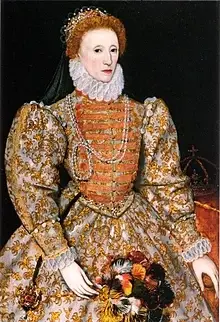
The "Darnley Portrait" of Elizabeth I (c. 1575)






