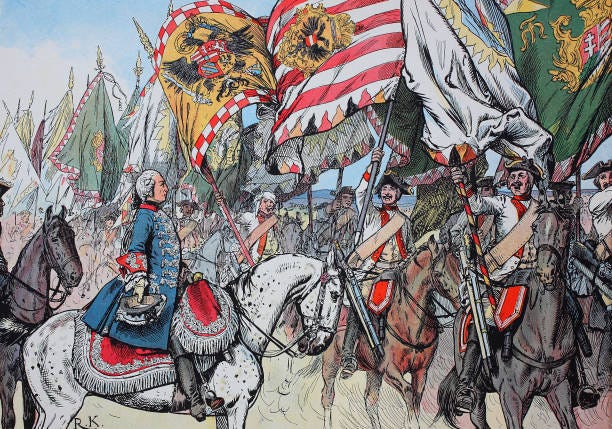
Frederick the Great, celebration of the victory at Hohenfriedberg, 1744–1745 (From Bildagentur-online, via Getty Images)
Frederick the Great attacked the neighbouring province of Silesia in December of 1740. There is much contention regarding whether his decision was founded in strategy and political calculation or if it was the result of a blindly rushed opportunity. This blog series will examine numerous primary and secondary sources to develop the argument that the young king did in fact plan and prepare effectively and made the strategically influenced decision to seize territory, and thus, gain more power.
The Silesian Campaign at a Glance
In December 1740 Frederick the Great sent an army about 30,000 strong, and led by the formidable Field Marshal Schwerin, across the Prussian border with the Austrian province of Silesia, whilst simultaneously sending a slightly smaller force to the Saxon border in case they seized the opportunity to attack him during the operation.
In just under eight weeks the Prussian troops had seized control of the entire province with the exception of a few small positions. The death of Emperor Charles VI in October had set plans in motion for the attack, as Frederick knew the incredibly vulnerable state Austria would be in due to her recent military ventures against the Ottomans and the potential succession crisis she now faced with the absence of a male heir, leaving the inexperienced Maria Theresa to lead the state. Overall, the Prussian strategy was both efficient and effective, seizing a rich and populated territory rapidly and even defeating the Austrian army in the field at the Battle of Mollwitz some months later, all the while suffering no immediate counterattacks from countries condemning Frederick’s actions, much of which was either planned or predicted by the young king.
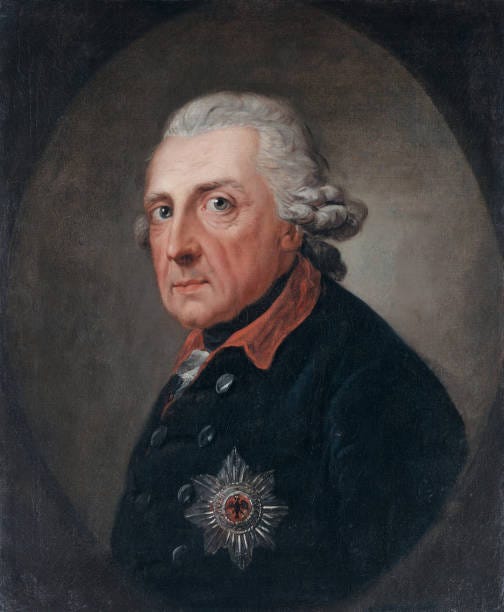
Portrait of Frederick II (The Great) of Prussia, 1781–1783 (From Heritage Images, via Getty Images)
Objective of This 3 Part Series
This series will discuss and analyse Frederick II’s motivations and strategy for his attack into Silesia with the aim of concluding that, while opportunistic to some extent, the King’s decision was calculated and planned rather than simply the result of vanity and rushed opportunism. The vast majority of material available in English that covers Prussian history fails to provide an in-depth analysis of this topic, and when one is presented it usually ignores the relevance of such things as Frederick’s time spent in the company of Eugene of Savoy on the Rhine, or the political awareness exercised by the King in his writings at the time.
Supporting the Argument
What can be expected of this 3-part series? A well-structured and supported argument that Frederick II’s decision to lead troops across the Silesian border in 1740 was one made not in rash vanity, but through planning and strategic timing. Considering this, it should be noted that there is no consistent pattern of agreement on it between the authors of the literature that is referenced, with some explaining the attack as the result of a young and immature king rushing at a perceived opportunity to ‘make a name for himself’, whilst others highlight the sharp and calculated behaviour the king displayed in the decision.
However, there is a general consensus among most of the literature that the state which was crafted and developed by Frederick William I gave his son the resources and infrastructure necessary to carry out such an attack, especially as a result of the vastly reformed military Frederick William left behind. This point can be found in the relevant sections of nearly all the books referenced in this paper, a pattern which is best represented by Christopher Clark in his book when he states that the ‘exploits of Frederick the Great would have been inconceivable without the military instrument fashioned by his father’. Overall, the majority of the literature used in this dissertation consists of books focused heavily on either Frederick the Great or his father, Frederick William.
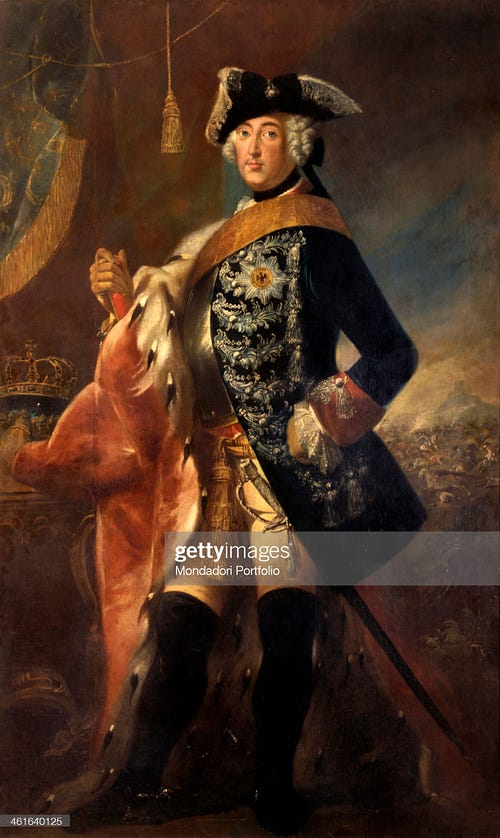
Portrait of Frederick II (The Great) (From Mondadori Portfolio, via Getty Images)
In regards to the primary source material, a number of published works, as well as extracts from letters and notes, will be analysed and used to support the argument. Much of the work was written by Frederick himself or Frederick William. This will allow for discussions and points made about topics such as the reforms of Frederick William or the actions of his son against Silesia to be supported by both the secondary and primary source material in close succession, allowing for more cohesive and well-structured arguments to be made. This is best observed in the later parts where topics such as the significance of Frederick’s experiences on the Rhine and the accuracy of his political assessments in the prelude to his invasion are both discussed with support from both the literature and Frederick’s own writings.
Structure of the Argument
This series will be chronologically structured in a broad sense but will occasionally use thematic arguments when it is extremely relevant in making a point or coming to a conclusion. The first chapter will focus on the administrative, fiscal and military reforms led by Frederick William during his reign as king in Prussia and ruler of Brandenburg (both of which are referenced as just ‘Prussia’ from here on) and how they created a state with one of the strongest army’s and most efficient administration systems in Europe by 1740. These achievements put the necessary resources and infrastructure in place for Frederick II to have the capacity to attack Silesia following Charles VI’s death and therefore will be discussed with reference to the attack.
Chapter two shall focus on the relevant experiences Frederick had during his time in an Austrian war-time camp as well as the actions he took against Herstall following his accession, and how both of these events can be linked to his strategy in attacking Silesia. Austrian vulnerability that the Prussian king would have been aware of by 1740 will also be examined, such as her weak local military presence and political instability, all of which will again be linked to the research objective and used to support the appropriate contentions.
Finally, the third chapter will be primarily centred around the weeks before and after Frederick’s attack, as well as a more detailed analysis into some of the strategic and geographical advantages the King was aware of.
Sources:
- Asprey, Robert B., Frederick the Great: the magnificent enigma (New York, 1999)
- For somewhat accurate political calculations he made before the attack see ‘Frederick II (“the Great”), Notes to Himself on the Invasion of Silesia, 1740 (German History in Documents and Images (G.H.D.I.), 1648–1815, no. 4, doc. 7, pp 1–2)
- H.M. Scott, ‘Prussia’s emergence as a European great power, 1740–1763’ in P.G. Dwyer (ed.) The Rise of Prussia, 1700–1830 (UK, 2000)
- Haffner, Sebastian, The rise and fall of Prussia (London, 1980)
- Clark, Christopher, Iron kingdom: the rise and downfall of Prussia, 1600–1947 (UK, 2006)






