
As Splinterlands has continued gaining traction in the crypto and DeFi worlds, I have been approached more often by people who are not interested in trading card games. Let's face it: Not everyone has the time to learn all the ins and outs of a complex strategy game like Splinterlands. Additionally, I'm always the first to admit that the game is not for everyone. It takes a certain type of thinking to keep coming back to the fast-paced, drafting game play of this unique trading card game.
So why are they coming to me to ask about Splinterlands if they have no interest in card games? The answer is that they have noticed that there is far more to Splinterlands than most TCGs.
The game has been a pioneer in the blockchain space, and while they have been running successfully for 2.5 years and continually growing, they have also made some groundbreaking innovations in decentralized markets, low marketcap trading and staking rewards. Even if you have no interest whatsoever in playing the game, when you take a closer look at Splinterlands, you'll open the door to a vast world of decentralized finance and opportunity.
Why I Got Hooked in the First Place
When I first found Splinterlands before the Alpha release, I saw the same things that the founders saw. There was a big problem with gaming. More specifically, something was very wrong with the way that players' in-game assets are owned. It's difficult to even use the word "owned" in this context, because the players do not actually own them. In classic TCGs for example, once they went digital, the ownership of cards was merely an illusion. Cards in these games are owned and completely controlled by the companies, not the players. This means that the cards can be reprinted, overprinted, or even confiscated if the company feels that the user has violated their most sacred terms.
Even worse than the above is the idea that if a player decides to quit playing a game, their assets simply belong to the company for evermore. There have been very few examples of effective markets by which players can buy, sell or trade their cards. Most of the time, such exchanges are forbidden outright by the company that actually owns the cards that they claim are yours.
With Splinterlands, you actually own your cards.
For them to have tradable value, the players must always rely on the game's development and have faith in the game. Still, if you decide to quit playing Splinterlands, you can simply sell your assets on the internal market or one of the many external ones. They can even be bridged over from the game's native HIVE blockchain to Ethereum mainnet, where they can be listed on Opensea or any such ETH marketplace.
That is my absolute favorite way that true freedom is available through Splinterlands, and it is the foundation of the founders' vision for the game. Furthermore, it opens a Pandora's Box of ways that players (not the company) can play the game not as a card game, but as an investment game.
Investing and Splinterlands
I firmly believe that a game must be brilliant to succeed in today's competitive gaming world. In the Play-to-Earn space, a game must be 100% enjoyable first as a non-rewarding game. This means that if players are only playing for the rewards and not for the fun of it, the game is doomed to fail at some point. I'm happy to say that Splinterlands has this covered. I would not have played the game daily for over two years if it was not fun to play. Some Splinterlands players are so absorbed in the addictive strategic gameplay that it has become their one and only hobby. I think it's beautiful that for an ever-increasing number of these players, it can also eventually be their livelihood.
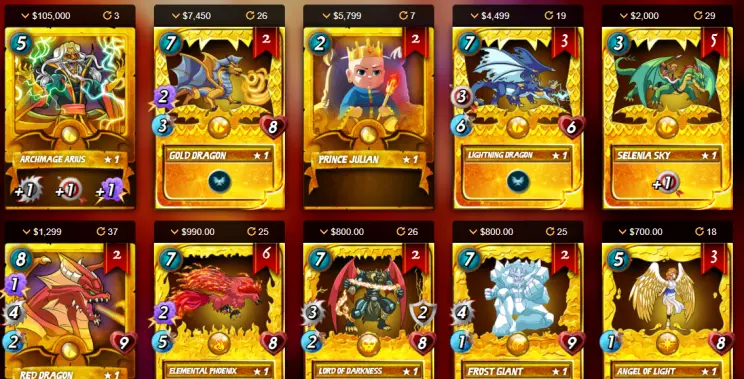
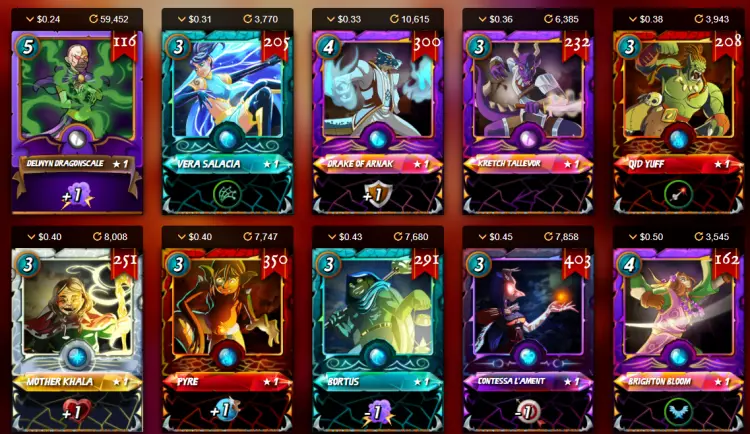
Above are the most expensive cards listed on the market.
I found this world as an investor. I was never a big-time investor. I was a very small-time crypto investor with no experience in the traditional markets at all. I'm not even ashamed to say that I started this wild journey by checking into BTC faucets years ago to collect satoshis and multiplied them playing "provably fair" gambling games like Bitsler. That's the way I got my first cryptocurrency and saw my first gains. I started doing some trading on exchanges, eventually finding the STEEM blockchain and Steem Monsters (now HIVE and Splinterlands).
It's clear to me as Content Director and half of the Splinterlands marketing team that as we grow, more and more people are going to see this lovely little trading card game as a powerhouse of cryptocurrency investment opportunity. I have already seen the tides beginning to turn. The game is well known, well respected and well loved in the blockchain industry, and what's not to love? Fast and free transactions, freedom and provable ownership of your cards are worth the attention.
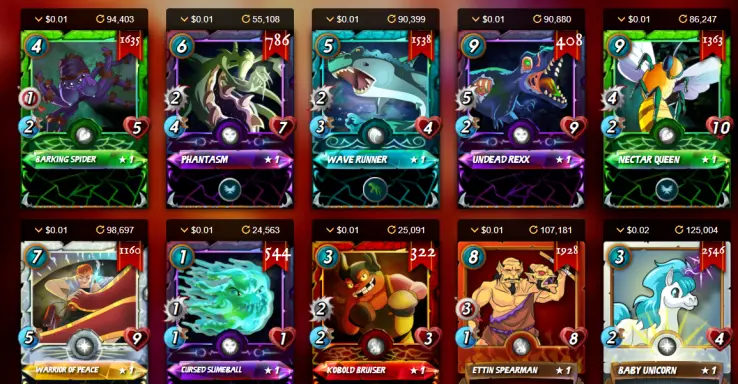
Above are the cheapest cards listed on the market. Do you see some potential growth? I do.
How to Play if You're not a Player - A GUIDE
Like I said, you don't have to be a gamer to earn money playing Splinterlands. If you're approaching it as an investor, learning the ropes is substantially easier than learning all the nuances of strategy that make the game so competitive. Trust me, there are some Splinterlands players with otherworldly skills, and I personally have no hope of consistently beating them.
I'm now going to go through a step-by-step guide of my own making. This is an example of how to invest and earn, how to play without playing. Of course you have the complete freedom to fit this to your preferred style or budget, but hopefully it gives you an idea of how easy it is and where to begin.
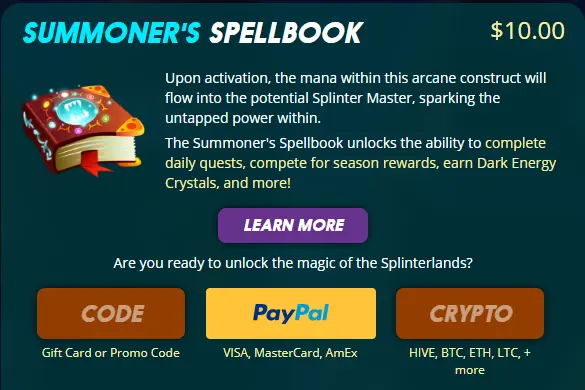
STEP 1 - Buy the Upgrade for $10
This is the first crucial step to be able to interact with the game on the blockchain level. Before you have purchased the Summoner's Spellbook upgrade for $10, you are only able to play the game in a sort of free trial mode.
The Summoner's Spellbook costs because it creates a HIVE blockchain account, and these accounts have a cost associated with their creation. Without this initial cost, the system would crumble quickly under the various ways that it would be exploited and abused by people all over the world.
By purchasing this upgrade, you'll be able to earn rewards for playing the game, but more importantly, you'll be able to interact with the markets. It's a necessity to play to earn with Splinterlands. If this snags you somehow, then you probably shouldn't even bother reading the rest of my article.
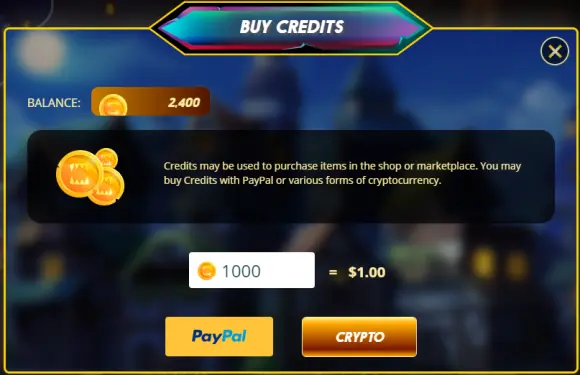
STEP 2 - Buy some Splinterlands Credits
Credits (pegged at 1000 = $1) are essentially your spending balance within Splinterlands. They can be purchased with either Paypal or one of the 22 different cryptocurrencies accepted by Splinterlands. They are not transferable out of the game, which allows Splinterlands to have all this market functionality without being considered an exchange and without subjecting Splinterlands to a far greater degree of regulation. Just be warned that once you've purchased Splinterlands Credits, they may only be spent on assets within Splinterlands.
It doesn't matter how many Credits you buy, and obviously I'm not going to tell you much you should spend. All I'm going to say is one of the general pieces of investment advice that is (necessarily) repeated over and over by creators like myself: Do not invest more than you can afford to lose. If you're willing to sacrifice necessities like food and shelter to invest in digital assets, then you're just a fool and God knows I cannot help you. Okay, that was harsh, but important nonetheless.
Now that you have some Splinterlands Credits, you're ready for the next step, which is not a small one.
STEP 3 - Do the Research (longest step)
I know that we all secretly hate this part while acting like we love it, but it's an absolute imperative to success in any type of investment. Sure, you can get lucky sometimes, especially when BTC is near its all-time high and crypto awareness is spreading like wildfire. You cannot rely on luck with your money in this industry. You need knowledge, experience, money, and a little bit of luck.
YOUR GOALS (What to Research)
Even though you don't need to know everything about how the game is played, I strongly recommend learning the basics. I'm talking about basics like the difference between Summoners and Monsters, and the crucial scarcity mechanic of BCX and Combining Cards. You must also be able to accurately judge Community Enthusiasm and the Utility of Individual Cards.
Summoners and Monsters - This can be understood easily. Each battle uses one Summoner, who summons a team of up to 6 Monsters. This means that Summoners are always an important necessity to players of the game. Special attention should always be paid to Summoners when looking at the game with an investor's eye.
Above are the cheapest Summoners currently available.
The level of Monsters that can be played in a given battle are limited by the level of the Summoner. This means that while players can always keep the levels of their Monsters lower if they choose, combing and leveling Summoners is a must for most players. This is an important piece of information for investors that I will dig into under the next mini-heading.
BCX and Combining Cards - This incredible mechanic is one of the engines that drives the success of Splinterlands and continually assures balance in the game by controlling scarcity. It is very important for investors to know how and why cards decrease in total circulating supply, especially if they wish to capitalize on the card markets.
The only way to level up Splinterlands cards is by combining them. For example, to create a Beta Common MAX LEVEL card, 505 single cards are needed. They must be combined in a permanent action that leaves a single max card where there were previously 505 single cards. The term used around this mechanic is BCX (Base Card Experience). A basic and single level 1 card is 1 BCX. If ten of them have been combined, you get a single card that is 10 BCX.
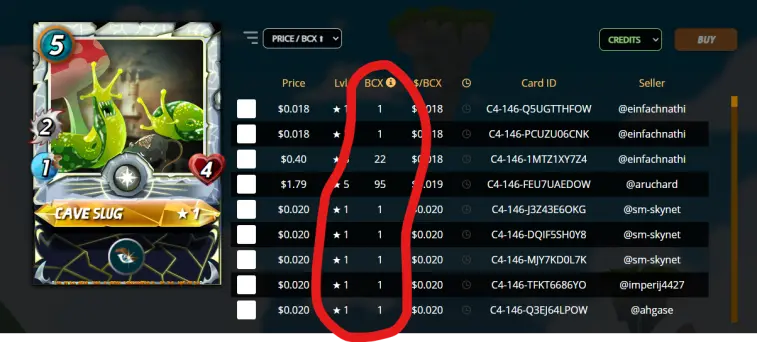
There are many variables that affect how many cards are needed to reach new levels, including Set (Alpha, Beta, Reward, Promo, Dice), Rarity (Common, Rare, Epic, Legendary) and Foil (Regular or Gold). You'll find greater details about how this works in THIS POST.
As an investor, here is the important thing: DO NOT COMBINE CARDS. Combining cards cannot be undone, and the sole reason for doing it is playing the game. If you have no intention of seriously playing the game, leave your investment cards as single BCX versions to keep your options open.
Community Enthusiasm and Utility - This is where you must use your keen investor's intuition and observation to determine which cards are undervalued and which ones have the greatest potential for growth. You must also determine which cards are unpopular and will never have an increase in value. There are several ways to go about this step.
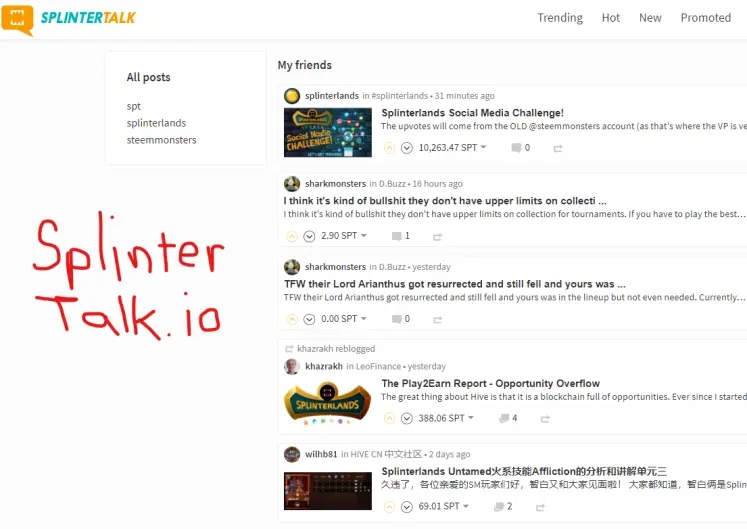
The best place to start is Splintertalk.io.
This is the native blogging platform of Splinterlands. Everything there is 100% Splinterlands all the time. Content creators are rewarded in the SPT token, which can be traded and staked on HIVE-Engine. There you'll find posts of all types, including videos, detailed battle breakdowns, strategy posts, reviews of cards and more.
You can also explore the wide world of Splinterlands Twitter by searching #Splinterlands. Many members of the Splinterlands community live on Twitter, and there you'll find links to many useful posts from lots of different publishers and creators.
Another place to check regularly for analyses of Splinterlands from an investor viewpoint is Leo Finance (another project built from the HIVE blockchain). There you'll find a community of investors who are not afraid to talk about investing. Many of them talk about Splinterlands, because after all, Splinterlands is the most used Dapp on the blockchain.
The currency of Leo Finance (LEO) is accepted as a payment method in Splinterlands.
Another important resource for information is the REWARD CARD STAT PAGE designed by Hiver Kiokizz. There you'll find a live updated chart of all Splinterlands Reward Edition cards. These are the cards that are earned by players in their Loot Chests from Daily Quests and Season Rewards. Each of these cards has a limited "print run" and once all have been printed, they are never earned again. After the print run, they will only be available on the secondary markets. This means that it is almost assured that there will be an increase in the value of those cards, especially as their print runs vanish further and further into memory.
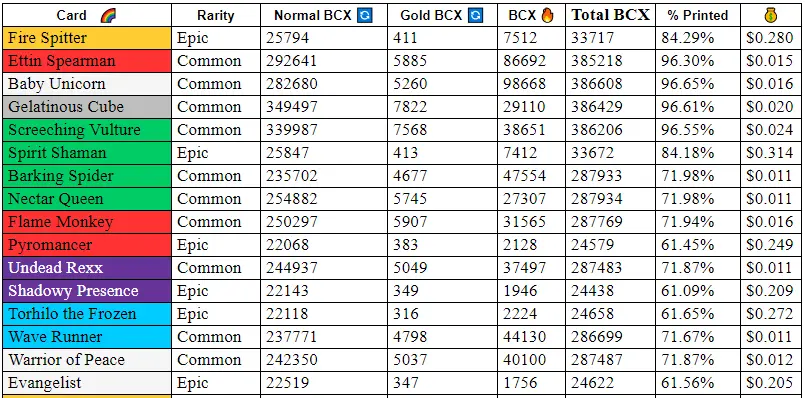
For example, notice above that 4 of the Reward cards are now nearing the end of their print runs: Ettin Spearman, Baby Unicorn, Gelatinous Cube, and Screeching Vulture. Seeing this information, a smart investor would next want to know which of these cards are the most played, and which are the most valued by players.
It can usually be assumed that Reward cards will be undervalued on some level as long as players are earning them for free. That's simply the nature of free, and it is quite predictable. This is why one of the greatest places to look for an investor looking to make a profit is Reward cards.
Cards from non-Reward sets (Booster Packs) follow similar patterns. When they are out of print, the supply will only decrease. If the card with the decreasing supply is relied upon by players, it's only a matter of time before the value of that card goes up on the market. After all, there are never really enough cards to go around, and the scarcity mechanic is built right in by the game's brilliant founders. Starting to get the picture?
STEP 4 - BUY SOME CARDS
If you have completed the above steps to a level with which you're comfortable, it's time to hit the market and start buying some cards! You should know at this point what kind of cards you're after. Since you're not trying to make a collection to use to reach the Champion League, you can focus on purchasing quite differently.
There is no need to buy Booster Packs as an investor at this point. You're merely seeking out the most undervalued cards in the game and buying them in quantities with which you're comfortable.
For me the perfect example is Daria Dragonscale, the Epic Dragon Summoner. I personally have noticed that Epic cards have a particularly wide range from when they are undervalued as Reward cards to when they are out of print later and finally find an appropriate value on the market. I actually wrote a short post two years ago entitled Is Daria Dragonscale the Best Investment of 2019? I still think she may have been, as I was 100% sure of my decision at the time, and it worked out exactly the way I expected it would.
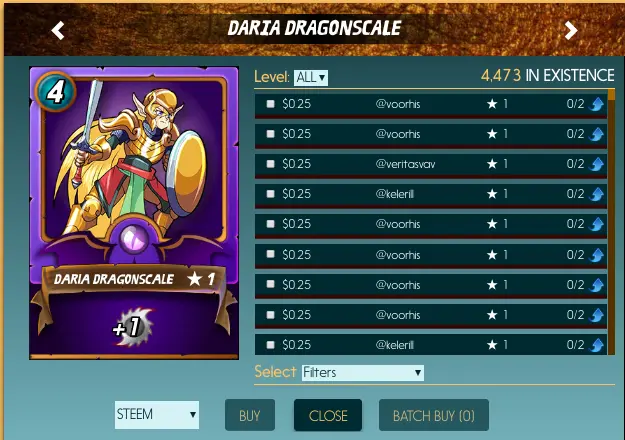
That was back then. Before writing that post, I had cleared out every Daria that was cheaper than a quarter. I got many of mine for as low as ten cents each. They are currently valued at over $1 each.
STEP 5 - Wait and Watch
This step may be difficult, but it is very important: You must have patience. If you're serious about investing and not just another crypto dweeb looking to get rich quickly, then you know about patience. You may have to wait a year, but you may also see tripling (or more) on the money you've invested, especially if you have followed my steps correctly.
There are certain things you can do during this waiting time that require minimal effort on your part. The best of these is probably to use your personal referral link. This link will earn you 5% of everything your referrals spend when purchasing Credits and Booster Packs. You'll be rewarded in Dark Energy Crystals and Credits, which works out well because it will simply allow you to buy more cards on the market and increase your collection.
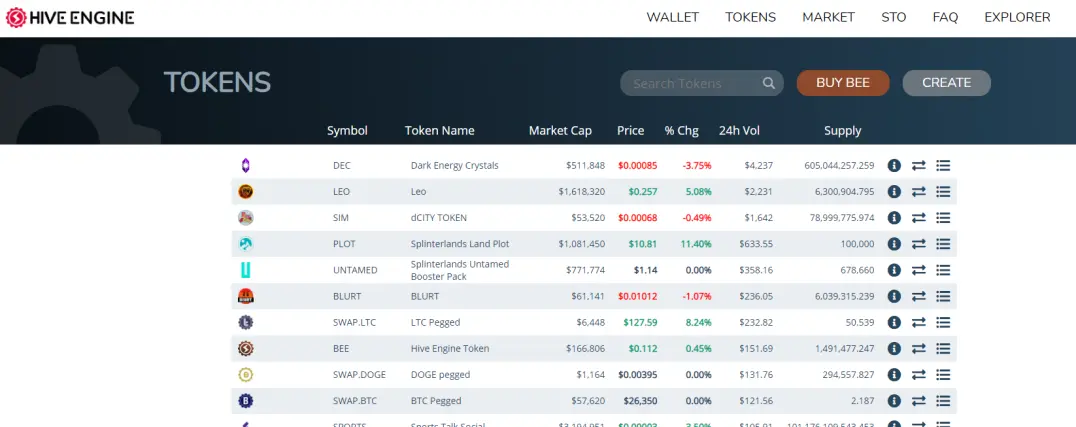
During this time, it is also a good idea to become familiar with the decentralized exchange (DEX) on HIVE-Engine. This is the second layer DEX of the HIVE blockchain, where tokenized packs, land plots, and Dark Energy Crystals are traded at fluctuating prices. If you would like to dabble in Booster Packs as a non-player, I would recommend trading them in their tokenized, HIVE-Engine form.
STEP 6 - Sell (When the Time is Right)
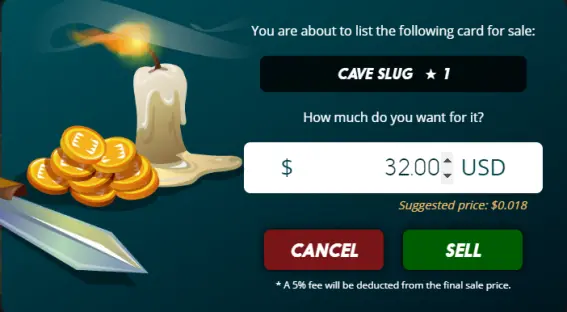
There will come a time when people are looking for the cards that you're holding. They will most likely be players who need them for their collections, and if you chose the right cards during their print runs, this time will always come. Remember, it's built right into the system. Patience is rewarded. When this time comes, simply list the cards on the market and they will sell quickly and easily.
As with your referral rewards, you will be paid either in Credits or Dark Energy Crystals. With the portion of your profits that are paid in Credits, you'll buy more cards to increase your collection for next time. With the Dark Energy Crystals, you'll send them to HIVE-Engine where they can be traded for Bitcoin using the SWAP.BTC Bitcoin pegged currency there. There you have it. I'm not going to explain how to get money out of BTC (since its already money ;).
If there is not enough liquidity on HIVE-Engine, you can transfer your Dark Energy Crystals to Ethereum and swap them for ETH on Uniswap. You can even earn sweet Splinterlands rewards for providing liquidity to that pool, but I'm not going to go into greater detail about that right now.
STEP 7 - Repeat the Process
This step is fairly self-explanatory. Good luck and have fun!
I hope you enjoyed my guide, and if you're thinking of investing, I hope you were able to find some sort of value in this information. Please sign up with my REFERRAL LINK so that I can continue finding value for my time and energy in creating content such as this.
Thanks for reading NON-FUNGIBLE STEW!

The enchantress beside me is my better half, the lovely Carrie Allen, Director of Splinterlands Marketing






