The strange little ways money becomes a language for status, success, taste and identity.
Nobody asked.
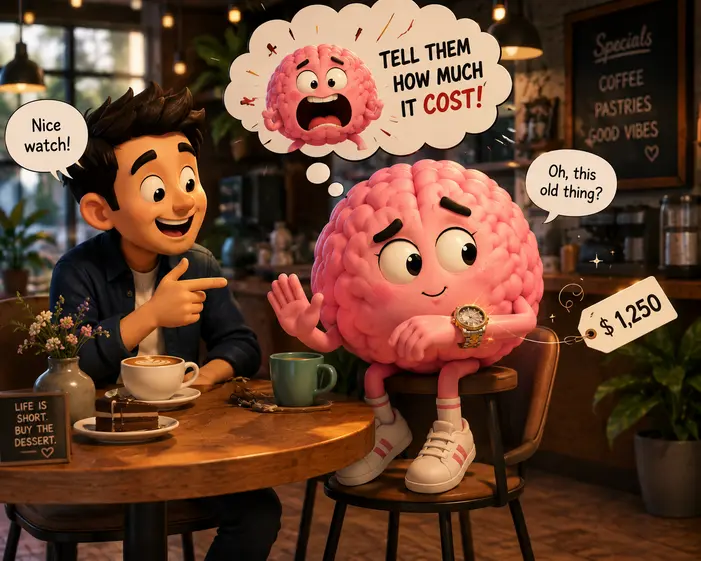
You bought the watch.
You like the watch.
It's nice.
You wear it.
Perfectly normal.
And yet, somehow, there comes a moment when the price enters the conversation.
Not directly, obviously.
That would be showing off.
You just casually say:
“Yeah, it wasn't cheap.”
And wait.
Nothing.
So you add:
“It's actually a pretty good brand.”
Still nothing.
Now you're in trouble.
Because apparently the conversation needs a little more context.
Eventually, the price escapes.
And suddenly everyone knows.
Congratulations. The watch has completed its mission.
Sometimes money talks before we do
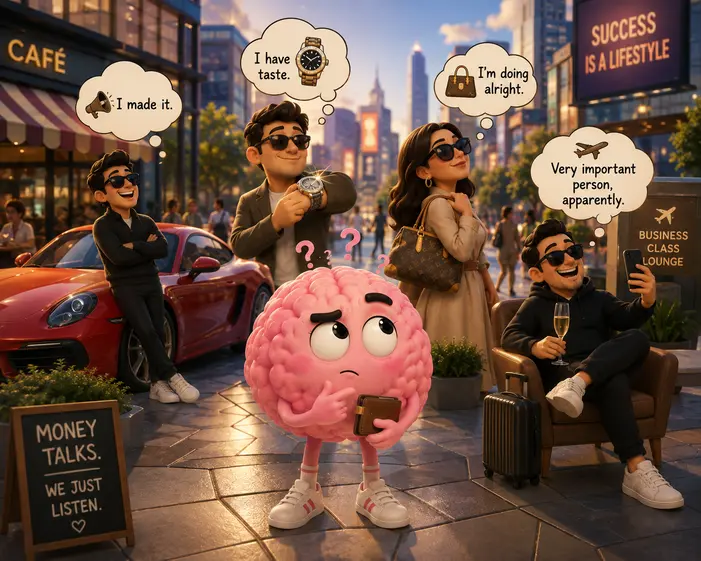
A nice car can say:
I made it.
A designer bag can say:
I have taste.
A business-class ticket can say:
I'm doing rather well, thank you.
Even an unnecessarily expensive coffee can quietly say:
I have made some questionable financial decisions, but look how sophisticated they are.
We don't always buy things because we need them.
Sometimes we buy what they say about us.
And that's hardly a new human habit.
Clothes have always said something.
Houses say something.
Cars say something.
Even the restaurant we choose can say something before we've opened the menu.
Sometimes the object isn't just an object.
It's a sentence.
Then someone else's sentence gets louder
You're perfectly happy with your phone.
Until your friend gets the newer one.
Your car is completely fine.
Until someone parks beside you with something twice the price.
Your holiday was fantastic.
Until Instagram serves you somebody's “casual weekend” from a villa overlooking the Mediterranean.
Suddenly, your perfectly good life has developed a strange little problem.
Someone else's life.
Nothing about yours changed.
Your phone still works.
Your car still starts.
Your holiday memories are still yours.
But comparison has a sneaky little habit of moving the finish line.
You reach it.
Then somebody moves it.
You reach it again.
Another person shows up with a newer watch.
Excellent.
New finish line.
The funny part? We don't even need to like the audience.
An old colleague.
A distant relative.
Someone from school.
That person who somehow always has something slightly more impressive.
You don't want their life.
You don't even particularly want their approval.
And yet...
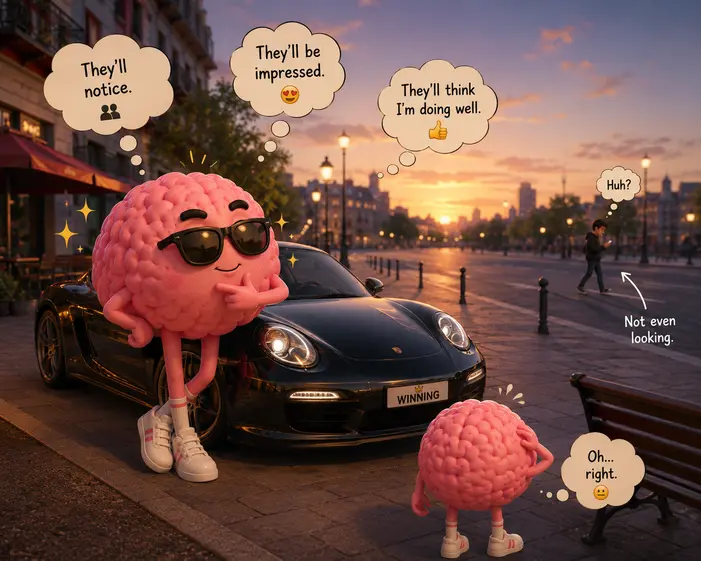
If they notice your new car?
Well.
That would be nice.
It's one of those wonderfully ridiculous human contradictions.
We're not always buying the thing.
Sometimes we're buying the reaction.
The raised eyebrow.
The “Oh, nice.”
That tiny moment where somebody recalculates where they think we stand.
And sometimes we don't even realize we're doing it.
There is no final level
This is where money gets particularly funny.
Because there is always another level.
New phone.
Newer phone.
Nice car.
Nicer car.
Business class.
First class.
Private jet.
And then, presumably, a helicopter just to get from the private jet to the private jet.
At some point, we're no longer asking:
“Do I like this?”
We're asking:
“How does this look next to what everyone else has?”
And that's a completely different question.
One can make you happy.
The other can keep you running.
Because if your happiness depends on looking like you're winning, you've entered a competition with no finish line.
And the funniest part?
Most of the competitors don't even know they're competing.
So who are we actually buying it for?
There's nothing wrong with nice things.
Buy the watch.
Take the trip.
Order the stupidly expensive dessert.
Sometimes you simply like beautiful, ridiculous, unnecessary things.
Fair enough.
But every now and then, there's an interesting question hiding underneath the purchase:
“Would I still want this if nobody ever saw it?”
If the answer is yes?
Lovely.
Enjoy it.
If the answer is no?
Well...
Maybe the purchase came with an invisible audience.
And invisible audiences are notoriously difficult to impress.
They don't clap.
They don't compliment you.
They don't even know you're performing.
Yet somehow, we keep buying tickets to the show.
Maybe the weirdest thing about money isn't what it can buy. It's how often we spend it trying to be seen.
☕ Until next coffee thought,
— The Everyday Mind






