
While the broader market remains intoxicated by AI-driven multiples, the latest 13F filings reveal a cold, calculated retreat. The portfolio of berkshire hathaway is no longer just a collection of American icons; it has transformed into a massive $382 billion volatility hedge. By maintaining a net-selling streak for 12 consecutive quarters, the Oracle of Omaha is signaling that the current "Buffett Indicator" (Market Cap to GDP) at 225% has reached an unsustainable apex.
The Liquidity Fortress: $20B in Passive Yield
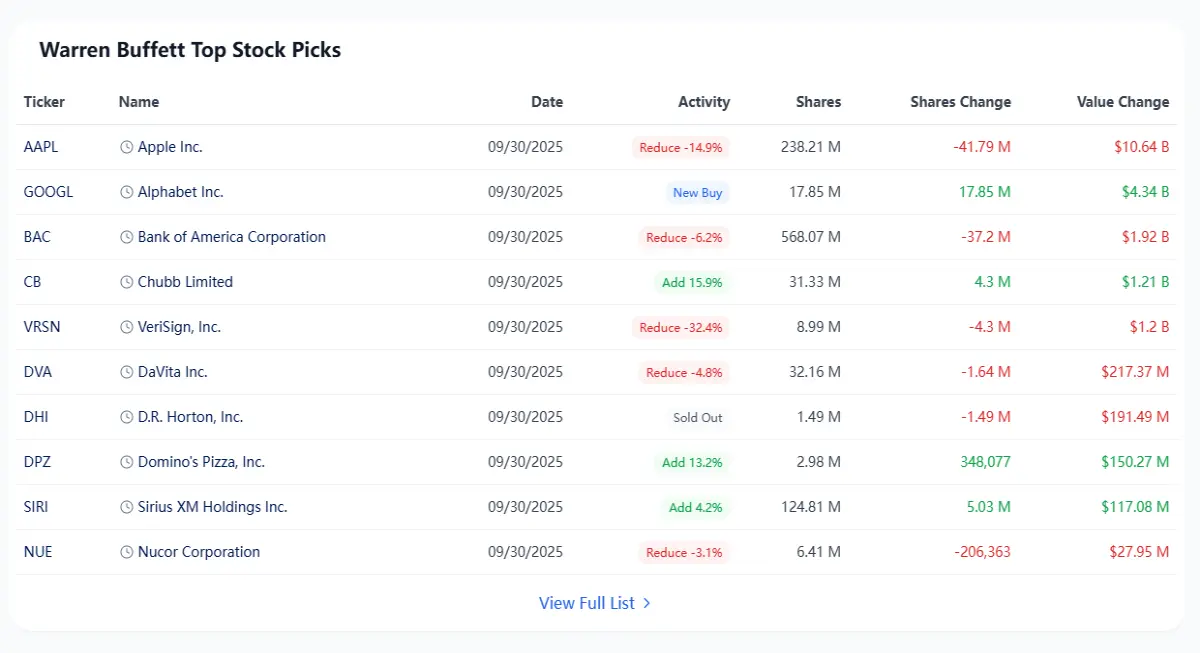
The most striking data point is not what Berkshire is buying, but the yield on its inaction. With $381.7 billion parked in Treasuries, the conglomerate is now out-earning 90% of the S&P 500 through interest alone, generating roughly $20 billion annually. This "War Chest" was fueled by the aggressive 70% liquidation of Apple ($AAPL) from its peak and a systematic 6.1% trim of Bank of America ($BAC) in the most recent quarter.
The "Value-AI" Pivot: Alphabet and Insurance
Despite the defensive posture, the portfolio of berkshire hathaway isn't dormant. The surgical $4.93 billion entry into Alphabet ($GOOGL) suggests a pivot toward "Value Tech"—buying the search monopoly at a discount compared to hardware-centric AI plays. This is supported by a 15.9% stake increase in Chubb ($CB), proving that Buffett still views insurance float as the ultimate weapon during inflationary cycles. For a deep dive into these cost bases, you can track the full portfolio of berkshire hathaway on 13Radar.
2026: Preparing for the Valuation Reset
Entering the Greg Abel era, Berkshire’s allocation is a masterclass in optionality. With a cash-to-asset ratio nearing 30%, the firm is positioned to be the liquidity provider of last resort during the next market dislocation. For professional traders, the signal is undeniable: when the greatest value investor in history builds a fortress of this magnitude, he isn't just retiring—he is waiting for the market to break.






