Your Bitcoin can be offline. Your device can be air-gapped. Your seed can never touch the internet. And you can still lose everything.
That is the uncomfortable lesson emerging from one of the most disturbing Bitcoin security incidents of 2026.
A vulnerability in Coldcard firmware has been linked to the theft of approximately 1,082.65 BTC, worth around $70.2 million, from 1,196 Bitcoin addresses in just 41 minutes.
And there is a detail that makes this incident particularly alarming:
The attackers apparently never needed physical access to the victims' hardware wallets.
Instead, the problem was buried much deeper — in the way some Coldcard devices generated their wallet seeds.
That is why this story matters far beyond Coldcard.
It raises a fundamental question for anyone practicing Bitcoin self-custody:
What happens when the thing protecting your private keys is secure… except for one tiny mistake in the code?
The $70 Million Attack Happened in Just 41 Minutes
According to research attributed to Galaxy, the attacker swept funds from 1,196 Bitcoin addresses during a remarkably concentrated 41-minute period on July 30.
The stolen amount was initially estimated much lower, but further blockchain analysis pushed the figure to more than 1,000 BTC.
The transactions were highly similar and were spread across only six Bitcoin blocks, suggesting an automated operation rather than hundreds of independent compromises.
The attacker didn't need to phish victims.
They didn't need to convince anyone to install malware.
They didn't need to steal a Coldcard from someone's house.
They apparently did something much more interesting:
They reconstructed the keys.
Galaxy's analysis connected the attack to a weakness in the generation of seeds on affected Coldcard firmware.
And this is where the story becomes genuinely scary.
The Problem Wasn't Bitcoin
Let's make one thing clear.
Bitcoin's cryptography wasn't broken.
The Bitcoin blockchain wasn't hacked.
The attacker didn't discover a way to magically reverse a SHA-256 hash or crack Bitcoin's underlying cryptographic system.
The weakness was in the process used by affected devices to generate the secret material that ultimately controlled the Bitcoin.
That distinction is extremely important.
A Bitcoin private key is supposed to be effectively impossible to guess.
The number of possible combinations is astronomically large.
But what if your wallet doesn't actually choose from that enormous universe?
What if a software bug accidentally forces the wallet to choose from a dramatically smaller set of possibilities?
Suddenly, an impossible attack can become a computational problem.
And computers are very good at computational problems.
How Could Hackers Recreate the Seeds?
The vulnerability reportedly involved a fallback mechanism in the firmware responsible for generating randomness.
Instead of relying on the device's dedicated hardware random-number generation as intended, affected code could fall back to a much weaker source of entropy.
Information such as the device's serial number and internal clock state could become relevant to the generation process.
Those aren't secrets.
And that is the critical point.
If enough information about how a seed was generated is predictable, an attacker doesn't necessarily have to steal the seed.
They can attempt to reconstruct it.
For certain affected models, researchers estimated that the possible search space could be reduced to roughly four billion possibilities.
Four billion sounds enormous.
But compared with the astronomical search space that properly generated Bitcoin keys are supposed to have, it is microscopic.
With sufficient computing infrastructure, a search of that size becomes feasible.
The attacker could generate candidate keys, derive the corresponding Bitcoin addresses and compare them against addresses visible on the public blockchain.
Once a match was found?
The Bitcoin could be moved.
No physical wallet required.
No internet connection to the Coldcard required.
No interaction with the victim required.
This Is the Part Most People Miss
When people hear "hardware wallet," they often imagine something like this:
Internet-connected computer → dangerous
Exchange → dangerous
Software wallet → risky
Hardware wallet → safe
Reality is more complicated.
A hardware wallet dramatically reduces the attack surface.
That's why hardware wallets remain one of the strongest tools available for Bitcoin self-custody.
But "reduced attack surface" does not mean "zero risk."
The hardware wallet still has firmware.
The firmware still contains millions of lines of logic and dependencies.
The device still needs to generate cryptographically secure randomness.
And somewhere in that chain, a single mistake can potentially undermine the entire security model.
Coldcard itself describes its devices as generating and storing private keys offline, while current setup documentation says supported devices use independent hardware true-random-number generators.
That makes the incident particularly ironic.
The whole point of cold storage is to move your Bitcoin away from online threats.
But if the seed was generated incorrectly in the first place, putting the device in a safe, disconnecting it from the internet and hiding it under a mattress won't solve the underlying problem.
The secret itself was compromised by predictability.
CZ Has a Warning for Everyone
Changpeng Zhao, better known as CZ, also reacted to the incident.
His message was surprisingly simple:
Even hardware wallets can have bugs. Even old wallets with a long history can have bugs.
His suggested mitigation was to consider splitting funds between multiple wallets rather than keeping everything in one place.
But CZ also acknowledged the uncomfortable downside.
Diversification creates a different category of risks.
More wallets mean more backups.
More seed phrases.
More recovery procedures.
More opportunities to lose track of something.
And if you split your Bitcoin between five wallets but lose the backup for one of them, you have simply created another security problem.
As CZ effectively summarized it:
Nothing is 100% safe.
That might be one of the most important lessons from this entire incident.
"Not Your Keys, Not Your Coins" Isn't the End of the Story
Bitcoiners have repeated "not your keys, not your coins" for years.
And the principle remains valid.
If your Bitcoin is sitting on an exchange, you don't have direct control over the private keys.
But self-custody introduces another layer of responsibility:
You have to secure the entire key-generation and recovery process.
Your security isn't just:
"Where are my Bitcoin stored?"
It's also:
"How were my keys created?"
"Which firmware generated them?"
"Can the randomness be trusted?"
"Is my backup secure?"
"Could a vulnerability affect old seeds?"
The Coldcard incident demonstrates that self-custody isn't a single security decision.
It is a chain.
And the chain is only as strong as its weakest link.
What Should Coldcard Users Do?
This is where caution is essential.
If you own a Coldcard, don't assume that simply installing the latest firmware automatically makes an old vulnerable seed safe.
A firmware update can fix the software problem going forward, but it cannot magically increase the randomness of a seed that was already generated incorrectly.
That distinction is crucial.
Users should consult Coldcard's official support and firmware documentation for model-specific instructions and determine whether their device or seed generation process was affected.
And never enter an existing seed phrase into a website, app, online "checker" or random support form.
Ironically, trying to fix a hardware-wallet problem through an online solution could create an even bigger security problem.
Should We Stop Using Hardware Wallets?
Absolutely not.
That would be the wrong conclusion.
Hardware wallets remain an extremely powerful security tool because they dramatically reduce exposure to malware, phishing and compromised computers.
The lesson is not:
"Hardware wallets are useless."
The lesson is:
Hardware wallets are not magic.
Security requires layers.
For large holdings, some users may consider distributing funds across multiple independently secured wallets, using strong operational procedures and carefully maintaining physical backups.
Advanced users can also explore multisignature setups, where spending requires multiple independent keys instead of a single device.
These approaches don't eliminate risk.
They change it.
And that's ultimately what good security is about.
You are not looking for a system with zero risk.
You're trying to make catastrophic failure extremely difficult.
The Bigger Bitcoin Lesson
What happened with Coldcard is uncomfortable precisely because it attacks one of Bitcoin's strongest narratives.
We often imagine the biggest threat to our Bitcoin as a hacker breaking into our computer.
But sometimes the most dangerous vulnerability can exist before the Bitcoin ever reaches the wallet.
The moment your seed is generated is one of the most important moments in the entire life of your Bitcoin.
If that randomness is truly random, the attacker faces an astronomical problem.
If it isn't?
The game changes completely.
The blockchain can remain perfectly secure while millions of dollars disappear.
That's exactly why this incident deserves attention.
Bitcoin didn't fail.
The cryptographic foundation didn't fail.
A piece of software did.
And software can fail.
Even after years of development.
Even inside a product specifically designed to protect your most valuable secrets.
Even inside a device marketed around offline security.
The New Rule of Bitcoin Self-Custody
For years, the golden rule was:
Not your keys, not your coins.
After this incident, I'd add another one:
Not your entropy, not your security.
The Coldcard exploit is a brutal reminder that self-custody doesn't mean trusting nobody.
It means deciding what you trust, understanding the risks and building enough redundancy that one failure doesn't destroy everything.
Keep your firmware updated.
Understand whether your wallet generation method was affected.
Protect your backups.
Consider diversification if your holdings justify it.
And most importantly, never assume that "cold" automatically means "invulnerable."
Because the $70 million Coldcard incident just demonstrated something the Bitcoin community doesn't like hearing:
**Sometimes the attacker doesn't need to touch your hardware wallet.
They only need to predict what happened inside it.**
Stay informed. Stay cautious. And, as CZ would put it:
Stay SAFU. 🔐
💎 Free Crypto Opportunities I Personally Follow🔥
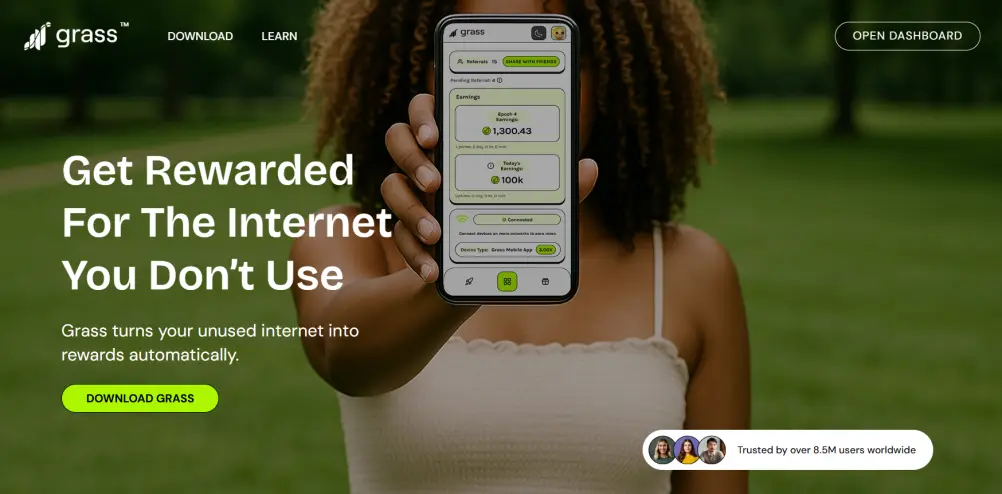
1. GRASS — (DePIN/AI)
Grass is a decentralized network that lets you turn your unused internet bandwidth into crypto rewards!
Just install the browser extension, desktop app (2× rewards) or mobile app (3× rewards) — and start farming Grass Points automatically while you browse.
🔥 At the end of each season, your Grass Points are converted into $GRASS tokens — and Season 1 has already rewarded thousands of users (including me!).
👉 Farm Grass airdrop now: https://app.grass.io/register?referralCode=lNAoYuHQUPN22mF
2. UPROCK — (DePIN/AI)
AI needs real-world data. UpRock is building the decentralized network that powers it — and participants earn $UPT rewards.
Help power the next generation of AI by contributing to a global decentralized data network while earning $UPT rewards through the UpRock ecosystem. You can also earn more $UPT sharing your unused internet (desktop & mobile), watching videos (mobile only), playing games, answering surveys and completing simple tasks.
👉 Start earning $UPT now: https://link.uprock.com/i/f38853d4