
How Does a Community Become a State? The Case of Liberland
A response to Leon Žganec-Brajša of the Law Faculty of the University of Zagreb, Department of International Law
The Ministry of Foreign Affairs thanks Mr. Leon Žganec-Brajša for his article on the website of the Zagreb Faculty of Law published on 19 September 2023 concerning statehood of Liberland. We have read it with great interest, and in this memorandum we intend to review and respond to the points made in this article.
Whether it is recognized as a state by Croatia or not, Liberland has existed as a community since 2015. It has had a continuous presence on the territory of Gornja Siga (Liberland) since 6 August 2023.
How Does a Community Become a State? The Case of Liberland
A response to Leon Žganec-Brajša of the Law Faculty of the University of Zagreb, Department of International Law
Ministry of Foreign Affairs
Free Republic of Liberland
Whether it is recognized as a state by Croatia or not, Liberland has existed as a community since 2015. It has had a continuous presence on the territory of Gornja Siga (Liberland) since 6 August 2023. With over 800,000 applicants worldwide, 3000 E-Residents, 1000 citizens and close to 100 representative offices, interest and support for Liberland is undeniable.
Croatian authorities have gone from referring to Liberland as a joke or “virtual narrative” to branding it as a “parastate” – i.e., an "institution or body which takes on some of the roles of civil government." We realize it was likely not meant in the sense of a compliment, but it does represent an important admission and recognition of our community as an entity with a legal personality.
Croatia does not have to recognize Liberland as a state. It only has to decide to what extent it wants peaceful and prosperous relations with Liberland as a community.
We feel this is a step in the right direction, and hope that we can build peaceful and prosperous relations together.
The Montevideo Convention on the Rights and Duties of States
In his article, Žganec-Brajša discusses the criteria established by the Montevideo Convention, which are essential for setting the parameters necessary for establishing a state. He also notes:
“In practice, there are variations and it is often difficult to distinguish the exact moment in which a country acquired or lost its statehood.”
This is true. However, Liberland issued its proclamation of independence on 13 April 2015. According to the declaratory theory of statehood, this is the first and primary step – without requiring formal diplomatic recognition from other states. While we take no position on the Kosovo question, its example is instructive and deserves our further study. As the ICJ stated following Kosovo’s declaration of independence, there is no violation of international law because international law contains no 'prohibition on declarations of independence',
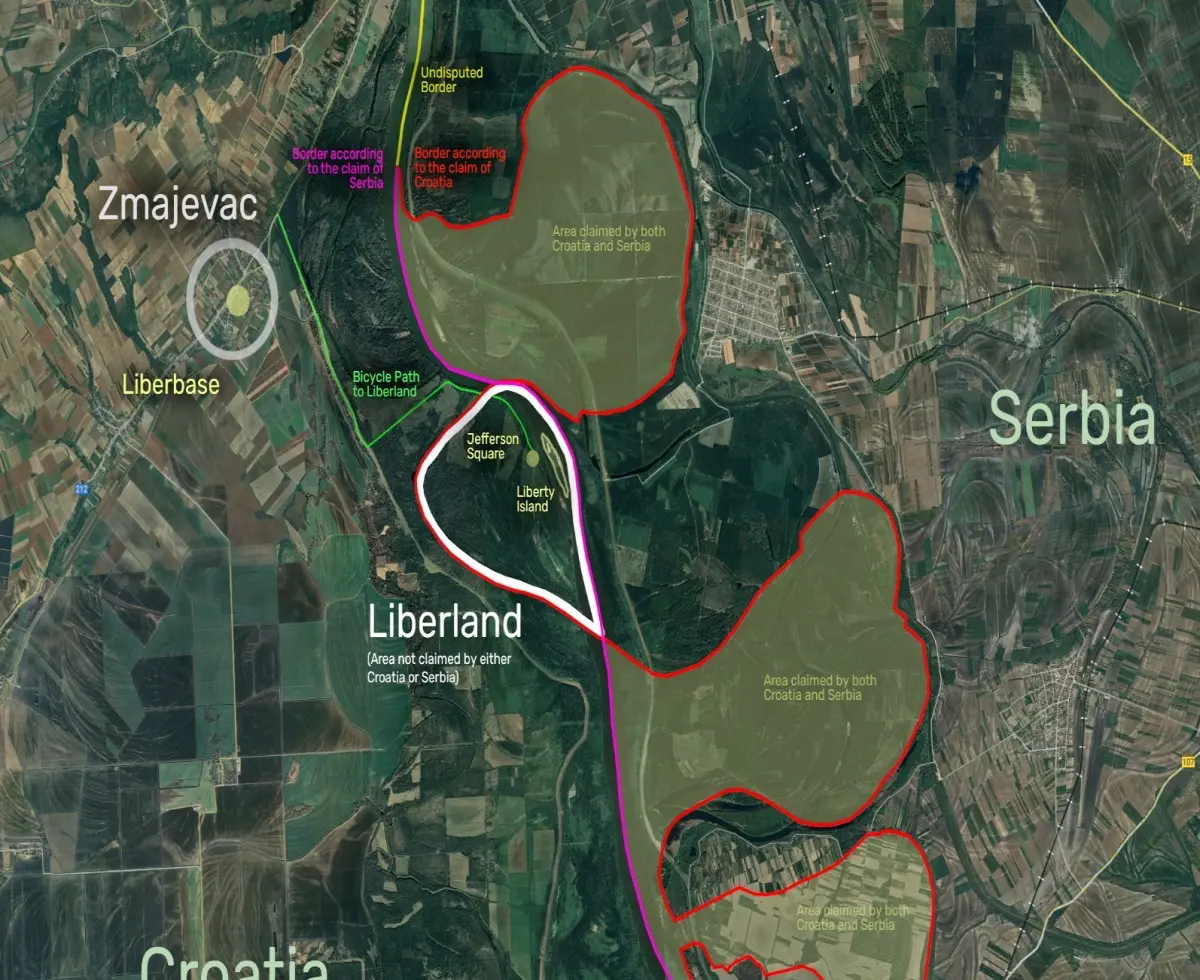
Žganec-Brajša states that since the area is disputed, it does not mean that it is free for occupation. That is his opinion and also the stated opinion of Croatian authorities. We disagree. Boundary disputes do not necessarily prevent an entity from becoming a state. In fact, the area of Liberland itself—Gornja Siga—is not disputed in the sense that neither Croatia nor Serbia wants it. Gornja Siga does not belong to Croatia in their view of the border dispute, nor does it belong to Serbia in their vision of how the border should be drawn. The other areas may be considered disputed or contested areas because they are claimed by both Serbia and Croatia. If Liberlanders were to occupy one of the pockets of land on the left riverbank (the left bank is the eastern side, and the right bank the western), then the dispute-related argument might have relevance (there are a few settlements in those areas already, such as the small village of Dondo and various weekend huts, hunting, agricultural and beekeeping facilities).
The Badinter Commission and the borders of former Yugoslav republics
In 1991, the Arbitration Commission of the Peace Conference on Yugoslavia (also referred to as the Badinter Commission) ruled in Opinion #3 that the borders between federal units of the SFRY became inviolable international borders.
The inter-governmental commission established to address border questions between Croatia and Serbia (the Interstate Diplomatic Commission for the Identification and Determination of the Border between Croatia and Serbia) has only convened a handful of times, and basically has agreed to disagree with no further resolution.
The Serbs prefer the thalweg of the Danube to be the line of control between Serbia and Croatia, although they have taken few steps if any to formalize the establishment of new borders. The Serbian Ministry of Foreign Affairs famously issued a statement after the founding of Liberland that the "new state" does not infringe upon their territory, effectively issuing a quitclaim to that particular piece of land. Nonetheless, Serbian pilots avoid flying over the Croatia-claimed pockets on the left bank as it is deferentially treated as Croatian airspace.
Croatia insists Gornja Siga (Liberland) is Serbian territory, even though Serbs who try to enter Liberland are not treated very well and regularly expelled. One state cannot dictate the borders of another or what goes on outside its own borders; otherwise it is in effect an international bully.
Fulfilling the Montevideo Convention criteria
Žganec-Brajša makes a number of assertions that are demonstrably incorrect or at least disputable. He writes:
“No one lives in the area along the Danube where Liberland is supposedly located. Despite sporadic attempts by the "citizens" of Liberland to visit the territory of their "state", it does not have a permanent population, and therefore does not meet this criterion either.
This is incorrect. While Croatian police prevented from entering Liberland for most of its history, this has not been true since 6 August 2023, over one month before his article was published. The community of Liberland has had a continuous presence on the land since that date, even with the difficulties posed by police behaviour as well as challenges presented by the weather and the water. He continues:
“Independent government, normally in the case of serious states the most disputed criterion and the one about which doubts most often arise, is also not present in the case of Liberland. Neither the "authorities" of Liberland can sovereignly dispose of "their" territory, nor can they guarantee any rights to their "population", nor can they act independently in international relations. So Liberland does not meet this criterion either.”
The community of Liberland does not exercise full control over its territory because of police controls and harassment both in and outside of the settlement. Croatia also installed “no mooring” signs along the Liberland coast (among several other breaches of the Convention Regarding the Regime of Navigation on the Danube). In spite of this, we are still there on the land itself. Liberland has a provisional government and its Constitution and Congress are the expression of the will of its people. Liberland has and does act independently in an international context. It has sent many official legations to other nations since long before the settlement began.
We often point out that Croatia did not have full control over its territory when other nations began to issue formal diplomatic recognition, nor did it have consent from the people living in the areas it did not control, which amounted to a considerable part of the country.
Liberland is not part of Croatia, and never was
It is our position that Croatian authorities are acting in an extralegal, unconstitutional manner in the way they are dealing with the Liberland question. We assert that the activities of the Croatian Border Police violate the Constitution of the Republic of Croatia; according to Article 7, Croatian forces may only cross borders pursuant to approval by the Croatian Parliament and with the prior approval of the President. We know no law within Croatia's legal framework that explicitly grants the country ownership or jurisdiction over this area. Our understanding is that Croatia's jurisdiction should be limited to border monitoring and specific, coordinated actions with Serbia, which as noted, they are averse to engage in.
According to Article 8 of the Constitution, the borders of the Republic of Croatia may be altered solely by a decision of the Croatian Parliament, and to date the Parliament has made no such decision to include the area of Gornja Siga inside of its borders. Instead, it seems they are colonizing an area that does not lie on any Croatian map and that they do not officially claim.
We do not grasp how Croatia can assert authority over the disposal of a territory that is not and was not part of Croatia. Gornja Siga was never part of Croatia during the time of the Socialist Federal Republic of Yugoslavia. In the late 1990s, as the area of eastern Slavonia was integrated into the Republic of Croatia following the operations of the United Nations Transitional Administration in Eastern Slavonia, Baranja and Western Sirmium (UNTAES) administrative zone, Gornja Siga was decidedly not included in it.
Getting through to Croatian decision-makers
Croatian authorities seem rather stubborn in the way they have responded to matters at hand – with police overreach, trumped-up charges and harsh treatment of curious but innocuous visitors. As the saying goes, “if the only tool you have is a hammer, you tend to see every problem as a nail.” It seems their only tool in dealing with the Liberland community is a hammer.
There have only been indirect responses to our many attempts at correspondence with Croatia’s Ministry of Foreign and European Affairs, the Ministry of the Interior, the Ombudswoman’s office or other state organs. We have had brief but cordial meetings with President Zoran Milanovic, former President Kolinda Grabar-Kitarović, a few members of the Sabor (Parliament), and Defence Minister Ivan Anušić while he was still the governor of Osijek-Baranja County. The Foreign Ministry also responded to a letter-writing campaign to Croatian embassies around the world, to which we issued a counter-response.
As the saying goes, “if the only tool you have is a hammer, you tend to see every problem as a nail.”
It is nonetheless difficult to determine who actually decides Liberland policy and why we are being treated in the odd and often unpleasant way we are. There are some indications that the SOA intelligence service has a hand in making things difficult for us and our allies, or that the Croatian “deep state” is attempting to keep us discouraged, using law enforcement and Šume as muscle to push us around. Finally, some sources have informed us that local interests want to continue using the area for exploiting timber or for hunting. Perhaps it is precisely because the land is not in Croatia that they can get away with what they do, and it is probably our own lack of a cloak-and-dagger approach that leaves us guessing.
We have pointed out ad nauseam that a thriving Liberland would bring considerable business, investment and tourism to our friends in Croatia. We have already done this in Croatia to a certain extent, and in Serbia to a far greater extent, with Liberland community members purchasing real estate in the area around Zmajevac and Batina and spending a considerable amount of money in maritime services, local hardware shops and other service providers. Liberland is prepared to pay Croatia for goods, services, infrastructure improvements and much more. We can bring more jobs to a region that has seen a mass exodus of people over the past few decades. After all, Liberland has a unique selling point. We sincerely do not understand why Croatia ignores this tremendous opportunity.
Liberland is prepared to pay Croatia for goods, services, infrastructure improvements and much more. We can bring more jobs to a region that has seen a mass exodus of people over the past few decades. We sincerely do not understand why Croatia ignores this tremendous opportunity.
With Croatia actively hindering our state-building capacity as much as they can, they might disingenuously claim that Liberland does not possess the capacity to manage the territory and exert effective power over it.
But as mentioned, Croatia does not have to decide whether it recognizes Liberland as a state. We don't expect it to. It only has to decide to what extent it wants a peaceful and prosperous co-existence with Liberland as a community.
The role of Hrvatske Šume
On multiple occasions, personnel from the state forestry concern, Hrvatske Šume d.o.o. – accompanied by Croatian police units – entered Liberland community settlements and destroyed or stole the personal property of community members. We know the area is exploited by them, even though it does not hold legal jurisdiction over the community here nor is it the owning entity of the land in Gornja Siga. Šume’s own website clearly shows Gornja Siga as outside of the territory of Croatia. Perhaps the presence of the settlers has interfered with illicit hunting or other use of the area. There is plenty of wildlife including deer and boar, and many people have said that they spotted hunters entering the area prior to the settlement.
Good heavens! A Serbian plot?
To be sure, Croatian authorities have done plenty to undermine their own position in the border dispute with Serbia. As we have noticed, there is Croatian suspicion of Serbian involvement in Liberland to sabotage the resolution of the dispute or to simply provoke Croatia. While our community has received considerably better treatment on the Serbian side, and we employ many Serbians in the Apatin area, there is no Serbian direction of our activities. There is lingering, mutual nationalist resentment between Serbia and Croatia. The two countries cannot even exchange diplomatic notes without referencing each others’ aggression in wars past. While it is important to understand the region’s conflicts and their legacies, we’d love to see that mutual suspicion disappear. In fact, Liberland could be a bridge between the two and bring benefits to people on both sides of the Danube.
Again, regardless of whether Croatia recognizes Liberland as a bona fide state, we should call attention to some realities of the situation.
Our Grievances
We are thankful that there have been to date no serious casualties, refugee problems or famine. Nonetheless, our list of grievances is not small and is rather well-documented. It is our position that Croatia’s actions towards the community in Gornja Siga are occurring outside of their jurisdiction, outside of their state borders and outside of the Schengen Zone, which Croatia joined in January 2023.
- Direct attacks on the nascent settlement; facilitating theft or destruction of community members’ property by Hrvatske Šume
- Travel restrictions, expulsions and bans on individual members of the Liberland community:
- Certain EU citizens have been banned from entering Croatia for five years
- Bans for non-EU and non-Schengen citizens (usually 30 or 90-day bans, as well as travel-related red flags that result in delays when crossing other borders). Some of these individuals never even went to Liberland and were entrapped or lied to by Croatian police officers in a very unprofessional manner. This differential treatment of non-EU citizens contradicts principles of equality before the law
- Refusal of entry to people arriving by private aircraft at public airports (Osijek)
- Administrative and other barriers to navigation on the Danube River imposed by the border, port and navigation authorities of Croatia
- Erecting and enforcing "No Mooring" signs on the coast of Gornja Siga, among other breaches of the Danube Commission treaty
- Delays, harassment and detainment at border crossings such as Batina
- Overzealous inspection stops of Liberland community members’ vehicles in Croatia
- Intimidation and harsh treatment of Croatians helping or interested in Liberland, especially students and other young persons. Some of our Croatian personnel have been fined or even physically assaulted
These actions are quite peculiar and warrant an elevation of our grievances to a higher, international level—including but not limited to the EU, EC, Council of Europe, the ECHR, and various international organizations and bodies.
Possible outcomes of the border dispute
Regardless of the outcome of the border disagreement, Liberland is an existing community and will continue to exist in the face of these challenges. However some speculation on possible outcomes is instructive. Every option contains interesting possibilities for Liberland.
- Status quo prevails. The current situation continues, with Liberlanders being allowed to make no-to-low-impact visits to the territory while having to endure a heavy Croatian police presence (this is admittedly better than the situation prior to August 2023, as we are actually on the land now).
- Croatia wins. The left-bank pockets are unequivocally established as Croatian territory. Serbia reluctantly retains Siga, but potentially allows Liberland to develop under a policy of benign neglect. Croatia builds a wall or other barrier and may or may not establish a permanent crossing.
- Serbia wins. The line of the thalweg (deepest point) of the Danube River becomes the border. Croatia has no more territory or airspace on the left bank, and integrates Siga into Croatia (for which they need an act of parliament to do). As a consolation prize, Serbia could make an agreement with Liberland to take charge of part of the former Croatian claim and establish a semi-autonomous, eco-friendly zone there.
- Compromise is reached. Croatia retains some of its territory on the left bank while other parts are integrated into Serbia. In this case, each country loses some of its claimed territory. So what happens to Liberland? This scenario for Liberland definitely depends upon the disposition of the deciding arbitration body or bilateral or multilateral organization towards Liberland. However, why would an international arbitration body award land—Gornja Siga—to a country that does not claim or want it? Why not let it continue as an autonomous free zone bringing benefits and jobs to both Croatia and Serbia?
- Liberland becomes an internationalized territory. Consider the UN Trusteeship Council which has in the past administered trust territories, or perhaps the UNTAES occupation of the nearby region in the 1990s. Such a situation guaranteeing peace and stability could allow Liberland to build out its real-world administrative capacity without interference from the Croatian side. Liberland would have a viable growing community if such a status could guarantee our safety and security – and this would present far fewer challenges than the UNTAES mission.
In any scenario, we seek to have friendly relations with Croatia and we take pride in what we have worked hard to accomplish so far. Our wish is to move from a state of confrontation to one of cooperation. We do not expect Croatia to recognize Liberland as a state any time soon, but we do hope that it will turn to diplomacy and goodwill in its approach to the Liberland question.
The Ministry of Foreign Affairs sincerely hopes that we have provided an accurate view of the points raised in the article and that other relevant information has been contributed to the discussion.






