None of the above is intended to serve as financial advice. The content is entirely for educational purposes. Please do your own extensive research when forming the basis of investment decisions.
Polkadot is one of the world’s leading blockchain networks, created by one of Ethereum’s co-founders – Dr. Gavin Wood.
Without going too much into the network’s structure (we’ll save this for another time), it’s important to note that parachains play a critical role in it. Unlike Ethereum and other blockchains, Polkadot operates one main chain, called the Relay Chain, whereas every project that wishes to build on it “clips to it” through a parachain – a side chain of sorts, if you will.
Parachains were conceptualized in the Polkadot whitepaper but they only saw the light of day on December 19th, 2021, when they were launched officially.
This is where Acala steps in.

What is Acala (ACA)?
Acala is the very first parachain auction winner on Polkadot. In other words, it’s the first project to secure a parachain on the Polkadot network by winning the first auction. It was a neck-to-neck battle with another strong contender – Moonbeam – the project that went on to eventually win the second parachain auction.
Acala’s crowdloan received over 32 million DOT contributed by over 81,000 community members – this is what made winning the first parachain auction possible.
In essence, Acala is a decentralized finance network and a liquidity hub for Polkadot, representing a layer-1 smart contract platform that’s designed to be scalable, optimized for DeFi, compatible with Ethereum, ready-made for financial apps, and on top of all that – it comes with built-in liquidity.
It features a decentralized stablecoin called aUSD, a trustless exchange, DOT Liquid Staking (LDOT). If all of the above sounds a bit overwhelming, let’s break the terms down a bit and see what they actually mean.
-
Ethereum Compatibility
The platform is fully compatible with established technology stacks, as well as tools and popular wallets such as MetaMask.
-
Acala Dollar Stablecoin (aUSD)
The aUSD is the network’s built-in programmable stablecoin. It’s native to Polkadot and it’s backed by DOT, DOT derivatives, as well as cross-chain assets which may even include BTC.
-
Optimized for DeFi
This means that Acala is customized for decentralized finance applications and can also continue to upgrade without having to fork, making the integration of features a lot easier. For instance, the on-chain keepers automate protocol execution in a way that makes risk manageable, improves the overall user experience. It also makes the transaction fees payable with virtually any token – this reduces friction.
-
Polkadot’s Liquidity Hub
Users can access DOT-based assets and derivatives as well as the aUSD which, as mentioned above, is also native to Polkadot.
For those who are more interested in the tech stack behind Acala and want to dive deeper into its codebase, we recommend having a look at the official documentation page.
The ACA Token: Everything You Need to Know
Underpinning the entire ecosystem is the ACA token. In its essence, it’s a utility token that is used for various purposes on the Acala Network. Some of these include:
Transaction fees
The ACA token is used to power the micro gas fees, as well as the smart contract execution. In this regard, it’s just like any other protocol token used to compensate network nodes.
Node Incentivization
As a function of the previous, the ACA token is used to properly incentivize network nodes to keep monitoring and relaying messages to Polkadot. Remember, Acala is a parachain and the executions on it need to be communicated to Polkadot’s Relay Chain.
Governance
ACA tokens are used to empower the community to make important protocol decisions such as to vote and elect council members.
Pallet Deployment and Risk Adjustment
The ACA token is used to deploy new Substrate pallets on the Acala blockchain by staking it. It’s also used to auto-adjust certain risk parameters.
Here are some of the technical details for the ACA token.
Ticker: ACA
Relay Chain: Polkadot
Maximum Supply: 1,000,000,000
Inflation: None
Supply Profile: Fixed, deflationary
Supply at Launch: 1,000,000,000
This is what the token distribution looks like:
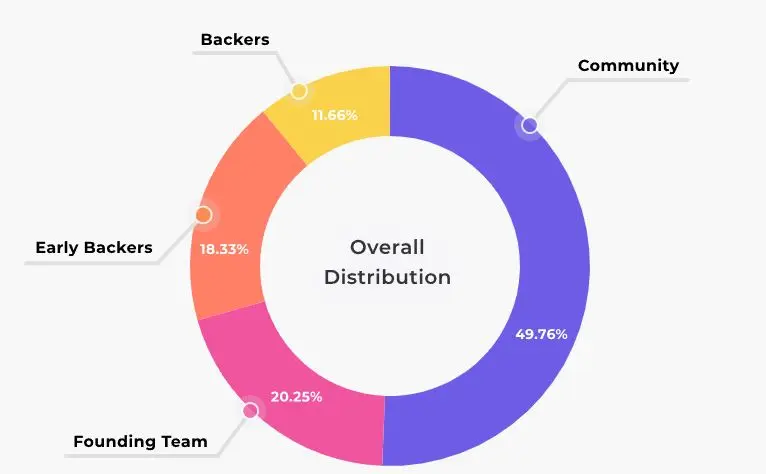
The official launch of the ACA token transfers took place on January 25th, 2022.
How to Buy Acala (ACA) Token?
The launch of the ACA token was one of the most highly-anticipated events of January 20222 and it didn’t disappoint. The coin is already ranking high in terms of total market capitalization. With serious backing, a renowned team, and hundreds of millions in funding, Acala looks like an interesting project. The fact that it’s on Polkadot and targets the constantly growing DeFi segment creates a certain appetite because it’s still an untapped field. Looking at Solana and Avalanche and how DeFi blossomed on these, it’s not out of the question for Acala to also be successful.
While there are plenty of exchanges that already support Acala (ACA), MEXC has managed to establish itself as one of the most reputable altcoin exchanges on the market.
It’s ranking well within the top 20 cryptocurrency exchanges according to CoinMarketCap and has taken plenty of steps to improve the overall user experience and regulatory compliance.
You can buy and sell Acala (ACA) tokens on MEXC Exchange and if you use this link, you will get 10% off the trading fees and you will also support us in our quest to deliver easy-to-digest and actionable information on exciting cryptocurrency projects.
Also, if you enjoyed this piece, please hit that like button, and don’t forget to leave a comment to let us know!