
How obsolete can we consider something before renewing, changing or updating it for a thing that does the same as the old one, but better. This question is convenient in light of current events at the global level, where, for fear of the contagion and spread of the virus, we have decided to stop using many tools and means necessary for our daily development. A specific case of this is the use of physical money, which we know as FIAT. This money is being seen in many countries and by central banks as an obsolete way to carry out transactions and has led them to show great interest in issuing the next evolution of money.
An example of this is what was said by Deutsche Bank researcher Marion Loboure:
"A unique pandemic in the century deserves unique solutions, an obvious place to start is to accelerate the inevitable shift towards digital currencies."
First of all, remember that China destroyed most of its physical money reserves as a preventive measure against the pandemic, which further helped the use of the electronic payment system. That is supported by the use of online applications from banks or private payment gateways.
Reason why it has led some nations to consider digital currencies as an optimal solution to the problem of physical cash. These have been called Central Bank Digital Currencies (CBDC).
China goes ahead and performs first tests of its e-RMB
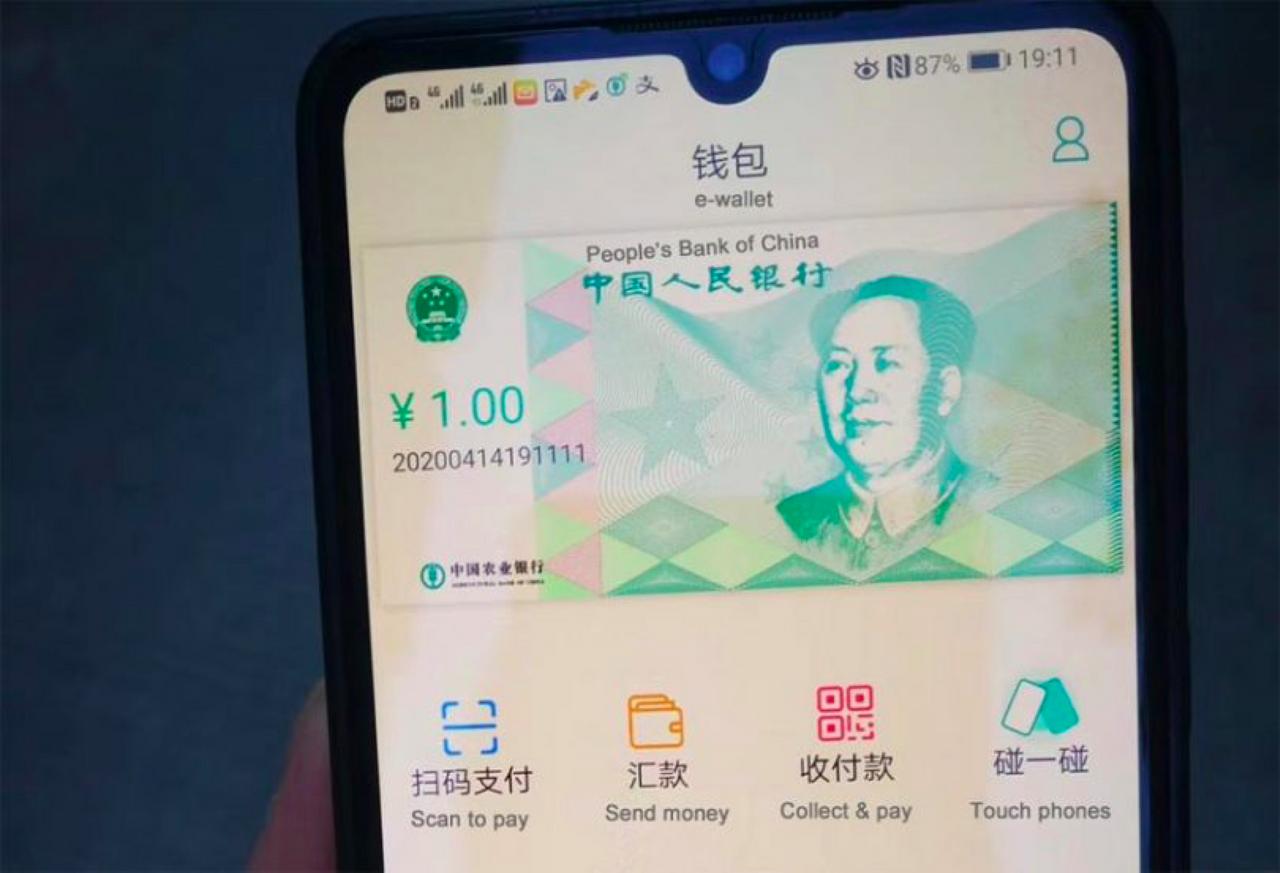
China, being the first country to fall before the virus, was pushed and highly motivated to take the first step in the field of digital currencies, launching the first known in the world. This currency has been called e-RMB, hinting at the physical Reminbi whose physical unit is the Yuan.
Initially its use will be reserved for public employees, public servants and as a form of public transport subsidies, they also project that it may be used during the events of the Olympic games, Beiging 2022.
The first phase of this project is carried out in several cities including: Shenzhen, Suzho, Chengdou and the southern area of Beiging called Xiong`an. The digital version of the Yuan will be linked to its physical counterpart.
While China seems and is ready to use its e-RMB other countries such as the US, Sweden, Canada, or the European Central Bank are just exploring the idea of issuing digital currencies, obviously now none of them will want to stay out of digitizing their currencies.
Cryptocurrency is not the same as digital currency.
Although they are managed within the digital universe we cannot confuse a digital currency with a cryptocurrency, these have very recognizable differences that define it in themselves.
I quickly list some of the differences between them:
Digital currency:
- Issued by a Central Bank.
- Linked to its physical counterpart.
- It is controlled and regulated by the government.
- They cannot be speculated, only exchanged for banknotes or viceversa.
Cryptocurrency:
- It has commercial value.
- The same people can create their own cryptocurrency and distribute them.
- People generate fractions of existing cryptocurrencies through mining.
- It does not have a specific emitter.
- Does not need mediation.
- Reduce transaction time and cost.
With these small differences we are clear that they are very distinctive and each has its own use according to which they were created. Therefore we cannot confuse them.
Quite possibly governments want to make their digital currencies look like cryptocurrencies but let's not mix the different concepts and let's be clear that one is an e-FIAT and the other is a CRYPTO, one offers a lot of control and the other is free and anonymous.






