
Anyone who’s taken the time to delve into this crazy world of crypto knows how expansive and revolutionary this industry is and it’s crazy to think of how far it has come. It all started in 2009 with the launch of Bitcoin as peer-to-peer electronic cash. The next catalyzing development was 6 years later with the launch of Ethereum as a blockchain-based distributed computing platform and operating system featuring smart contract functionality. Ethereum gave birth to a wealth of new ideas and the means to bring them to life through initial coin offerings (ICOs).
Thousands of new cryptocurrencies, tokens, and digitized assets quickly became a reality. The cryptocurrency ecosystem was suddenly extremely expansive with new ideas, projects, and developments which captured value from their digital tokens. In 2017, speculation was at an all-time high as investors poured money into ICOs and traded in the global cryptocurrency market. Digital tokens enabled borderless and efficient fundraising for companies as well as opportunities for retail investors to speculate and trade their tokens. A new digital token economy was born and continues to thrive to this day even though the ICO mania has since died off and hype has subsided.
The Future will be Tokenized
Looking at these past events and how far the cryptocurrency market has come, we can project what’s to come in the future. We already experienced ICO mania where ideas were essentially tokenized and speculative value was created and traded. This will continue to an extent, but the next era of digital tokens will be more than just ideas that rarely come to fruition. It will consist of the tokenization of any type of asset including real estate, art, virtual game items, oil, gold and much more. Tokenization of any type of asset will allow for fractionalized ownership, meaning anyone can own a fraction of a million-dollar piece of art, anyone can become a partial owner of a billion-dollar condo building, etc. The possibilities are literally endless and it will create massive economies of scale.
This future of tokenized assets is coming, it may be years ahead of us, but it will come. In the meantime, the world of crypto and digital tokens faces many hurdles to overcome regarding regulations, security, and perhaps most importantly, asset exchange.
In the future, there will literally be hundreds of thousands of tokens and we will need a way to trade them securely and seamlessly. Currently, the crypto industry largely relies on centralized exchanges for the trading of tokens. In fact, 99% of all crypto trading volume is still on centralized exchanges like Coinbase, Binance, and Bitfinex.
Unfortunately, this is a huge problem for a number of reasons:
- Centralized exchanges are vulnerable to hacks. This is a problem because users are required to send their crypto to the exchange where it’s then held by the exchange.
- Centralized exchanges could exit scam and steal everybody's money. Users must put their trust in the exchange and hope their funds don’t get temporarily locked up or vanish forever.
- Centralized exchanges often require users to sign up and provide identifying know-your-customer (KYC) information. Users cannot remain anonymous and their privacy is at stake.
- Centralized exchanges set deposit and withdrawal limits, controlling how you move your money.
- Centralized exchanges experience server downtimes and maintenance periods where users cannot access their funds or trade.
All in all, there are a lot of negatives to centralized exchanges and if the future is going to have hundreds of thousands of tokenized assets, we’re going to need better ways to securely and seamlessly trade. Which brings me to my next point, the future of trading will be powered by decentralized exchange (DEX) protocols.
What is a DEX Protocol?
A decentralized exchange protocol is the foundation in which a DEX application is built on. It’s software which is hosted on or integrated into one or more distributed ledgers, ie Ethereum, Qtum, Neo, etc. DEX protocols enable peer-to-peer transactions that are automatically settled on a distributed ledger. Also, they enable users to retain full custody of their private keys by facilitating and settling transactions directly from a user’s personal wallet.
Essentially, DEX protocols are aiming to be the infrastructure in which decentralized exchanges are built on. They provide all of the necessary components and rules for decentralized and secure trading of digital assets. They are generally open-source and free to use so that anyone can easily utilize the protocol and implement it as the backend software of any particular DEX.
There are a number of decentralized exchange protocols being built today and whichever one successfully provides reliable, fast, and secure DEX transactions without relinquishing control over a user’s private keys will be extremely valuable.
Therefore, today’s DEX protocols are competing to become one of the most valuable protocols in the world, and two of the most promising ones that I’ve come across thus far are 0x (ZRX) and Loopring (LRC).
0x (ZRX) - A DEX Protocol
0x is probably the most popular open-source protocol for decentralized exchange of ERC-20 tokens on the Ethereum blockchain. The protocol facilitates low friction peer-to-peer exchange of ERC-20 tokens and is intended to serve as an open standard and foundation in which decentralized applications (dapps) with exchange functionality are built on.
The protocol has created a unique set of rules written into a system of Ethereum smart contracts. This system is publicly accessible and free to use so that any dapp can hook into the 0x protocol and facilitate decentralized trading. Projects, dapps, or exchanges that utilize the 0x protocol are called Relayers.
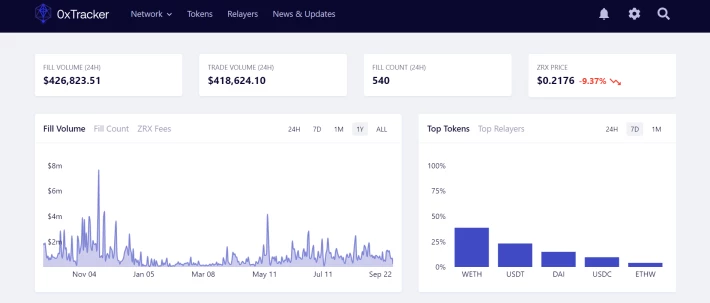
Currently, 0x has 27 active Relayers with the most popular being:
- Radar Relay with 133,139 trades and $252,146,823 in volume
- DDEX with 223,172 trades and $159,815,554 in volume
- Paradex with 45,242 trades and $49,922,679 in volume
- Tokenlon with 48,800 trades and $48,275,379.37 in volume
- DeversiFi with 16,441 trades and $28,791,099.49 in volume
As seen from the numbers above, it’s clear that 0x is being used extensively and is actually achieving real-world adoption. The number of developers utilizing 0x is growing at a very healthy rate, making it one of the leading DEX protocols. This is a very good sign as the more developers that utilize 0x, the better the protocol becomes, and the more likely it is to become adopted. This is because Relayers share their liquidity pools with each other and liquidity is critical for an exchange to function.
New decentralized exchanges start out small with few users, and they are incentivized to utilize the 0x protocol because they benefit from all of the liquidity it provides. Also, these DEX’s using 0x are incentivized to share liquidity with competitors because an exchange with large liquidity will earn part of the fee when a transaction on a small exchange is settled thanks to tokens provided by the larger one. It’s a win-win situation.
The 0x Token (ZRX)
The ZRX token is utilized in the 0x protocol by aligning financial incentives and offsetting costs associated with being a 0x protocol Relayer. 0x Relayers are paid ZRX tokens for trading fees and the tokens are also used for decentralized governance of the protocol. Governance is one of the most important utilities of the ZRX token. The 0x protocol aims to become a fully autonomous organization where token holders have the right to vote on the future of the protocol. For instance, they can vote for the replacement and improvement of the protocol’s underlying smart contracts as well as other protocol changes over time.
Loopring (LRC) - A DEX Protocol
Another decentralized exchange protocol which is growing in popularity, has a lot of potential, and offers a promising alternative to 0x’s architecture for the building of DEXes is Loopring (LRC).
Like 0x, Loopring is a decentralized exchange protocol in which scalable DEXes can be built on. However, Loopring uses an entirely different approach for the building of DEXes, one which is a bit more experimental, but promising nonetheless.
Loopring addresses Ethereum’s limited transactional capacity by using a form of zero-knowledge cryptography called zk-SNARKS. This solution verifies data without revealing its underlying information and enables a much more scalable service while maintaining security on the underlying blockchain. The way it works is; the DEX batches thousands of transactions together, verifies them off-chain, and submits them to the Ethereum blockchain as one. This provides DEXes with high liquidity and will enable orderbook-based DEXes to be commercially viable for the first time.
Additionally, with Loopring v3.0, a new fee model and greater transactional throughput of the protocol was achieved. The maximum throughput with on-chain data availability increased from 160 TPS (trades per second) to 200 TPS, and the maximum throughput without data availability increased from 525 TPS to 660 TPS. Therefore, the DEX’s built on Loopring can potentially outcompete and displace many centralized exchanges.
The Loopring (LRC) Token
The Loopring protocol can be integrated into any blockchain supporting smart contracts and for each blockchain, it integrates with, there is a specific Loopring token. Currently, there are three cryptocurrency tоkеnѕ uѕеd bу Lоорring: LRC (ERC-20 оn Etherеum), LRN (NEP-5 оn NEO), and LRQ (Qtum). The most popular token is LRC as Loopring’s integration with Ethereum is by far the most developed and there are many more Ethereum-based DEXes that are garnering the most adoption.
That being said, the LRC token is at the heart of the Loopring protocol and is used by both DEX owners (Relayers) and LRC holders (traders). See the various utilities of LRC tokens below:
- Earn Protocol Fees - LRC token holders can stake LRC to earn part of the protocol fees paid by all Dexes built on top of Loopring (70% of the fees are rewarded to stakers, 20% will be used to fund the Loopring DAO, and the remaining 10% will be burned.)
- Build up DEX Reputation - Loopring Relayers must stake some LRC to provide economic security and build up their reputation. This reputation mechanism ensures that malicious DEXes have something to lose.
- Reduced Protocol Fees (Relayers) - Apart from building up DEX reputation, Relayer staking of LRC will also reduce the protocol fee they must pay for each trade. The more LRC staked, the bigger the discount they receive.
- Reduced Protocol Fees (Traders) - In addition to DEX owners staking, operators, market makers, and professional traders can also stake LRC to lower the protocol fee.
All in all, the LRC token plays an integral role in the Loopring protocol and token holders as well as Relayers, professional traders, operators, and market makers are incentivized to buy and hold LRC tokens. The LRC tokenomics are excellent and as Loopring grows in popularity, the LRC token is expected to continually rise quite significantly.
Conclusion
All in all, decentralized exchange protocols are projected to be some of the most valuable protocols in the world and they are being built right now. The cryptocurrency and blockchain industry is still very much in its infancy but as this space grows and matures, decentralized exchanges will become a necessity.
There’s no saying which DEX protocol will become the most successful as both 0x (ZRX) and Loopring (LRC) are in an early development stage, but there’s no question that they’re very promising decentralized exchange protocols.
Which DEX protocol do you think is best? When will these DEX protocols truly be utilized? Do you think decentralized exchanges are the future? Let me know in the comment section below.






